“This is the first time that a structure has been autonomously constructed in space,” said Sergio Pellegrino, a professor of aerospace and civil engineering at Caltech who led the project.
Building structures directly in orbit
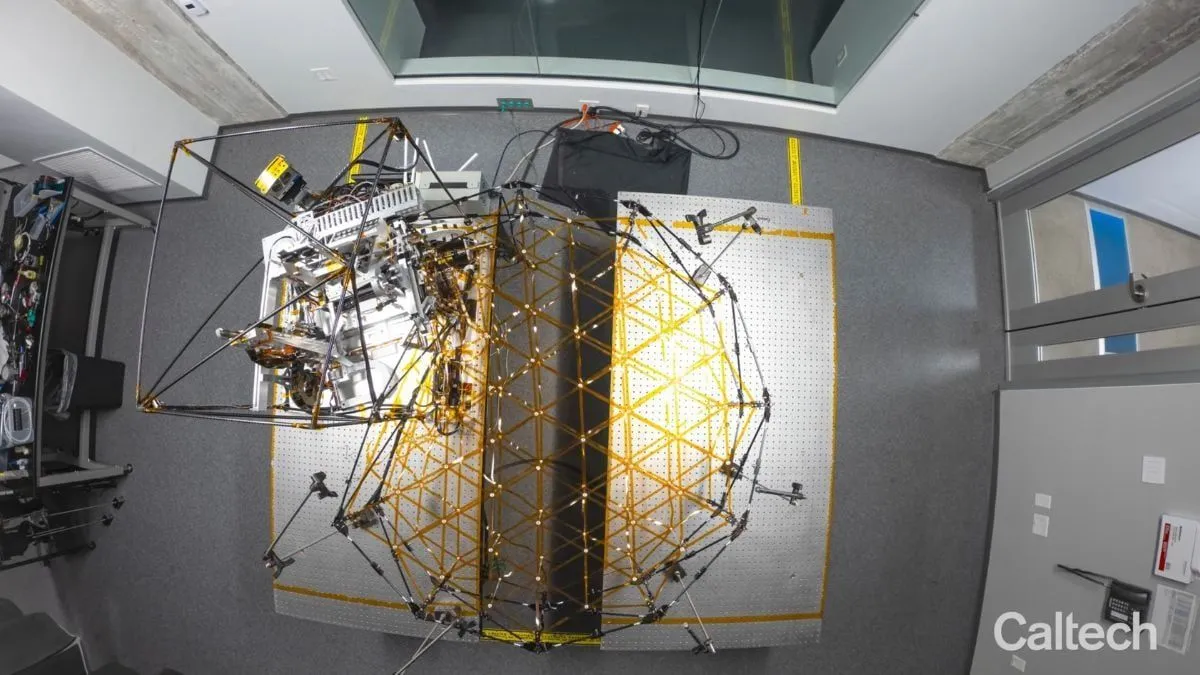
The robotic system, called Autonomous In-Space Tensioned Reflector Assembly (ASTRA), was developed under a programme funded by the US Defense Advanced Research Projects Agency (DARPA).
ASTRA was launched into low-Earth orbit on 30 March aboard SpaceX’s Transporter-16 mission, carried by a spacecraft operated by Momentus.
The robot uses a mechanical arm to retrieve composite tubes and connecting joints from dispensers. It then assembles these into repeating sections, called bays, which form a larger supporting framework known as a truss.
The system launched with two preassembled bays and successfully constructed a third in orbit. The complete antenna would have required 11 bays.
Also read: There’s a new space race, and it is in West Asia. UAE, Saudi Arabia and Oman are leading it
Why build in space?
Large spacecraft and scientific instruments are currently limited by the dimensions of the rockets carrying them into space.
Engineers usually overcome these restrictions by folding structures for launch and unfolding them in orbit, or by having astronauts assemble components.
Autonomous construction could offer another, safer option, allowing engineers to transport individual components and assemble much larger structures after launch.
Such technology could eventually be used to construct enormous reflectors for space telescopes, large communication antennas and solar arrays capable of generating electricity in orbit.
DARPA programme manager Andrew Detor wrote that the agency hopes to eventually enable the construction of structures measuring hundreds of metres or even kilometres across.
Challenges remain
The Caltech team encountered several technical difficulties during the experiment, including problems that required troubleshooting from Earth.
Researchers could communicate with the spacecraft during only seven or eight short windows each day, lasting around 15 minutes each.
To resolve problems, they used an identical robot in their laboratory to recreate the difficulties encountered in orbit before sending new instructions to the spacecraft.
“That’s basically the reason you do proof-of-concept testing. There are a lot of differences in the space environment compared to down on Earth,” said Jaden Suh, a former Caltech researcher and assistant professor at the University of Texas at Austin involved in the project.
With the mission scheduled to conclude in December, researchers do not expect to complete the entire antenna. However, they believe the demonstration has established that their approach is feasible.
“Once you get to the size limit where structures cannot be prebuilt on the ground and unfolded, you have to think about how to build them in space,” Pellegrino stated.
(Edited by Janaki Pande)