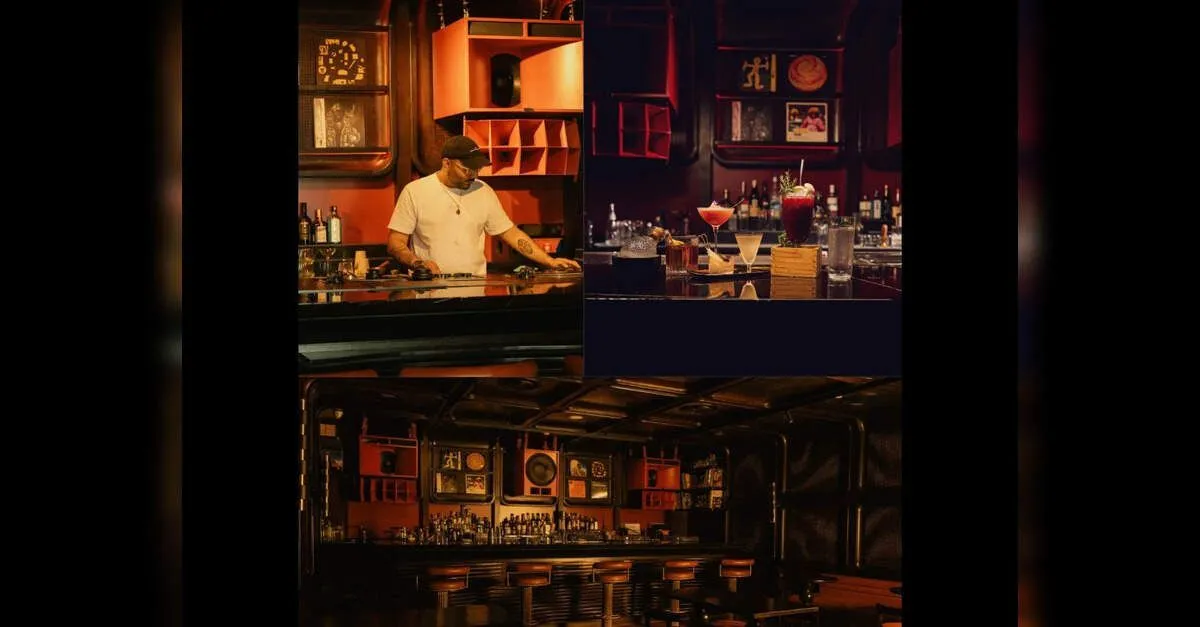
NAMI, the new vinyl listening bar by Aditya Birla New Age Hospitality (ABNAH), opens in Bandra West. Its name is the Japanese word for wave or ripple, a fitting starting point for a space built around sound.
NAMI is international in the truest sense because it has carefully curated talent, ideas and points of view from across the world - not to recreate a listening bar from elsewhere, but to create something new through their exchange. From Japanese listening-bar culture and Singaporean cocktail craft to Indonesian hi-fi engineering, Berlin-built audio technology and Mumbai’s own creative energy, NAMI is shaped by a genuine cross-pollination of cultures, craftsmanship and contemporary thinking. Its international character comes not from a single aesthetic or imported template, but from the people and ideas that have come together to build it. The result is a distinctly Mumbai expression of a global idea. NAMI, an intimate 25 seater, is a hybrid between a listening bar and an inclusive social space centred on music, with an intimate dancefloor where the frequency is meant to be felt, not just heard. Listening can be active or passive: guests can engage deeply with the sound or simply enjoy it while socialising. Guiding it all is the Japanese philosophy of Shoshin (初心), or “beginner’s mind”: an attitude of openness and eagerness, free of preconceptions. NAMI draws on the intimacy of Japanese listening-bar culture but reinterprets it through a distinctly Mumbai lens, with the aim of making hi-fi culture accessible rather than intimidating. “At ABNAH, we believe hospitality extends beyond food and beverage. Culture is increasingly shaping how people choose to spend their time, and we see a growing desire for intentional, analogue experiences that offer depth and genuine connection. With NAMI, we are investing in India as a platform for the world- bringing together talent, technology and ideas from across the globe to create something that is deeply rooted in Mumbai yet truly international in its conception and ambition. NAMI is a product of this exchange of ideas and expertise. For us, this is not simply about bringing the world to India; it is about building in India at an international standard, creating experiences and cultural platforms that can take India to the world.” says Udai Pinnali, CEO, ABNAH. Programming at NAMI is curatorial rather than genre-specific. Resident selector Owlist, a hip-hop and lo-fi producer originally from Jaipur with 280,000+ Spotify streams, brings a sound rooted in vinyl sampling and beat-making. Community manager Anisha Parwani, a Mumbai-based DJ, tastemaker and culture builder, is someone guests will often meet at NAMI. Evenings unfold in sequence: early hours open with jazz fusion and spiritual jazz, then move through soul, world disco and trip hop before closing on house and electronica. Alongside its residents, NAMI will host selectors from across the globe, making the room a place for musical exploration and discovery. The calendar is already mapped out for the next three months, with guests through December including Jayesh Veralkar of Vinyl Souk, Dubai; Ani Phoebe from Hong Kong; Mumbai vinyl favourites Dreamstates, Sindhi Curry and Zokhuma; Assam-born Jitwam, acclaimed for his sensuous disco-jazz fusion; and Japanese vinyl maestro Que Sakamoto. Ahead of opening, NAMI hosted an invite-only Hard Hat Party in August for around 100 creatives, tastemakers and DJs, with Osaka-born, Berlin-based DJ Tomoki Tamura (Holic Trax) on the decks. “The world is moving towards intimate spaces. NAMI is ABNAH’s attempt at activating counter cultures: a room where music sits at the centre of the hospitality experience, not in the background as its soundtrack,” said Sumit Vaswani, head of experiences at ABNAH. Vaswani’s collection of 500+ records has been built through crate digging across Europe and Asia. Over the last three years, he has spent hours in listening bars and record stores from London, Amsterdam, Paris and Lisbon to Singapore, Bangkok, Taiwan and Japan, the undisputed mecca of listening bars, studying every detail: how a room sounds, decibel and conversation levels, the crowd, the lighting, the mood and how the night flows. “One night in Tokyo changed how I thought about all of it. Little Soul Cafe in Shimokitazawa is a 12-seat bar where the owner poured the drinks, chose every record from around 14,000 of them, wrote the bill and looked after each of us as if we’d dropped by his living room,” said Vaswani. NAMI brings that feeling of being welcomed into a music lover’s living room to Mumbai. The sound system is the heart of the room. NAMI features India’s first multicell horn system, alongside a high-fidelity system handmade in Indonesia. Records spin on Technics SL-1210 MK2 turntables refurbished by MasterSounds and run through a Resør rotary mixer, hand-built in Berlin with discrete Class A analogue circuitry. The room’s acoustics are designed by Munro Acoustics. The room is designed by Mumbai’s Patch Design Studio, with NAMI’s visual identity created by Indo Anglo Studio, the Mumbai design and communication studio founded by brothers Gary and Liam Curzai, whose English and Indian Koli heritage shapes their blend of traditional Indian elements and modern Western design. Inspired by Chladni figures, ripples and waveforms run through the identity, custom typeface, staircase and acoustic panelling, while Japanese minimalism and calligraphic forms meet Indian references including the rangoli and kolam. The bar front takes the form of a large wave, a programmable modular lighting system ripples across the ceiling, and wood and brass bring warmth to the technical precision. A discreet entrance and staircase act as a tunnel between worlds, leaving the energy of the city behind. The cocktail programme is by Sago House, Singapore, ranked No. 10 on Asia’s 50 Best Bars and No. 32 on The World’s 50 Best Bars in 2023. Every drink is inspired by its own frequency, pairing Japanese precision with an international flavour direction: unique in technique and presentation, recognisable and inviting in taste. Highballs and lower-ABV serves encourage longer, more considered listening. Chef Akanksha’s Itameshi menu brings together Italian technique and the nuanced flavours of Japan, designed to complement the room rather than compete with it.