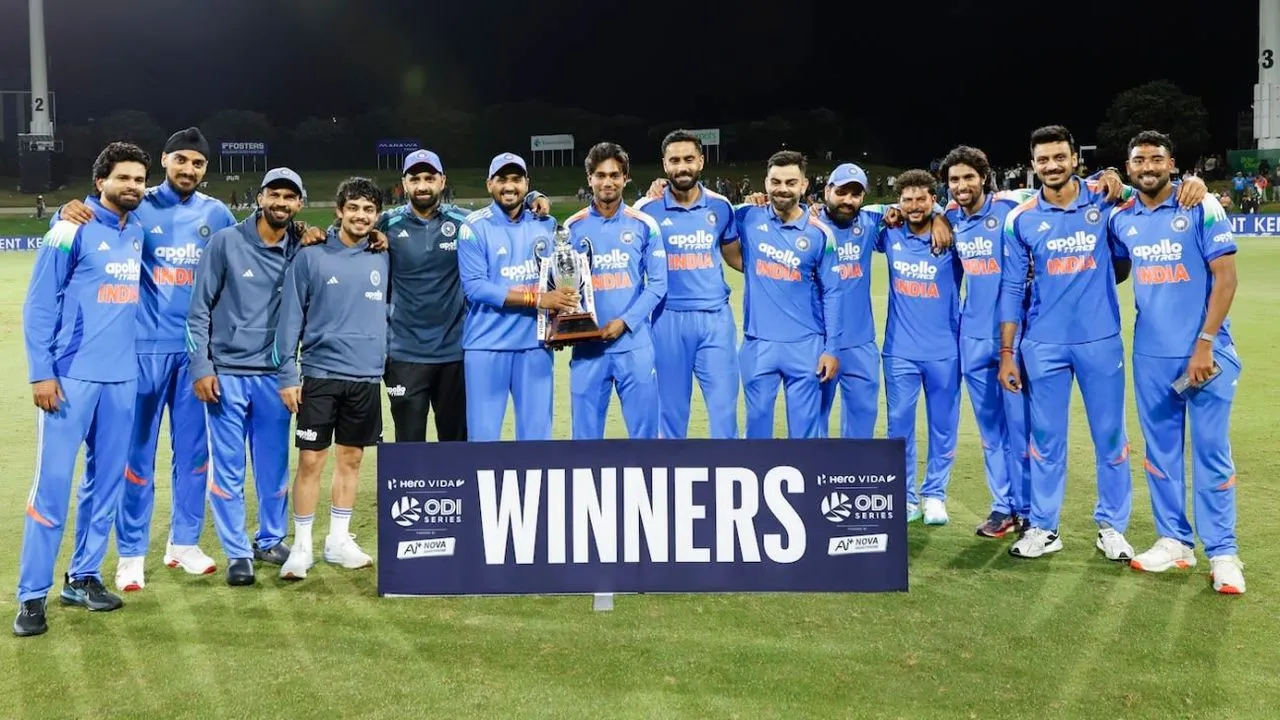
It was India's first away ODI series win under Gautam Gambhir as coach
Sidharth Monga
Published: Nov 15, 2026, 10:12 AM (1 hr ago)
India 209 (Axar 46, Kishan 46, Santner 3-47, Duffy 3-60) beat New Zealand 187 (Foxcroft 31, Arshdeep 3-30, Axar 2-28) by 22 runs
Arshdeep Singh and Mohammed Siraj hit a pair of 14s to take India past 200 for the first time in the series, and then led the defence with five wickets between them to give India their first away ODI series win under Gautam Gambhir as coach. Both sides were depleted with players gone for Test preparations, but India had Yash Thakur on debut and Auqib Nabi in his sixth ODI to lend the required support to Arshdeep and Siraj, who was playing his first match of the tour.
Winning their toss for the first time in the series, New Zealand risked batting under lights - India were bowled out for 89 under lights the other day - out of concerns for the dew, but found themselves having to negotiate seam movement for all of India's four quicks. Shreyas Iyer kept attacking, introducing spin only in the 36th over, and India kept New Zealand to 187, only four more than the score at which Arshdeep and Siraj came together.
The last wicket fell to another man who proved useful with both bat and ball. Axar Patel top-scored with 46 off 55, was put under pressure by Mitchell Santner, who hit him for two sixes and a four in his first three overs, but responded with two tailend wickets even as India ran out of the quicks.
Indian would have themselves chased had they won their ninth toss out of 10 on this tour, but they lost a good toss. The seam movement in the first innings wasn't as pronounced as in the second, and the feared dew and rain largely stayed away in the evening. If anything, the problem for India's batters was the hold in the surface, resulting in three catches to close-in fielders in front of the wicket.
The first of those was Rohit Sharma after what looked like a comfortable opening stand of 23. It ended a disappointing tour for the former captain: a total of 30 runs in four innings, including two ducks. Virat Kohli, India's only half-centurion in the whole series, soon became victim to the similar sponginess, getting a top edge on the cut to give Matt Fisher his second wicket.
Ruturaj Gaikwad was the first batter to fall to sideways movement when Jacob Duffy took the inside edge on the drive. At 34 for 3 in the ninth over, India promoted Axar, who has continued this troubleshooting role he first acquired under Rohit and Rahul Dravid. He survived two touch catches on 0 and 3, but soon began to look comfortable even as Iyer fell to a short ball again to make it 86 for 4 in the 18th over.
New Zealand now relied on Michael Bracewell to bowl offspin against two left-hand batters, and he enjoyed the hold in the surface. By the time he had Axar caught at short straight midwicket, Axar had made a vital contribution.
Santner brought himself on only when one end had a right-hand batter on. He didn't make a great start but used his guile and changes of pace to take out Naman Dhir and two bowlers. All of a sudden, India were looking at Ishan Kishan having to bat upwards of 10 overs with the tail. Without quite farming the strike, Kishan did manage to hit Duffy for two sixes and end up with 46 himself, but New Zealand looked like they had got India for a sub-par score in conditions that called for more.
Arshdeep and Siraj, though, went about rearranging the figures of Duffy and Santner as they hit three sixes and two fours before Duffy managed to hit the top of Arshdeep's off stump with a slower ball.
When Arshdeep's second over went for two fours, resulting in his removal from the attack, it seemed those cameos would go in vain, but India managed to draw consistent seam movement once the sun set fully.
Siraj brought India the first wicket, against the run of play much like India's first wicket, as Seifert slogged a length ball to mid-on. Amid helpful conditions and an inexperienced middle order, Iyer kept rotating his fast bowlers to keep the pressure on.
Arshdeep returned with a second spell of 6-1-17-2. He mostly bowled good length, but took the wicket of Will Young with a bouncer, one of four New Zealand batters to get out to the short ball. The real highlight of Arshdeep's night was his seam movement against the angle from around the wicket, which made batting a nightmare for right-hand batters. He had Dean Foxcroft dropped early at second slip, but a bottom edge on the cut compensated partly with the wicket of Nick Kelly.
Iyer went into attack mode again, bringing Siraj back, who knocked Finn Allen's off stump over with a wobble-seam ball that nipped in appreciably. India did have four wickets for 87, but in doing so they had spent eight overs each from Arshdeep and Siraj in the first 24.
The ball hit the middle of the bat most often in the fifth-wicket partnership between Foxcroft and Bracewell as they faced Thakur and Nabi. This is when Axar denied Foxcroft 11 runs with diving saves at backward point. Nabi, the beneficiary, returned the favour with a bouncer to have Bracewell caught at deep midwicket to make it 119 for 5.
Thakur, who bowled with hostility to replace the similarly tall Gurnoor Brar in the attack, found some luck when he had Foxcroft dragging on a pull at the same score. The only blemish on Thakur's night, on which he also bowled the 48th over for just five runs, was the three no-balls he bowled by knocking the bail at the non-striker's end over with his leg. However, none of the free hits went for a boundary.
Santner, whose top hand Arshdeep injured with a bouncer in his ninth over, managed to reverse the pressure by going after Axar as he and Kristian Clarke added 39 for the seventh wicket. This was the longest India had waited to introduce spin in an ODI since Auckland in 2003. It appeared these overs of spin could squeeze a series-levelling win for New Zealand.
This is when Dhir's golden arm struck, not giving Santner the room to find elevation on the sling sweep that he had timed cleanly. Iyer had kept one Arshdeep over in the kitty, which Arshdeep used to finally produce the wicket he had been working towards: angling in from around the wicket, seaming away, taking the edge to hand, removing Clarke.
With nine, ten and jack needing 49, New Zealand needed copious amounts of luck or bad bowling and captaincy to avoid a first series defeat at home in seven years. None of those was forthcoming; Axar was good enough to benefit from the pressure Siraj and Thakur created in their last three overs, and India, the last team to defeat New Zealand at home, did it again despite none of their batters aggregating 100 runs in the series.
Sidharth Monga is a senior writer at Cricinfo