The India U-19 captain talks to Cricinfo about his partnership with Sehwag, the thrilling final, and his future goals
Daya Sagar
Published: Nov 16, 2026, 2:53 PM (5 hrs ago)
Ever since Lakshya Raichandani has been old enough to understand cricket, India and Pakistan haven't played bilateral cricket. While the two teams still meet at ICC events and the Asia Cup, nail-biting encounters are less common.
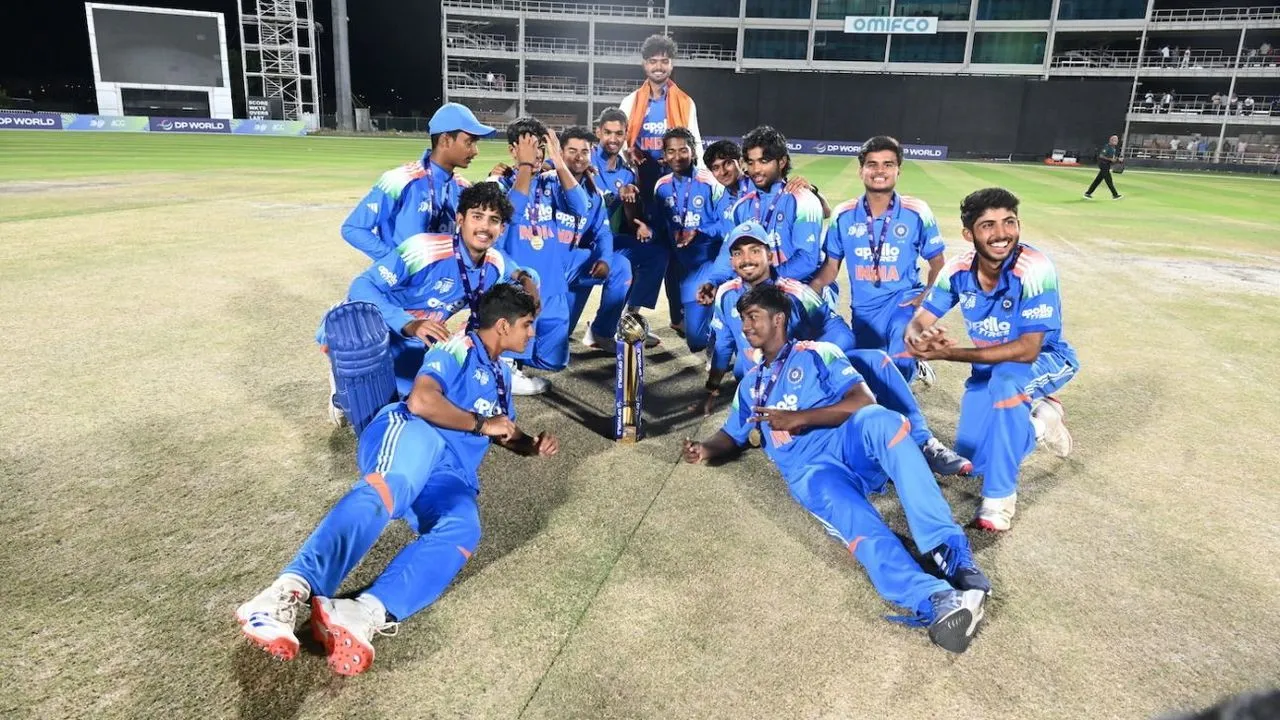
However, Raichandani had heard plenty of stories about thrilling India-Pakistan matches from his father and his late coach. And on Saturday, when the India Under-19 team led by him faced Pakistan Under-19 in the U-19 Asia Cup final, he experienced something very similar to those tales.
Chasing 338 in 50 overs, India lost eight wickets for just 252. However, a brisk 57-run partnership off just 35 balls for the ninth wicket between Manal Chauhan and Mohit Ulva kept India in the hunt. Ulva eventually hit a boundary off the final delivery when the team needed three runs to win to seal the deal.
Related
Raichandani keeps red-ball plans on track, one big innings at a time
Ulva pulls off heist as India lift Under-19s Asia Cup after thriller against Pakistan
Ulva: 'I knew it was my day and I'll finish the game'
"It still hasn't sunk in what we have achieved," Raichandani told Cricinfo two days after the win in Oman. "What a match. The game went down to the last ball, and when we won, we couldn't believe it for a few moments. Everything felt surreal. This was probably like one of those India-Pakistan matches my dad or coach used to tell me about."
Chasing a daunting target, India U-19 made a solid start with a 95-run opening stand between Raichandani and Aaryavir Sehwag. A half-century partnership for the second wicket between Raichandani and VK Vineeth kept India firmly in the game. However, wickets tumbled in quick succession thereafter, leaving India needing 86 runs in the final eight overs, with only two wickets in hand.
Raichandani, though, said he had complete faith in lower-order batters Chauhan and Ulva. "Everyone in our team is an all-rounder," he said. "We are batting all-rounders, and the bowlers are bowling all-rounders.
"Everyone has the ability - they do batting in nets and we knew they could contribute somewhere. They had done it in previous matches and series too, so we had full belief that we would pull it off. The wicket was good, and we knew that if the match went deep, we would definitely win."
The partnership between Chauhan and Ulva rescued India from trouble and instilled belief again. After Chauhan was dismissed, No. 11 batter Chigurupati Venkata supported Ulva with two boundaries of his own.
Raichandani revealed that during both these partnerships, every member of the India squad stayed rooted to where they were sitting, reminiscent of the 2011 ODI World Cup final between India and Sri Lanka, when Sachin Tendulkar didn't leave his seat until MS Dhoni hit the winning runs, and didn't let Virender Sehwag move from his spot either.
"No one told them to do it, yet everyone stayed right where they were; nobody moved from their spot," Raichandani said. "Aaryavir was chanting 'Ram, Ram' and I was also praying. Everyone was manifesting that we would chase it down and lift the trophy. In the end, our manifestation came true."
Following the victory, the young Indian team's celebrations have also sparked plenty of discussion. While some have called it overly aggressive and unnecessary, others see it as emotion naturally pouring out from young players.
"We hadn't planned any celebration like that," Raichandani said. "Everything was very random. As soon as that boundary was hit, everyone ran towards the pitch, and whatever happened after that was completely natural.
"Everyone had put in so much effort to win, and the match was so close that normal emotions just came out. When they (Pakistan U-19) won the group match, they also had a slightly over-dramatic celebration. Because of the context of the game and being an India-Pakistan match, you can definitely say that led to that kind of celebration."
Much of the credit for India's batting success in the Asia Cup goes to the opening pair of Raichandani and Sehwag, who registered four 50-plus partnerships in five innings, including two century stands. Both finished among the tournament's top three run-scorers. Sehwag topped the charts with 361 runs in five innings, including a century and three half-centuries and was named Player of the Tournament. Raichandani also led from the front, scoring 243 runs in five innings with three half-centuries at an average of 60.75. Together, they laid the foundation for India's win in the final too.
Speaking about his partnership with Sehwag, Raichandani said: "At the start of the innings, we decided we would play conventional cricket and will not over-try anything. The plan was to take the match as deep as possible, play with intent, take calculated risks, and switch gears according to the match situation. He understands his game, and I understand mine.
"We batted freely throughout the tournament. Whenever he is at the non-striker's end, the pressure lifts off the other batter because of his approach. Before this tournament, against Australia A he was getting good starts but wasn't converting them into big knocks. So before the Asia Cup, coach Sir (Yere Goud) and I spoke to him and told him he needed to take responsibility and convert his starts into big scores. Credit goes to him for stepping up and performing brilliantly through the tournament."
Following the Under-19 Asia Cup, Raichandani has set his sights on India's domestic season. Before leaving for the Asia Cup, he had played three of the four matches in the first phase of the Ranji Trophy for Uttarakhand. He hopes to soon receive a call-up for the white-ball tournaments, the Syed Mushtaq Ali Trophy and the Vijay Hazare Trophy, just as his team-mates Ulva and Arjun Rajput have been called up by Saurashtra and Punjab, respectively. He said, "I live in the present and will try to make the most of whatever opportunities come my way."
Raichandani also dedicated this Asia Cup triumph to his childhood coach, late Abhishek Kumar, who passed away just last month due to a brain haemorrhage at the age of 39.
"A huge credit for wherever I am today goes to my coach," he said. "I spent my entire childhood away from my family, learning and playing cricket with him in Haldwani. It was no age to go, nor did he have any prior illness. Everything happened so suddenly last month that we couldn't even make sense of it. I would definitely like to dedicate this victory to him."
Daya Sagar is a sub-editor with Cricinfo Hindi