You couldn’t be faulted for thinking that time travel was real. Attritional cricket, Powerplays at four runs per over, seam movement for the bowlers and a scrap to drag the total close to 200. All hallmarks of a bygone era. And yet, after a T20 series that mercilessly exposed the existential crisis of the modern-day bowler, they seem to have found hope after all in the first two one-dayers.
Inclement weather and the moisture in the surface have played their part, but both India and New Zealand’s bowlers have executed their plans exceedingly well thus far. The visitors have won two crucial tosses but for an attack devoid of arguably all of its first-choice fast bowlers, a young pace unit has relentlessly tested a vulnerable New Zealand top-order to keep them in check. And when they’ve had to switch to the hard and shorter lengths, they haven’t missed a beat with Gurnoor Brar’s extra wheels and lift proving to be a handful.
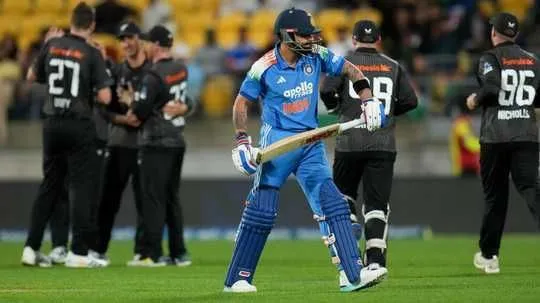
The hosts haven’t been far off themselves, making India work hard for their runs in conditions that might almost seem alien for a batter in the present age of white-ball batting. Barring Virat Kohli in Auckland, no batter has found life easy despite Daryl Mitchell and KL Rahul showing that batting in these conditions isn’t necessarily impossible. Sitanshu Kotak, India’s batting coach, reckoned that experience in these bowler-friendly conditions would help their preparation ahead of the two-match series that follows the one-dayers. His counterpart Luke Ronchi likened the pitch in Wellington to a Test surface, with both coaches acknowledging the challenges that lay on hand for their batters.
Yet, while Mitchell Santner would hope that the coin falls in his favour for a change, New Zealand’s top-order will want to find ways to disrupt the Indian new-ball bowlers’ rhythm and throw a few early punches, with their waiting game not yielding returns so far. As they enter must-win territory, taking a backward step isn’t an option. They will take solace from their enviable record at Seddon Park though, where they boast of a win-loss ratio of 4 in ODIs.
So far, this series has emerged as the antithesis of the new normal of pulverising strokeplay, and Hamilton’s rainy forecast could ensure it stays that way. But with a bigger assignment in the form of a World Cup on African shores looming next year, a test of resolve for the batters may not be a bad thing after all. And as the Test regulars from both sides depart following the conclusion of this contest, the batters in particular will look to lay down a marker before embarking upon a different challenge.
When: New Zealand vs India, 3rd ODI, November 10, 2026, 7:30 AM IST, 3 PM Local time
Where: Seddon Park, Hamilton
What to expect: A sellout crowd may have to brace for an anticlimax. Persistent rain hampered India’s practice on the eve of the match, forcing them to train indoors. More of it is expected on Tuesday, threatening a washout or at the very least, another truncated affair. The previous two ODIs at this venue saw England and West Indies bowled out for 175 and 161 last year, suggestive of the possibility of another good day to be a fast bowler.
Team news
New Zealand: Matt Henry has been advised to target a return in the fourth ODI while Blair Tickner will miss the next two games as he serves a mandatory seven-day stand-down period, despite being cleared of concussion. Matt Fisher, who replaced Tickner as a concussion sub in Wellington, is expected to start the game this time even as Kristian Clarke has been summoned as cover.
Questions could arise of Will Young’s spot, with the opener having crossed double-digits just once in his last 10 ODI innings at home. Nick Kelly is the spare batter in the side, although his inclusion will make it a left-heavy top-order. Considering Young’s decent returns in India and West Indies earlier this year, he may just hold on for another game.
Probable XI: Will Young, Tim Seifert, Henry Nicholls, Daryl Mitchell, Tom Latham (wk), Glenn Phillips, Mitchell Santner (c), Nathan Smith, Kyle Jamieson, Jacob Duffy, Matt Fisher
India: Mohammed Siraj hasn’t featured yet in the series and may have to wait his turn with India’s younger crop enjoying a fruitful series. Kuldeep Yadav appeared to be in great spirits on the eve of the game, but he too might have to wait for an opportunity considering the conditions and the balance of the side. Expect India to stick with their winning combination.
Probable XI: Rohit Sharma, Shubman Gill (c), Virat Kohli, Shreyas Iyer, Axar Patel, KL Rahul (wk), Naman Dhir, Anshul Kamboj, Auqib Nabi, Arshdeep Singh, Gurnoor Brar
Did you know?
New Zealand have a 6-1 record against India in eight ODIs at Seddon Park, with their contest in 2022 washed out.
New Zealand have won each of their last 12 completed ODIs at Seddon Park. The last time New Zealand lost an ODI here was a rain-shortened 34-overs a side contest against South Africa in February 2017.
Since the 2025 Champions Trophy, Rohit Sharma has averaged 103.2 in the third match of a bilateral ODI series, scoring three fifties and two hundreds.
What they said:
“Since I have joined, I think I can't remember many matches where he's got batting and he has not contributed. He has played some unbelievable innings and he never looks under pressure…He has never let the team down. So it is brilliant to have someone like him” – Sitanshu Kotak on KL Rahul.
“The other night, if either team had made 200 batting first, that would have been a massive score. So it's realising that ‘okay, for 10 overs you might be going at two, three and over, you're actually still going okay and those are the conversations we have. It's making sure that the guys understand that in those moments, it's just trying to stay calm and realise the adaptability of what you need to do” – Luke Ronchi, New Zealand batting coach.