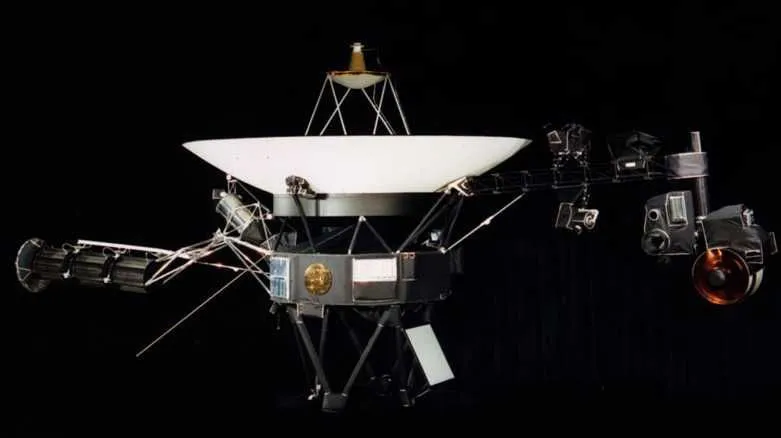
The most distant human-made object cast into space is about to reach a major milestone.
On Wednesday morning, Voyager 1, which was launched by NASA almost 50 years ago, will have traveled a full light-day away from Earth.
See an interview with a NASA scientist in the video above
A light-day is an incredibly far distance — over 16 billion miles. It’s the equivalent of how far a particle of light can travel over the course of 24 hours.
The moon is 1.3 light-seconds away. The sun takes 8.3 light-minutes to reach.
The Get the Facts Data Team built the interactive below to show the scale of 16 billion miles.
When Voyager 1 crosses a light-day, it will be more than 58 billion Empire State Buildings away from Earth. In sports terms, that’s the equivalent of more than 236 billion football fields.
To make it more absurd, if every single human on Earth were to stand on top of each other — and we were to use the average height of 5 feet, 6 inches and the current 8.3 billion world population — it would take 1,885 stacks of the human population to reach a light-day.
History of Voyager
The Voyager 1 probe was launched in 1977.
It overtook its twin, Voyager 2, which was launched a few weeks prior. Voyager 2 is about 13.5 billion miles away, as of Nov. 16.
NASA launched the two probes to collect data on interstellar space.