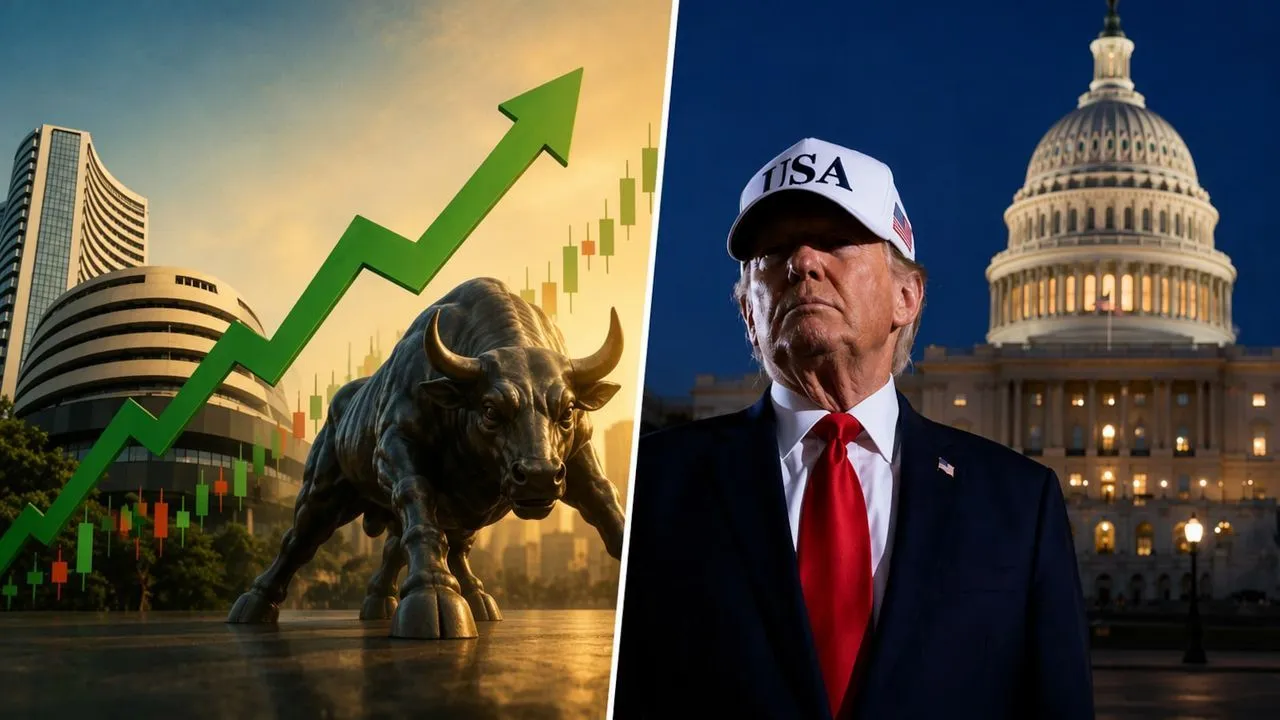
Stock Market Today 5 November: Dalal Street investors received an unexpected windfall on Thursday morning. A sharp fall in crude oil prices, renewed foreign investor buying and a rally on US Wall Street combined to lift Indian equities, adding nearly Rs 8 lakh crore to investors' wealth within hours of the market opening.
The Sensex opened more than 1,300 points higher at 78,630, while the Nifty 50 crossed the 24,350 mark in early trade. The rally extended India's winning streak to six consecutive trading sessions. By 1:45 pm, the Sensex had jumped over 2,000 points to 79,330. The Nifty 50 climbed 581 points to 24,548.55. More importantly, Nifty50 crossed the 24,000 for first time since September 4, 2026.
At the open on Thursday, the total market cap of all BSE Sensex companies stood at Rs 4,93,44,359 crore. By 1:45 pm, the total market cap jumped to Rs 5,02,36,269 crore -- a rise of nearly Rs 8 lakh crore. The surge followed a strong rally in US markets overnight, with the S&P 500 touching a three-month high after Democrats swept both chambers of the US Congress. Follow Markets Live Updates
Also Read | Layoffs Are Rising In Tech, But These Skills Are Helping People Unlock Better Pay
Why Is The Indian Stock Market Rising Today?
1. Crude Oil Crashes 8% After Democrats' US Election Sweep
The biggest trigger for Thursday's rally was a sharp fall in crude oil prices. Brent crude plunged 8.7% in the previous session, slipping towards $94 per barrel, while US West Texas Intermediate crude fell to around $88.
The decline followed the Democrats' victory in the US midterm elections. Investors are betting that the new political balance in Washington could increase pressure on the Trump administration to de-escalate the US-Iran conflict.
For India, cheaper oil is particularly important. The country imports a large share of its crude oil requirements. Higher oil prices increase India's import bill, put pressure on the rupee and raise inflation risks. A sustained decline in crude prices could ease these pressures, improve corporate margins and give the Indian economy some breathing room.
BSE Sensex Heatmap At 1:45 pm
2. Foreign Investors Return To Indian Stocks
Foreign investors bought Indian equities worth Rs 7,284 crore on Wednesday, marking their highest single-day purchase since October 28, 2025.
This was their fourth consecutive session of net buying. FIIs have purchased more than Rs 17,000 crore worth of Indian equities so far in November, after selling nearly Rs 90,000 crore in September and October.
The return of foreign money is important for Indian markets, which have faced considerable selling pressure in recent months. Sustained foreign buying could help support large-cap stocks and improve overall market sentiment.
3. Wall Street Rally Lifts Global Sentiment
The S&P 500 rose 1.6 per cent on Wednesday, while the Dow Jones Industrial Average jumped around 3 per cent. The Nasdaq Composite gained 1.4 per cent. The rally followed the Democrats' sweeping victory in the US midterm elections, which reduced political uncertainty and fuelled optimism about a possible easing of geopolitical tensions. Lower oil prices and improving risk appetite helped lift equities across global markets.
Democrats' Victory: What It Means For Global Markets
The Democrats' sweeping victory in the US midterm elections could have implications extending beyond Wall Street. Investors are now assessing its impact on US fiscal spending, bond yields, the dollar and geopolitical tensions.
Ankita Pathak, Head, Global Investments at Ionic Asset, told NDTV that the election outcome could ease some geopolitical risks, although its broader economic implications would take time to emerge. "There are many intertwined implications that will become clearer once the oath is taken in January," Pathak said.
She pointed to the possibility of lower US bond yields and a weaker dollar if political gridlock limits fresh fiscal spending and geopolitical risks ease. Such a combination could benefit emerging markets, gold and commodities.
However, Pathak cautioned that inflation could remain elevated for longer, limiting the extent of any decline in yields. She also flagged growing political scrutiny of America's artificial intelligence infrastructure expansion, particularly data centres and their electricity requirements. Pathak added that while AI capital expenditure would continue, electricity availability could increasingly become a constraint for the sector.