Chief Minister Shivakumar urged PM Modi to intervene in addressing the concerns of sugarcane farmers in Karnataka, who are demanding ₹5,500 per tonne against the Fair and Remunerative Price (FRP) of ₹3,650.
Mr. Shivakumar said sugarcane farmers were facing difficulties and highlighted that the sugar minimum selling price (MSP) had remained unchanged at ₹31 per kg since 2019. He also sought a fair share of ethanol allocation for Karnataka, urging the Centre to address the issues affecting the State’s sugar sector.
- Darshan Devaiah B.P.
Chief Minister D.K. Shivakumar urged Prime Minister Narendra Modi to provide financial assistance to Karnataka to address severe drought conditions and crop losses across the State.
Mr. Shivakumar said, “Karnataka had received its second-lowest rainfall in 70 years, with 246 of the state’s 240 taluks declared drought-affected. Nearly 85 lakh hectares of crops had suffered damage, and I seek ₹22,000 crore in assistance under the National Disaster Response Fund (NDRF).
He also offered to lead an all-party delegation to meet the Prime Minister to discuss farmers’ concerns, including sugarcane prices and ethanol allocation.
-Darshan Devaiah B.P.
Amid a political dispute between the ruling Congress in Karnataka and the BJP regarding cost sharing over the Bengaluru metro, Chief Minister D.K. Shivakumar urged Prime Minister Narendra Modi to ensure fairer financial sharing for Bengaluru Metro projects and expedite pending approvals for expansion.
Mr. Shivakumar said “Karnataka bears a higher financial burden despite the proposed 50:50 Centre-state partnership, including land acquisition costs, state taxes and loan repayments.
Highlighting delays in project clearances, he said that the proposed Red Line had been pending for two years and urged the Centre to expedite approvals. He also called for project costs to reflect the actual conditions of individual cities rather than a uniform national average.
He urged Mr. Modi to extend the Centre’s financial support to Bengaluru Metro by sharing operational cash losses and foreign exchange risks on external loans.
He also proposed establishing a dedicated technical institution for Metro projects across India to streamline approvals and promote indigenous technology. Referring to Bengaluru’s ambition of expanding its Metro network to 500 km, Mr. Shivakumar said the expansion could help address 50% of the city’s traffic problem with the Centre’s support.
Read more below:
Karnataka bears 84% of Bengaluru metro project costs, seeks greater Centre funding
Karnataka reveals it is funding 84% of Bengaluru Metro costs and seeks greater Centre funding and faster clearances for Phase 3 and future lines.
Chief Minister D.K. Shivakumar sought Prime Minister Narendra Modi’s support for Karnataka’s development, highlighting Bengaluru’s contribution to the national economy and its growing prominence in technology, defence and space sectors.
Speaking at the inauguration of the Bengaluru Metro Pink Line, Mr Shivakumar said Karnataka ranked first in exports and talent, second in GST collections and had recorded the highest FDI inflows over the past five years.
“We want your help,” he told the Prime Minister, emphasising the state’s contribution to India’s growth. He also highlighted Bengaluru Metro’s expansion, stating that over 103 km of the network had been completed, with plans to expand it to at least 500 km to ease traffic congestion.
Chief Minister D.K. Shivakumar and Greater Bengaluru Development Minister Krishna Byre Gowda briefed Prime Minister Narendra Modi on the Pink Line Metro’s route and connectivity following its inauguration in Bengaluru on Friday.
According to an official statement from the Chief Minister’s Office (CMO), the two leaders explained the Metro route using a model map displayed at the station.
Mr. Shivakumar also briefed Modi on the benefits of implementing the double-decker model in Bengaluru and its potential to ease traffic congestion in the city.
WhatsApp Image 2026-11-13 at 13.09.13 (1).jpeg
Mr. Modi arrived at the IIM-Bangalore auditorium after taking a ride on Bengaluru’s Pink Line Metro. On his arrival at the auditorium, Chief Minister D.K. Shivakumar presented Mr. Modi with a statue of Bengaluru founder Nadaprabhu Kempegowda.
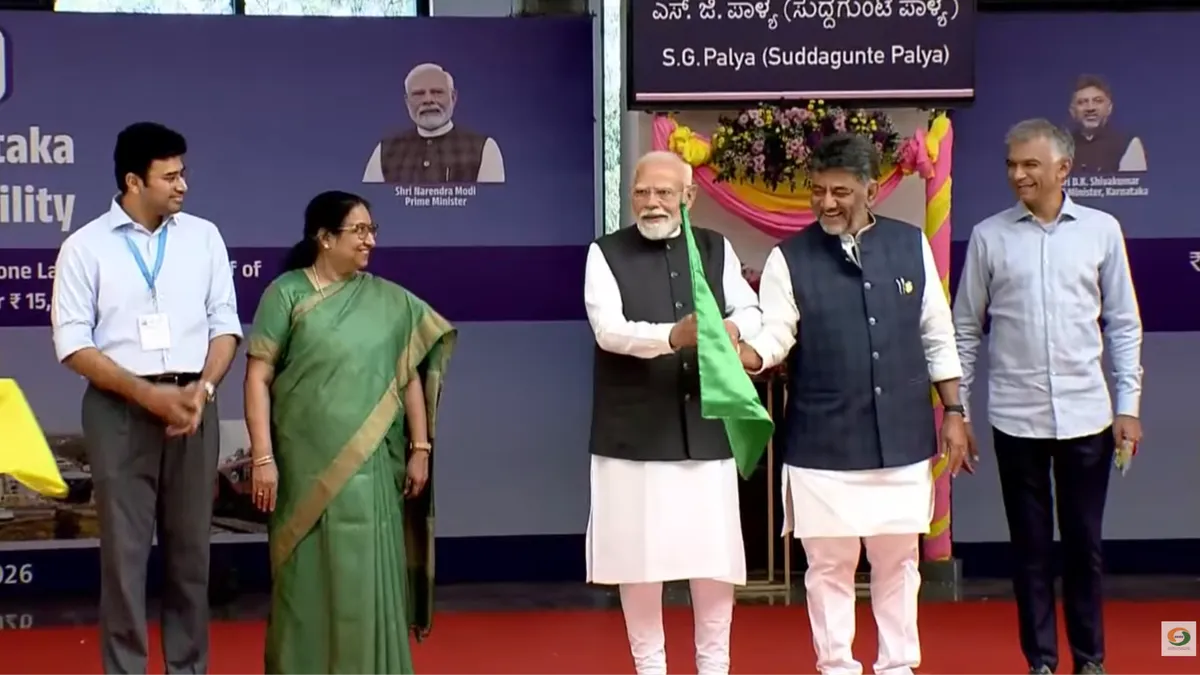
Prime Minister Narendra Modi flagged off the elevated section of Bengaluru’s Pink Line Metro at S.G. Palya (Suddagunte Palya) Metro Station, in the presence of Karnataka Governor Sudha Yadav and Chief Minister D.K. Shivakumar.
The Pink Line is part of Namma Metro’s Phase II and is designed to connect Kalena Agrahara in south Bengaluru with Nagawara in north Bengaluru. The 21.25-km corridor comprises a 7.5-km elevated section and a 13.76-km underground section.
Once fully operational, the corridor is projected to carry approximately 3.76 lakh passengers daily, according to the Detailed Project Report (DPR).
Screenshot 2026-11-13 130836.png
Mr. Modi later travelled by Metro to Bilekahalli-IIMB Metro Station accompanied by Karnataka Governor Sudha Yadav, Chief Minister D.K. Shivakumar, Greater Bengaluru Development Minister Krishna Byre Gowda and Bengaluru South MP Tejasvi Surya.
Before entering the platform, Mr Modi purchased a Metro ticket. BMRCL officials briefed him on the project before he boarded the train, a BMRCL source told The Hindu.
Read more.
Prime Minister Narendra Modi and Karnataka Governor Sudha Yadav have arrived by helicopter at the R.A. Mundkur Fire and Emergency Services Training Centre campus near Dairy Circle on Bannerghatta Road in Bengaluru.
Modi will proceed to S.G. Palya (Suddagunte Palya) Metro Station, where he, along with Karnataka Chief Minister D.K. Shivakumar, will flag off the Pink Line Metro service and undertake a ride to Bilekahalli-IIMB Metro Station.
The PM will also unveil plaques marking the foundation stone-laying of three projects, including a compressed biogas plant at Haralakunte village in Bengaluru South and two power transmission projects.
He will also inaugurate renewable energy transmission schemes in Koppal, Gadag and Bidar.
The programme also includes dedication of an 80 TMT LPG cavern developed by HPCL, the Devangonthi Marketing Terminal of MRPL, railway doubling and electrification projects.
Mr Modi will virtually flag off the Bengaluru-Mangaluru-Madgaon Vande Bharat Express before delivering his address from 1.35 p.m to 2.15 p.m. He is scheduled to depart at 2.15 p.m.
PM Modi said the government’s effort was to take the benefits of Ayurveda and yoga to every citizen. With holistic healthcare becoming a new movement across the world, there was also growing interest in Ayurveda and naturopathy.
For the first time since Independence, a separate Ministry of Ayush had been created in the country he said. Mr. Modi said exports of Ayush products were also increasing and that the economy associated with the Ayush sector had grown to several lakh crore rupees. He said with turmeric seeing growing demand across the world, the government had also set up the National Turmeric Board to boost production, quality and exports.
Modi said that 140 crore Indians were working towards the shared goal of building a Viksit Bharat and a recent World Bank report had provided fresh impetus to this effort noting that nearly 50 crore Indians had come out of “extreme poverty” over the past 12 to 13 years.
The effort should be to make a healthy lifestyle a priority for every family, and yoga could play a major role in this. He said he always maintained that yoga brought rog mukti (freedom from disease) as well as bhog mukti (freedom from material indulgence).
Yoga was the biggest health gift that came at zero cost, he said, urging S-VYASA university to prepare a roadmap for the next 25 years, with a focus on contributing to Viksit Bharat.
PM said that when India was caught in the chains of slavery, lakhs of freedom fighters were fighting for independence, while national spiritual leaders such as Swami Vivekananda were awakening India’s spiritual consciousness and showing the country’s youth the path of yoga.
He said the inspiration from sages such as Swami Vivekananda had led to the establishment of institutions such as Prashanti Kutiram. The institution had not only worked to take yoga to people but had also conducted research to test it against modern scientific standards.
Mr. Modi said, in the last 12 years, India had presented its culture, identity and knowledge and science before the world with full confidence. As a result of this, the entire world now celebrates International Yoga Day.
The PM said that on International Yoga Day, yoga-related programmes are held across the world, from Australia to Africa and America, with crores of people taking part. He said yoga had now reached schools, institutions and workplaces in many countries. In Saudi Arabia, he said, yoga had been recognised as a sporting activity and its Sports Ministry had signed an agreement with India’s Ministry of Ayush to promote it.
Modi said that whenever he travelled abroad, yoga almost always came up in conversations during lunches or dinners with foreign guests and heads of State. He said that in the families of several prominent world leaders, there was someone or the other associated with yoga. This showed how far India had reached through yoga. Yoga had become a gateway for the world to know India.
He said he had seen foreign nationals such as members of Qatar’s royal family, who were deeply devoted to yoga. He added that India had also honoured several such people with the Padma Shri.
Screenshot 2026-11-13 112952.png
PM Narendra Modi paid his respects to H.V. Sheshadri on his birth centenary, saying that he had devoted his entire life to the mission of vyakti nirman se rashtra nirman (nation-building through individual development). He said Mr. Sheshadri understood that for the country to reach the heights of success, it needed “dedicated, capable and disciplined” citizens.
He said Mr. Sheshadri devoted himself entirely to preparing such citizens. The goals he pursued while working in the RSS continue to inspire crores of swayamsevaks even today.
PM Modi said that whenever people remembered H.V. Sheshadri, the first thing that came to mind was his simple nature. Despite his stature and vast experience, he was humble in his behaviour. He believed in staying behind and bringing others forward, bringing people together and preparing them for the country. This was a major part of his life’s work.
He said Mr. Sheshadri often gave the example of a mother, who stays awake the whole night to care for her child, looks after the child and works without any selfish motive. If the same feeling was extended to society it could benefit society greatly. Sheshadri remained devoted to serving society with the same selflessness as a mother.
Modi said he had received H.V. Sheshadri’s affection and guidance over the years, and that the memories of the time spent with him and his words remained precious to him.
Recalling one of his sayings, Mr. Modi said Sheshadri would often say that if one gave to society with both hands, society returned it with lakhs of hands. He said he had seen this come true repeatedly in his own life. While serving the people, he had always received their blessings, which is one of his biggest assets
PM Narendra Modi said he was getting the opportunity to experience the wonderful energy of yoga in Bengaluru. He said Karnataka had been a centre of yoga for centuries, and several yoga teachers and scholars had been born here and enriched the tradition.
He also cited Kannada cinema legend Dr. Rajkumar as an example of personalities who had contributed to yoga alongside their work in the world of art.
WhatsApp Image 2026-11-13 at 11.23.10.jpeg
The 50-year journey of SVYASA Prashanti Kutiram was a story of service and dedication that every Indian should know. He said the way a simple yoga centre had grown into such a large movement was an inspiration in itself.
Photo credit: The Hindu Archives
The event has brought together two occasions, says RSS General Secretary Dattatreya Hosabale - the golden jubilee celebrations of S-VYASA University’s Prashanti Kutiram and the birth centenary of former RSS General Secretary H.V. Sheshadri, who had been a source of guidance to swayamsevaks like him.
He said that countless people, including himself, had been associated with H.V. Sheshadri over the years. Prime Minister Narendra Modi, too, had been closely acquainted with Mr. Sheshadri.
Mr. Hosabale said Mr. Sheshadri, after completing his M.Sc., worked as a teacher for a short period before dedicating himself to nation-building through the RSS, where he became a swayamsevak (volunteer).
As an RSS swayamsevak and later a pracharak (full-time worker), Mr. Sheshadri held various responsibilities. He also served as the RSS Sarkaryavah (General Secretary) for 13 years, Mr. Hosabale said.
Mr. Sheshadri, he added, believed that yoga should not be viewed only in terms of an individual’s physical and mental health. He saw yoga from India’s perspective as something that could benefit all of humanity. He believed that the different dimensions of yoga could play a significant role in guiding humankind in the future, especially at a time when people were experiencing stress due to modern life.
Years ago, Mr. Sheshadri had written a small book on yoga, which he had also spoken about at the S-VYASA campus, where he stayed for a long time. His interest was not limited to the benefits of yoga for one’s own health or personal practice. He would speak to people visiting the campus about how yoga should become a part of their lives and how, through a yogic way of life, they could make their lives meaningful.
He explained in different ways and from different perspectives how a yogic way of life could contribute to nation-building, service, social transformation and the progress of others, MR. Hosabale reminisced.
Prime Minister Narendra Modi will be in Karnataka to take part in a series of events, including the launch of the Pink Line Metro, a Vande Bharat train and the inauguration of four redeveloped railway stations under the Amrit Bharat Station Scheme.
According to an official statement, he will flag off the services on the new metro line and take a ride from Tavarekere to IIM Bangalore metro station, lay the foundation stone, inaugurate various development projects worth over Rs 15,600 crore in Bengaluru and address the gathering.
The Bengaluru metro’s Pink Line from Kalena Agrahara to Tavarekere has been developed at a cost of around ₹3,470 crore.
PTI