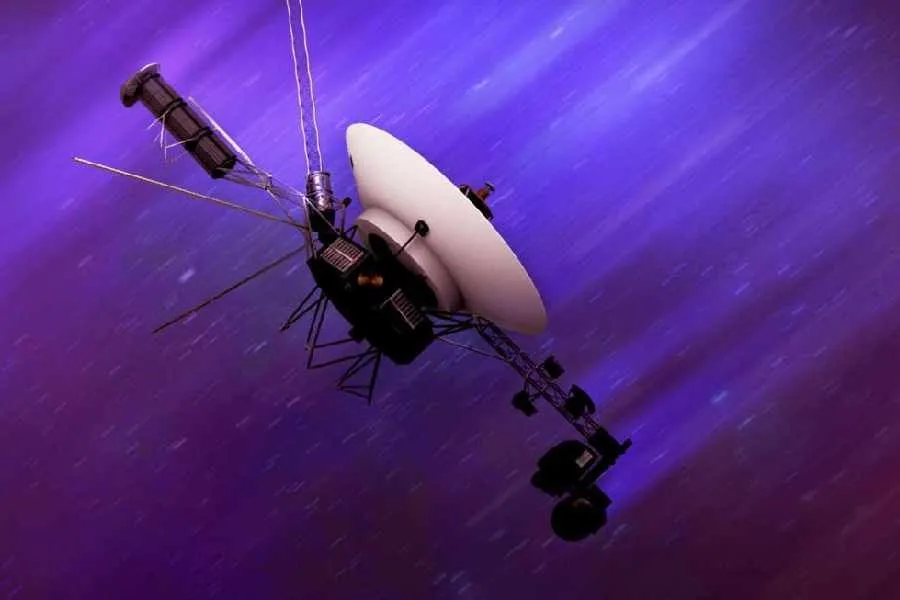
Nasa is inviting people around the world to turn on their phone torches and flash a message into the night sky as its Voyager 1 spacecraft prepares to reach a distance no human-made object has travelled before: one light-day from Earth.
The space agency has called the initiative “Shine Bright for Voyager’s Light-Day”, asking people to send the spacecraft’s call sign, V-G-R, in Morse code after sunset on Tuesday, November 17.
Participants can use a flashlight or phone light, or access an automated flasher provided by Nasa.
Those taking part can spell out Voyager 1’s call sign, V-G-R, using a sequence of short and long flashes: three short flashes followed by a long one for V, two long flashes followed by a short one for G, and a short-long-short sequence for R.
The milestone is expected on Wednesday, November 18, when Voyager 1 will be more than 16 billion miles (25.9 billion km) from Earth. A light-day is the distance light travels in 24 hours. In other words, a signal sent from Earth to a point one light-day away would take a full day to arrive.
Launched on September 5, 1977, Voyager 1 has spent nearly five decades travelling through space. It flew past Jupiter in 1979 and Saturn in 1980 before continuing towards interstellar space. In 1998, it overtook Pioneer 10 to become the most distant human-made object.
The spacecraft has already faced a major communications scare. In November 2023, Voyager 1 stopped sending readable scientific and engineering data to Earth, although it continued transmitting a radio signal and receiving commands. NASA engineers traced the problem to a malfunctioning memory chip in one of its onboard computers.
Unable to repair the chip, the team rewrote and relocated the affected software code to other parts of the computer's memory. Voyager 1 resumed sending usable engineering data in April 2024, after five months of troubleshooting. Its scientific data transmissions were subsequently restored.
The spacecraft continues to send faint signals and scientific information from interstellar space, but its power supply is steadily weakening. NASA estimates that the Voyagers could remain within range of its Deep Space Network until around 2036, depending on how much power remains to transmit signals.
When communication eventually ends, Voyager 1 will continue its journey through the galaxy without sending any more data to Earth. It will still carry the Golden Record, a collection of sounds, images and greetings from Earth intended for any future discoverer. Its journey will go on, long after humanity can no longer hear from it.