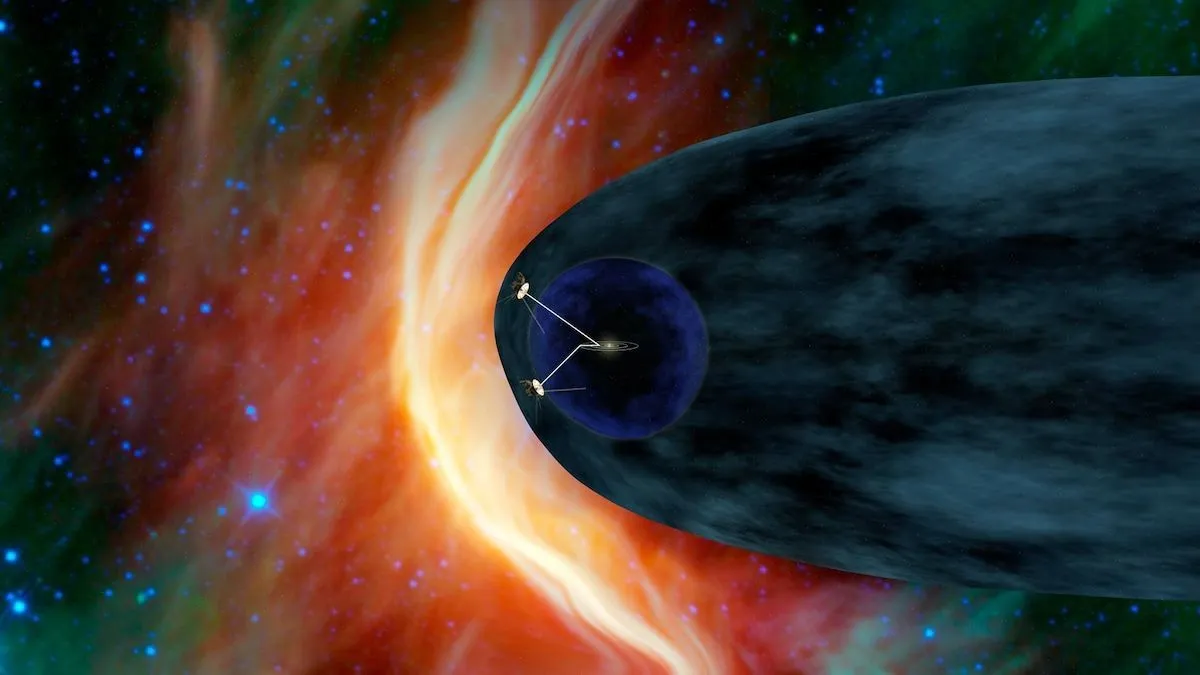
NASA's Voyager 1 spacecraft is set to become the first human-made object to travel one light-day away from Earth on November 18, 2026. The spacecraft will be approximately 16.09 billion miles (25.89 billion kilometres) from Earth, meaning radio signals will take 24 hours to travel between the probe and mission controllers.
Launched on September 5, 1977, Voyager 1 has been travelling through space for nearly 50 years. Originally sent to study Jupiter and Saturn, the spacecraft crossed into interstellar space in August 2012 and continues to send scientific data to Earth.
One-day journey
A light-day is the distance light travels in 24 hours, approximately 16.09 billion miles (25.9 billion kilometres). Voyager 1 is expected to reach this distance from Earth on November 18 at 5:16 am EST (3:46 pm IST).
The milestone will have a direct impact on communication with the spacecraft. A radio signal sent from Earth will take approximately 24 hours to reach Voyager 1, while its response will take another 24 hours to return.
“If you want to say 'hello' to Voyager, you send your message and then you go home and you wait two days before you finally get a response,” Suzanne Dodd, Voyager project manager at NASA's Jet Propulsion Laboratory (JPL), said.
Signal blackout
The milestone comes weeks after NASA briefly lost contact with Voyager 1. The agency's Deep Space Network failed to detect signals from the spacecraft during two scheduled communication attempts on October 18 and 19.
Communication was restored on October 20 without engineers having to send troubleshooting commands.
Engineers found that one group of the spacecraft's thrusters had gone offline, prompting its onboard fault protection system to activate backup thrusters automatically. The exact cause of the incident remains under investigation.
“This is the first time we've seen the spacecraft do something like this, but we are also at a point in the mission where we have to expect the unexpected,” Kareem Badaruddin, Voyager mission manager at JPL, said.
Power challenge
Voyager 1 is travelling at around 38,000 miles per hour (61,155 kilometres per hour) and continues to operate despite its ageing systems and declining power supply.
The spacecraft is powered by radioisotope thermoelectric generators, which convert heat from decaying plutonium into electricity. Both Voyager spacecraft lose around four watts of power each year as their plutonium supply declines.
To extend the mission, NASA engineers completed a power-saving operation in September, switching off three devices aboard Voyager 1 and replacing them with lower-power alternatives.
The operation, called the 'Big Bang', is expected to help keep its remaining science instruments operational for longer. Without the changes, NASA would have needed to switch off another instrument as early as summer 2027.
Still exploring
Voyager 1 was launched with 10 science instruments, several of which have been switched off over the years to conserve power. The spacecraft continues to operate in interstellar space, the region beyond the heliosphere, which is the bubble of particles and magnetic fields generated by the Sun.
It remains the most distant human-made object from Earth and, along with Voyager 2, is the only spacecraft to have directly studied the interstellar environment. Its one-light-day milestone will mark another distance record for the nearly five-decade-old mission.
Tags