

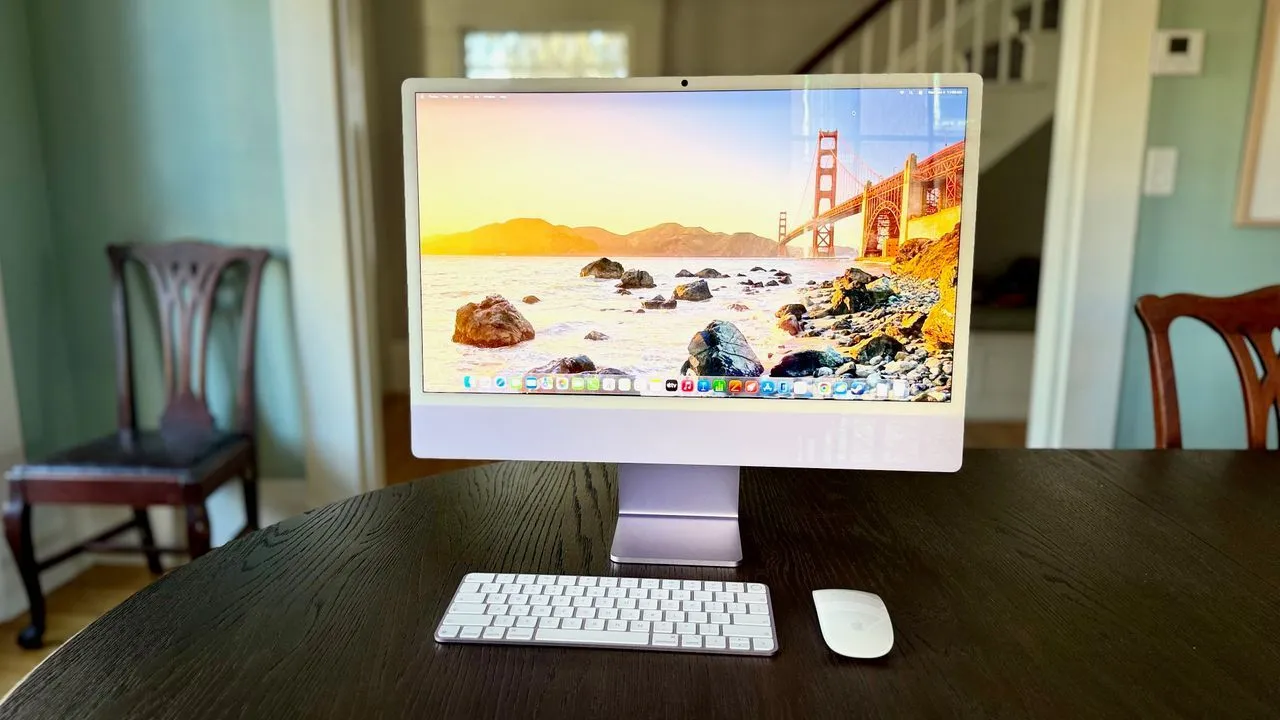
Has Apple grown bored with the iMac? Or maybe it pulled designers from the iMac team and shifted them to radical new products like the iPhone Duo? Or perhaps it’s of the opinion that the iMac’s form has achieved perfection that it never again needs to change? Whatever the reason, the M6-powered iMac continues a half-decade streak of internal upgrades arriving in the same tried-and-true design.
The last redesign for the iMac came in 2021 when Apple switched from Intel chips to its own M-series processors. The latest M6 iMac looks no different than the M1 iMac — or the M3 and M4 models in between (Apple skipped the M2 and M5 for the iMac).
I must admit that the iMac’s overall look remains stunningly elegant and superior to most anything on the Windows side, so it’s hard to argue the design is getting stale. That said, if we are doing touchscreen Macs now, then this is the Mac whose display I’d most like to tap and swipe. A touchscreen display might not change the iMac’s design, but it would certainly improve its usability.
More from CNET
While I await the arrival of a touchscreen iMac (which, frankly, may never come), I’m largely satisfied with the fourth consecutive internal upgrade. The M6 processor adds a couple more CPU and GPU cores for improved performance and doubles the cores of the neural processor for greater local AI capabilities. Memory bandwidth and networking also receive upgrades with the M6 iMac, but, sadly, the base storage capacity stays a miserly 256 gigabytes — undersized in general, but especially for a desktop that’s more likely to have multiple users.
Pricing does stay the same, but only because Apple raised the price of the previous M4 iMac a few months ago. The iMac starts at $1,499, but you’ll probably want to spend another $200 to double the storage to a 512GB SSD. I’d spend that amount for the added storage rather than $200 for the upgraded 12-core M6 processor that also doubles the number of Thunderbolt 4 ports on the back.
For most iMac buyers, the 10-core M6 and a pair of Thunderbolt 4 ports will suffice. It’s more important to get enough internal storage up front because you can’t upgrade it after purchase. And it’s a bit anticlimactic to buy a sleek iMac only to have an external hard drive attached to it and cluttering your desk.
Apple offers two versions of the M6 processor, one with 10 CPU and GPU cores and another with 12 cores each. That’s two more than the 8- and 10-core versions of the previous M4 chip. The M6 can pack more cores and transistors into a same-sized die because it’s manufactured on a 2-nanometer process, compared with the 3nm M4.
In addition to moving to a smaller manufacturing process with the M6, Apple introduced a new type of core. The M6 has the same performance and efficiency cores as the M4, but adds a new “super core” to the mix. The 10-core M6 has two super cores, three performance cores and five efficiency cores. The 12-core M6 has two super cores, four performance cores and six efficiency cores.
Instead of the single 16-core Neural Engine with the M4, you get a dual 16-core Neural Engine with the M6. The Neural Engine is designed to handle the integer math calculations required for local AI workloads. Also aiding AI performance is the M6, which adds a neural accelerator to each GPU core.
Memory starts at 16GB, with 24GB and 32GB upgrades as before, but the memory bandwidth has increased from 120GB per second to 153GB per second with 16GB of RAM, and to 170GB per second with 24GB or 32GB.
The biggest disappointment among the internal components is the minimum storage staying at 256GB. That’s not enough room for a laptop, let alone a desktop. Apple claims that the solid-state drive offers twice the read and write speeds of the previous model, thanks to the internal storage controller receiving PCIe 5.0 support.
The M6 iMac also received Apple’s N1 networking chip, which upgrades wireless networking to Wi-Fi 7 and Bluetooth 6. Wired networking also gets a bump from Gigabit Ethernet to 2.5Gb Ethernet. It’s still a $30 add-on with the baseline iMac and comes with the 12-core M6 upgrade. And the Ethernet port is still on the iMac’s power brick, not on the back of the display.
The M6 iMac starts at £1,499 in the UK and AU$2,399 in Australia.
M6 iMac performance
Apple sent me the 12-core M6 iMac for testing. It put its extra cores to good use and showed strong multi-core gains compared with the 10-core M4 iMac that I tested two years ago. It was 37% faster on the Geekbench 6 multi-core test and 36% faster on the Cinebench 2024 multi-core test. Single-core performance also improved, with a 19% gain on Geekbench 6 and a 26% gain on Cinebench 2024. The iMac M6 enjoyed a bigger 49% advantage on the Cinebench 2024 GPU test.
I didn’t run 3DMark on the M4 iMac, but compared with the M4 MacBook Pro, the M6 iMac delivered excellent graphics performance. Its score on 3DMark Steel Nomad was 66% higher than the M4 MacBook Pro’s.
Two years ago, we weren’t concerned with local AI performance and didn’t run any AI benchmarks on the M4 iMac. Borrowing the M4 MacBook Pro once again as a stand-in for the M4 iMac, you can see the benefits of the M6’s dual 16-core Neural Engines. The M6 iMac’s score on the Geekbench AI NPU test was 46% higher than the M4 MacBook Pro’s and 40% better than the scores of the M5 MacBook Pro and Air.
Same design, same display
The rest of the story remains the same. The M6 iMac features the same design with the same 24-inch, 4.5K Retina display in the same seven color choices: blue, purple, red, orange, green, yellow and silver. The included Magic Keyboard and Magic Mouse are color-matched to the system. Apple sent me the M6 iMac in purple, which I found quite fetching.
As with the previous model, the new M6 iMac provides one display upgrade. You can trade the glossy finish for Apple’s nano-texture glass that reduces glare and reflections. It’s the same upgrade available with Apple’s MacBook Pros, but Apple charges more for it with the iMac. It’s a $150 upgrade with a MacBook Pro but costs $200 with the iMac. I guess because the screen is larger? Maybe on a cost-per-inch basis, this pricing scheme makes sense, but I don’t like the higher charge — especially when most people will already need to spend $200 to replace the undersized 256GB SSD with a more suitable 512GB of storage before they can even think about the display upgrade.
I know my wish for a touchscreen iMac is a bit premature, but Apple has me thinking about it after introducing a touchscreen on the new MacBook Pro with the PROLED XDR Display. I’m already on record as saying a $3,000 MacBook Pro is the wrong pick for the first Mac with a touchscreen display.
Personally, I want a touchscreen iMac more than any touchscreen MacBook. Maybe I’m just lazy, but sometimes it feels like it takes too many swipes with the mouse to move the cursor around the iMac’s large 24-inch screen. It would be so much quicker and easier to just tap on a link or button with my finger rather than racing the cursor across the display. (Plus, I’ve always liked the idea of having a large touchscreen digital jukebox.)
Touchscreen or no, the M6 iMac remains the best all-in-one computer I’ve encountered. Along with the M6 Mac Mini, it gives Apple two great mainstream desktops.
How we test computers