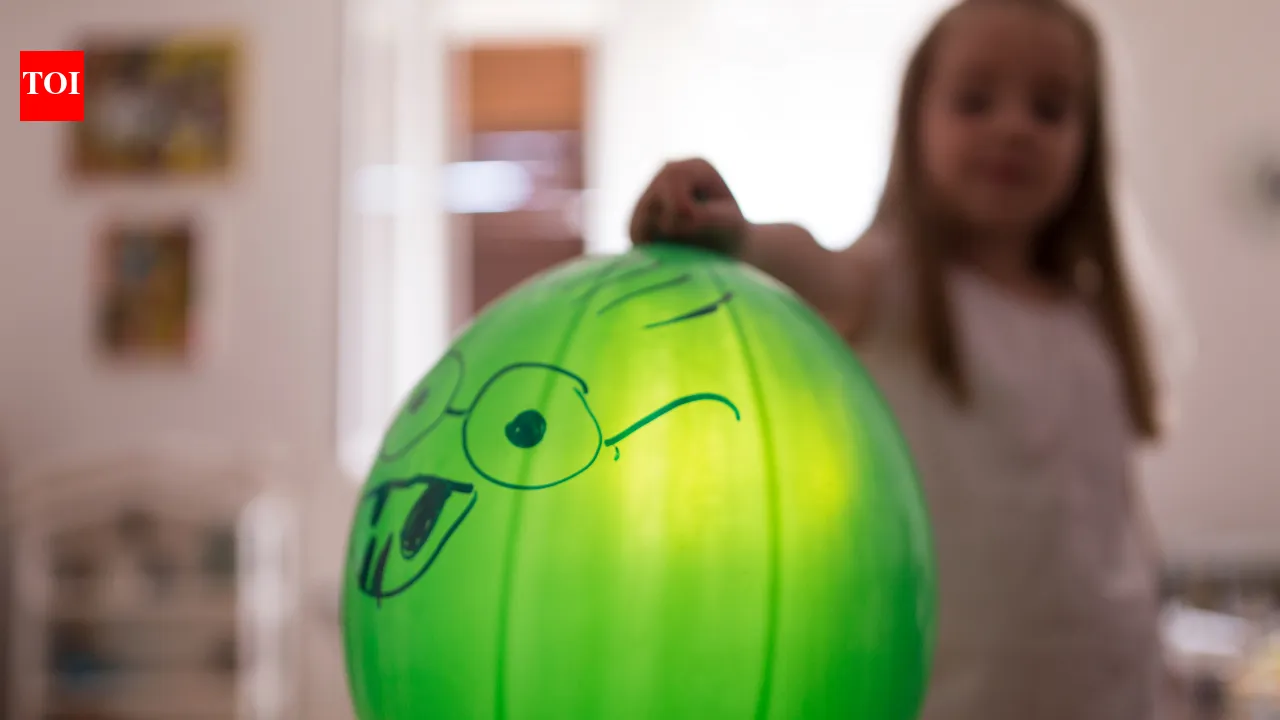
While a made-up friend raises alarms, there is little to worry.
We all remember our first friends, the ones who we took everywhere with us. They were always there for us to play and chat with. They were also, unfortunately, not real. Imaginary friends are one of childhood’s most misunderstood habits. A child talking to an invisible dragon at dinner, insisting that a stuffed bear has opinions, or introducing a made-up companion to a new classmate can make parents worry about loneliness, detachment, or something more serious. But the scientific evidence points in the opposite direction: imaginary friends are common, usually healthy, and often associated with stronger social and emotional understanding, not weaker. A landmark US study by psychologists Marjorie Taylor and Stephanie Carlson followed children from preschool into middle childhood and found that 65% had had an imaginary companion at some point by age 7. The study, published in Developmental Psychology, also found that school-age children were still engaging with imaginary companions and impersonating characters at rates similar to preschoolers. In other words, this is not a rare or strange phase. It is closer to a normal feature of how many children play, think, and practise being social.
What an imaginary friend is
An imaginary companion is not simply a toy. It can be an invisible character, an animal, a person, or a familiar object, such as a doll or stuffed animal, that the child treats as having a distinct personality, preferences, and point of view. Researchers include both invisible friends and “personified” objects because, from the child’s perspective, both can become consistent characters in play. Crucially, most children know the difference between imagination and reality. Research comparing children with and without imaginary companions found no difference in their ability to distinguish fantasy from reality; children with imaginary friends were simply more likely to engage in rich pretend play. A child may genuinely feel affection, frustration, or fear involving an imaginary friend, but that does not mean they believe the friend is physically present in the same way a real person is. Therefore, pretend play is not evidence that a child is confused about the world. It is evidence that they can hold two ideas in mind at once: this is not real, and I am choosing to treat it as real for now. Psychologists call this kind of flexible thinking part of healthy development.
Why children create them
An imaginary friend may not be made due to loneliness.
Children create imaginary friends for many reasons, and loneliness is only one possibility, but not necessarily the main one. An imaginary companion can provide entertainment, a safe audience for ideas, a partner in elaborate games, or a way to rehearse social situations. A child might practise resolving an argument, test what happens when someone says “no,” or explore a fear without the real-world consequences of doing it with another person. The University of Washington’s summary of Taylor and Carlson’s work noted that fantasy gives children a relatively safe context for managing social situations, including conflict. That does not mean an imaginary friend is a substitute for human relationships. Children with imaginary companions do not necessarily have fewer real friendships; research cited by psychologists Naomi Aguiar and Marjorie Taylor found they had similar numbers of reciprocal friendships as children without imaginary companions. There is also no developmental rule that every child must have one. Some children create elaborate imaginary worlds; others prefer real friends, solitary play, sports, drawing, or building things. Not having an imaginary friend is equally normal.
The empathy connection
Pretend play also appears to be linked with social understanding. In Taylor and Carlson’s study, children who had an imaginary companion or impersonated a character showed better performance on tasks measuring “theory of mind”: the ability to understand that other people have beliefs, desires, and intentions that may differ from one’s own. The researchers also found that school-age children who did little or no impersonation scored lower on emotion understanding. This does not prove that imaginary friends cause empathy. It may be that children who are already interested in other minds are more likely to invent companions, or that both abilities grow from the same underlying capacity for imaginative play. But the association is consistent: children who practise taking another perspective, whether by voicing a dragon, negotiating with an invisible princess, or becoming a fictional character, may get more practice at imagining how someone else feels. That practice can look trivial from the outside. A child tells their imaginary friend, “You can’t grab all the blocks; that makes people sad.” In doing so, they are rehearsing fairness, emotional language, perspective-taking, and conflict resolution. The “friend” may be invented, but the social learning is real.
When to pay attention
A parent may want to seek professional guidance if the imaginary companion is threatening, encourages violence or self-harm, dominates the child’s life in a distressing way, or appears alongside broader changes in speech, social interaction, hygiene, concentration, or mood. The concern is not the existence of an imaginary friend; it is whether the child’s overall functioning, safety, and relationships are being affected. It is also worth listening to what the friend says. Imaginary companions can sometimes give children a way to express fears, anger, sadness, or wishes they cannot yet articulate directly. That can offer adults a gentle window into what a child is processing.
Join conversation
Share your thoughts in the comments
Be respectful · TOI community guidelines
The better response
The most helpful adult response is usually curiosity; ask questions such as: “What does your friend like to do?” “What happened today?” or “How did your friend feel about that?” This respects the child’s play without treating it as a problem to eliminate. Parents do not need to pretend the friend is real, argue about whether they exist, or force the child to give them up. A calm, practical approach works best: acknowledge the play, include the friend when it makes sense, and gently maintain real-world boundaries, such as bedtime, safety rules, and kindness to actual people. Imaginary friends are not a red flag. For most children, they are a sign of an active imagination doing exactly what imaginations are built to do: rehearsing life, testing emotions, and making sense of other minds. The evidence suggests that the child talking to an invisible friend may not be withdrawing from the social world at all. They may be practising how to understand it.
End of Article