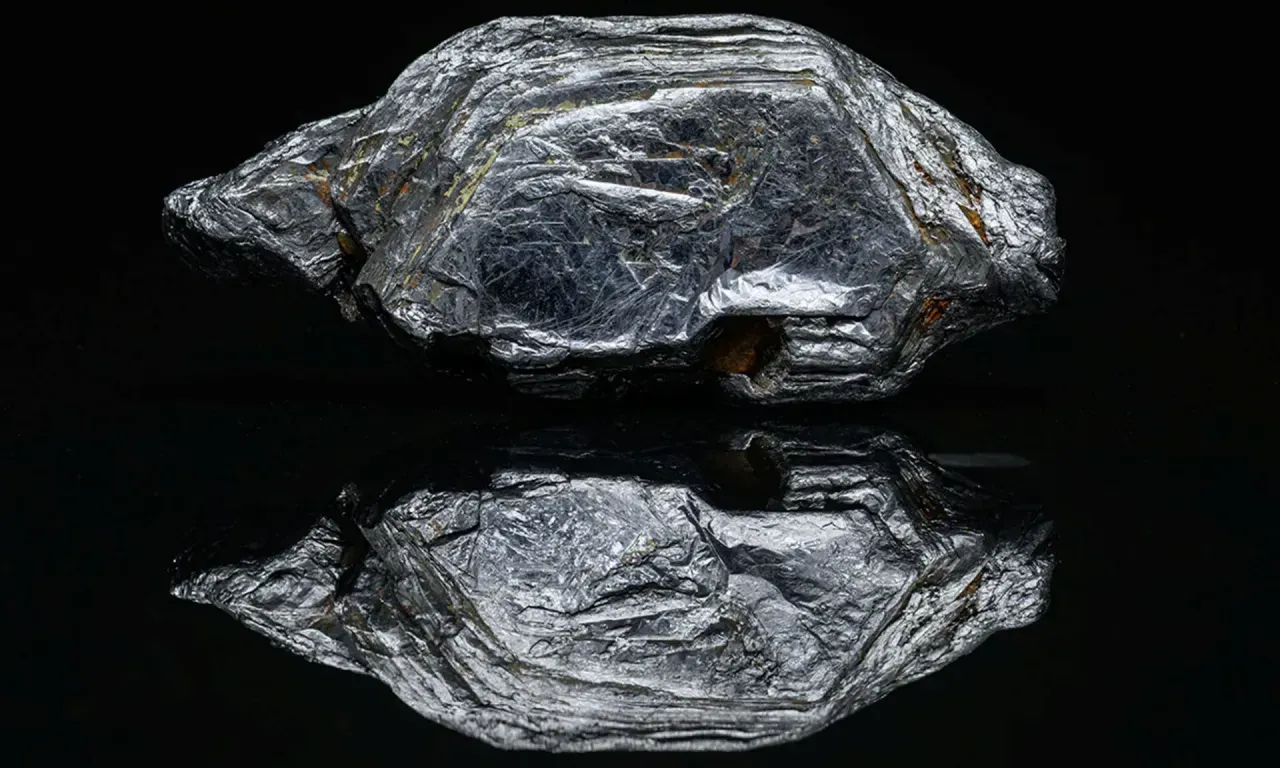
Molybdenum is one of the toughest metals engineers use. It strengthens nuclear reactors, jet-engine turbine blades, and rocket nozzles because it remains stable at temperatures exceeding 2,600°C. Normally, changing its internal crystal structure requires heating it to around 1,000°C.
But researchers from the University of Rochester and Technion–Israel Institute of Technology have now discovered an unexpected shortcut: a tiny diamond tip pressed into the metal can reorganize its crystal structure at room temperature.
The surprising finding, published in Proceedings of the National Academy of Sciences (PNAS), could open new possibilities for advanced manufacturing and future semiconductor technologies. The team originally set out to test a different idea.
“We had a hypothesis that applying extreme pressure to molybdenum would cause it to transform into a new solid phase,” said Associate Professor Niaz Abdolrahim of the University of Rochester. “But then we found this interesting phenomenon of an entirely different stress-driven mechanism.”
A secret of stronger metals unveiled
Like most metals, molybdenum is made up of countless microscopic crystal grains. The size, shape, and orientation of these grains strongly influence a material’s strength, flexibility, and durability. Traditionally, altering those grains requires intense heat. Instead, the researchers found they could trigger recrystallization mechanically.
A breakthrough came about through the use of a nanoindenter, a tool that uses a very thin diamond tip to test materials. When the nanoindenter tip pushes down on the surface of molybdenum, it creates a build-up of pressure until the metal finally breaks free from the force of the indentation. At this point, there is a small movement called a “pop-in” event. Researchers have found that this short period of time is extremely important.
If the process stops immediately after the pop-in, new crystal grains form around the indentation. If pressure continues beyond that point, the newly formed grains disappear. Through experiments and computer simulations, the team showed that controlling this narrow window allows molybdenum to recrystallize without heating.
“Currently, if you have a damaged sample, to fix it or form new grains, you have to heat the whole sample to 1,000 degrees Celsius or more,” said Afnan Mostafa, a PhD student involved in the work. “Here we show you don’t need to heat the whole sample. You just need to know where to poke, how much, and when to stop.”
New ultra-strong material for microchip sensors
The discovery may be especially relevant to semiconductor manufacturing.
Chipmakers are increasingly exploring molybdenum as a replacement for copper in the tiny interconnects that link electronic components inside advanced processors.
As circuits shrink, copper becomes less efficient because its electrical resistance rises significantly at very small scales. Molybdenum does not suffer from the same problem.
“Copper usually has a resistance increase at nano scales, which means electricity doesn’t flow through it as well,” Mostafa said. “Molybdenum doesn’t have that problem, which makes it appealing for the next generation of tiny microchip interconnects.”
However, molybdenum can be brittle at room temperature, limiting its usefulness in some applications. Researchers hope that precise room-temperature recrystallization could help overcome some of those limitations.
“While molybdenum is extremely durable at high temperatures, at room temperature, it can snap without any warning that it’s going to break,” Mostafa said. “So, we want to explore if we can improve that. If we can find new ways to recrystallize the material at room temperature, it could give us new uses for molybdenum that are currently only available at high temperatures.”
A tiny step forward toward achieving room-temperature superconductivity
The ability to selectively modify tiny regions of a material without heating an entire component could also prove useful for repairing defects or tailoring properties in specific locations.
For now, the finding is an example of how unexpected discoveries can emerge from basic research. A simple experiment with a diamond probe revealed a new way to manipulate one of industry’s most heat-resistant metals, potentially paving the way for stronger materials and more advanced electronics.
Journal Reference: