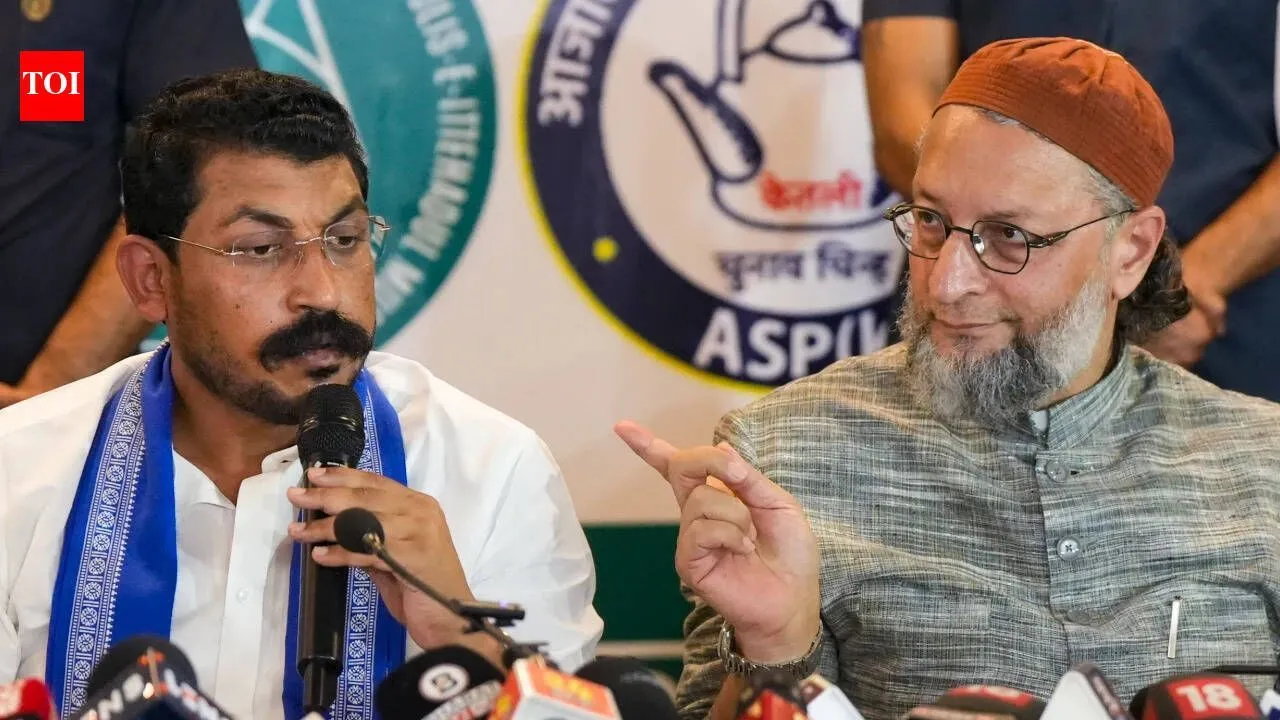
AIMIM chief Asaduddin Owaisi and Aazad Samaj Party (Kanshi Ram) national president Chandra Shekhar Azad will jointly contest the 2027 Uttar Pradesh assembly polls.
NEW DELHI: Asaduddin Owaisi wanted a place in the INDIA bloc's fight against the BJP in Uttar Pradesh. Bihar rebuke and several olive branches later, he warned four months ago: "I have said this before, and I am saying it again: the Majlis does not want the BJP to form the government again in Uttar Pradesh. I am ready to join hands. I am ready to form an alliance. Today is the time to talk. Don't cry later after the elections are over. We don't want the BJP to come to power again." But the Samajwadi Party and the Congress, who are yet to formalise their own seat-sharing plan, did not pay heed to him. Owaisi on Thursday joined hands with Chandrashekhar Azad to build an alternative political platform in Uttar Pradesh. This time, along with challenging the BJP, the AIMIM chief declared: "If we have to die for the cause of people, it's a good deal for us; Akhilesh Yadav won't be CM, engaged in politics of entitlement." The newly-formed Samajik Parivartan Morcha, with Azad as its chief ministerial face for the 2027 assembly elections, is seeking to mobilise Dalits, Muslims and backward communities under a common political platform. And the proposition is significant. Muslims account for an estimated 19 per cent of UP's electorate, Dalits 21 per cent and OBCs around 41 per cent. The two communities at the heart of the new alliance, Muslims and Dalits, together constitute around 40 per cent of the electorate.
Owaisi declared Chandrashekhar Azad as the Samajik Parivartan Morcha's CM candidate.
But demographic arithmetic obviously does not automatically translate into votes. The Uttar Pradesh contest is already too crowded with the BJP, Samajwadi Party, BSP, Congress and even smaller caste-based parties within the NDA. Chirag Paswan's Lok Janshakti Party (Ram Vilas), too, is looking to expand its presence in UP ahead of the elections. So how will this new Owaisi-Azad alliance fit into the play? But first, let's rewind a bit.
The Bihar deja vu
In Bihar, ahead of the 2025 assembly elections, Owaisi offered to contest just six seats as part of the RJD-led INDIA bloc. In September 2025, he had said that AIMIM's Bihar president Akhtarul Iman had written three letters, two to Lalu Prasad Yadav and one to Tejashwi Yadav, seeking an alliance. "We are ready to take six seats. You don't even have to give us a ministry if you come to power. Just set up a Seemanchal development board. What more can we do?" Owaisi had said. The RJD-Congress-led Mahagathbandhan did not accommodate AIMIM despite Owaisi's offer to contest just six seats. The decision came despite AIMIM's five-seat breakthrough in the 2020 Bihar assembly elections, when it won all its seats in Seemanchal. Four of those five MLAs later defected to the RJD in 2022.
We are ready to take six seats. You don't even have to give us a ministry if you come to power. Just set up a Seemanchal development board. What more can we do?
Owaisi ahead of Bihar polls 2025
But the party demonstrated that its support base had survived the defections. Contesting independently in 28 constituencies in 2025, AIMIM won five seats again, retaining all five constituencies it had won in 2020. Its performance came as a setback to the Mahagathbandhan in Seemanchal, where the NDA won 14 of the region's 24 seats, while the Congress and RJD managed five between them. Cut to one year later, Owaisi once again expressed his willingness to work with Akhilesh Yadav in Uttar Pradesh, that too repeatedly. The SP, however, dismissed his public overtures as "public posturing", arguing that electoral alliances were not negotiated through public statements. The SP's reluctance to accommodate AIMIM has now resulted in Owaisi building a separate front with Azad. In an interview with The TOI ahead of the alliance announcement, Owaisi said the two parties were already "shortlisting the seats and discussing who will contest from where". He also said the alliance would remain open to other parties and individuals. Now here's how the Owaisi-Azad alliance may make the parties feel its impact in upcoming elections:
Samajwadi Party
The SP, led by Akhilesh Yadav, may have the most immediate reason to worry. Its PDA (Pichhda, Dalit, Alpsankhyak) strategy seeks to consolidate backward classes, Dalits and minorities into a broad electoral coalition against the BJP. The Owaisi-Azad alliance is also attempting to mobilise precisely these constituencies, but outside the INDIA bloc opposition framework. The Muslim vote is the most immediate point of vulnerability for Akhilesh. Muslims account for approximately 19 per cent of UP's population and have overwhelmingly backed the SP in recent elections as the principal party challenging the BJP.
Party-wise performance in Muslim-dominated seats.
The constituency-level data shows that there are 143 assembly seats where Muslims have a significant electoral presence: 70 seats where their population share is estimated at 20-30 per cent and another 73 where it exceeds 30 per cent. The concentration is particularly important in Rohilkhand and the Upper Doab. Constituencies such as Rampur Nagar, Chamrauwa, Moradabad Rural, Kundarki, Behat, Amroha, Sambhal, Suar, Moradabad Nagar and Najibabad have estimated Muslim population or voter shares ranging from around 45 per cent to over 60 per cent. This gives AIMIM a potential electoral geography. The analysis of 59 Muslim-dominated constituencies in the 2022 assembly elections offers another indication of the stakes. The SP won 34 seats against the BJP's 22, but the BJP's vote share was marginally higher at 39.3 per cent, against the SP's 39.1 per cent. Owaisi has repeatedly questioned why Muslim voters should continue supporting parties that seek their votes but do not offer them an adequate share in political representation. This new alliance with Azad may give Owaisi a stronger political argument. Instead of merely seeking a share of the Muslim vote, he can now pitch a broader Dalit-Muslim coalition, with Azad bringing a Dalit support base and the credibility of having won the Nagina Lok Sabha seat in 2024. This could help the alliance present itself as an alternative social and political formation, rather than just another party seeking to divide the opposition's Muslim vote. For Akhilesh, even a limited erosion of Muslim support could matter in closely contested constituencies.
BSP
If Owaisi's immediate target is the SP's Muslim support base, Azad's political ambition could put pressure on the BSP and Mayawati. Dalits account for approximately 21 per cent of UP's electorate, but they are not a homogeneous political constituency. While Jatavs have remained the BSP's traditional support base, the BJP has steadily expanded its appeal among non-Jatav Dalit communities, including Pasis, who account for an estimated 4 per cent of the electorate. Through targeted outreach, welfare politics and the mobilisation of smaller caste groups, the BJP has drawn sections of these communities into its broader social coalition. This has further eroded the BSP's ability to command Dalit votes as a consolidated bloc. The BSP's vote share fell from 22.23 per cent in the 2017 assembly elections to 12.88 per cent in 2022. Its seat tally collapsed from 19 to just one. Azad's entry into the alliance could now open another front in this contest for Dalit support. Azad first emerged as a prominent Dalit voice through the Bhim Army, the organisation he co-founded in 2015 to fight caste discrimination and work for Dalit rights, particularly through education and grassroots mobilisation. His activism, often marked by confrontations with the authorities over caste-related violence, helped him build a following among Dalit youth in western Uttar Pradesh. His victory from Nagina in the 2024 Lok Sabha election gave him a parliamentary platform and established him as an electoral force, taking him beyond his earlier identity as a Dalit rights activist. For Mayawati, the challenge is not simply that Azad is emerging as a younger Dalit leader. It is that he is attempting to combine Dalit political assertion with Muslim representation, a combination that could appeal to voters looking for a new social justice platform.
Azad said marginalised communities will use their votes to assert political power.
However, replacing Mayawati is no easy task. The BSP has a decades-old organisational network and a political identity built around Kanshi Ram's Bahujan movement. Azad will have to demonstrate that his appeal extends beyond Nagina and sections of the Jatav community. The bigger test will be whether he can attract non-Jatav Dalits, particularly in central and eastern UP, where the BJP has consolidated support among several smaller caste groups.
BJP
For the BJP, the alliance is both good and bad news. On one hand, if Owaisi draws Muslim votes away from the SP and Azad takes away some Dalit support from the BSP and SP, the anti-BJP vote could become fragmented. This could work in the BJP's favour. The BJP won 255 seats in the 2022 assembly elections with 41.29 per cent of the vote. The SP secured 111 seats with 32.06 per cent. On the other hand, the alliance's attempt to mobilise non-Jatav Dalits and backward communities could challenge the BJP's own social coalition. The BJP's electoral strategy in UP has relied heavily on consolidating non-Yadav OBCs, who account for an estimated 33 per cent of the electorate, and non-Jatav Dalits.
How parties performed in the 86 SC/ST seats of Uttar Pradesh.
The BJP has successfully brought sections of these communities into its fold since 2014 through political representation, welfare outreach and alliances with smaller caste-based parties. These include Apna Dal (Sonelal), which has influence among Kurmis; the SBSP, led by Om Prakash Rajbhar, which draws support from Rajbhars; and the NISHAD Party, which represents riverine communities such as Nishads, Mallahs and Kewats. Together, these parties have helped the BJP build a broader non-Yadav OBC coalition across Uttar Pradesh, particularly in eastern UP. Azad's attempt to mobilise marginalised communities could put this support base under pressure. However, the alliance will have to demonstrate that it can translate its social justice pitch into votes across constituencies. The BJP, under CM Yogi Adityanath, also has an established organisational network and a much larger electoral footprint than either AIMIM or the Azad Samaj Party. For the ruling party, the bigger advantage could come if the new alliance weakens the SP's ability to consolidate anti-incumbency votes.
Congress
The Congress could also face a challenge, although its direct electoral vulnerability seems less clear.
Join conversation
Share your thoughts in the comments
Be respectful · TOI community guidelines
The party has been trying to rebuild its presence in Uttar Pradesh through its alliance with the SP and the broader INDIA bloc. Its outreach to Dalits and minorities overlaps with the social constituencies that Owaisi and Azad are seeking to mobilise. The alliance could complicate Congress's attempt to expand its independent support base, particularly among Muslim voters who have increasingly backed the SP as the principal challenger to the BJP.
Congress MP Imran Masood said Owaisi's electoral presence in Bihar benefited the BJP.
The UP assembly contest has intensified with the entry of a new opposition front. Will Owaisi and Azad be able to translate their Dalit-Muslim political alliance into a viable electoral force in Uttar Pradesh? And can the two leaders build a support base strong enough to challenge established players and make the Samajik Parivartan Morcha a factor in the 2027 assembly elections? We will know in the coming months.
End of Article