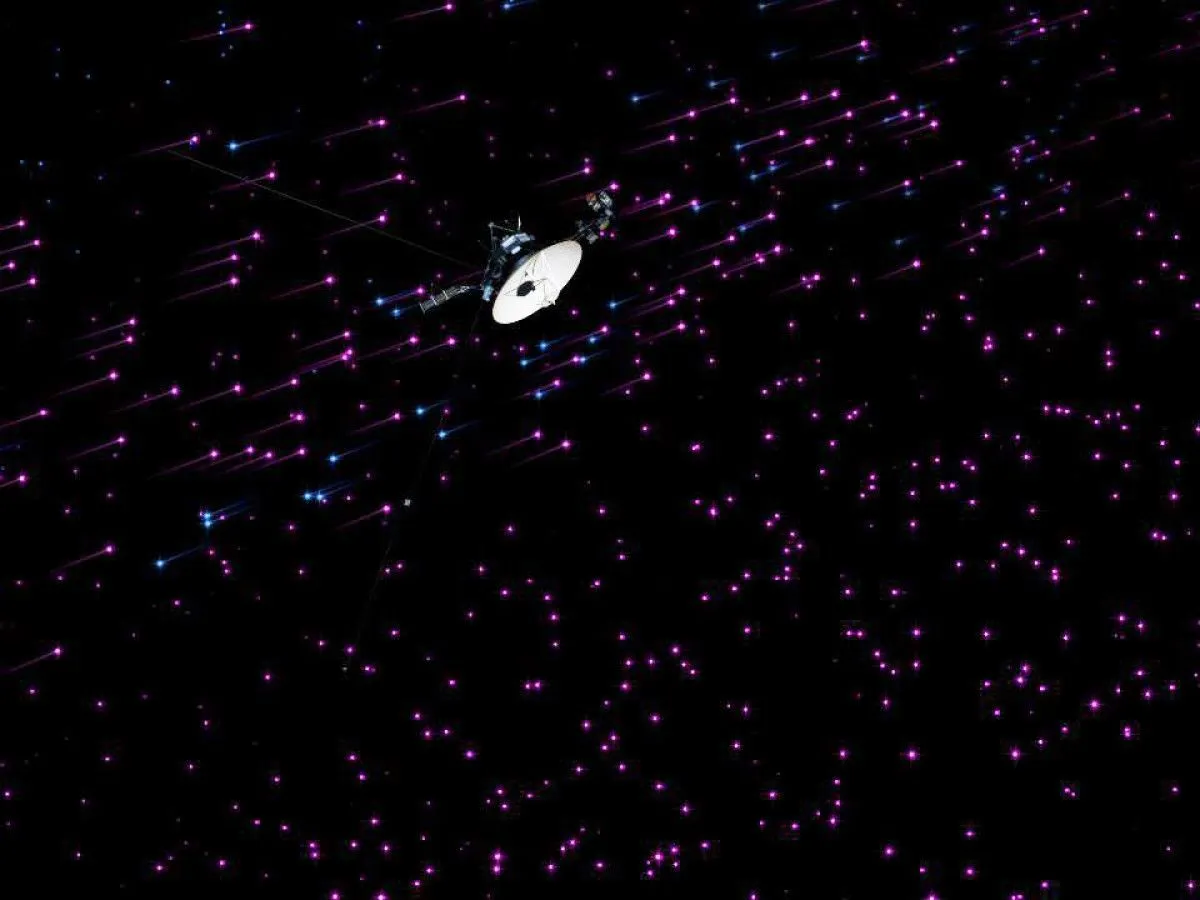
The Voyager 1 space probe is reaching one “light-day” from Earth. It is the very first time any spacecraft has achieved such a milestone. To put that into context, Voyager is currently over 24 billion kilometres - 16 billion miles - away from home. Incredibly, it’s still active and in touch with us, but the huge distance means the radio signals it’s sending back to us here on Earth take a day to arrive, and vice versa. NASA is inviting the planet to mark the milestone by flashing the mission's three-letter designation – VGR – at the sky in Morse code after sunset on November 17. Chris Smith speaks with Megan Argo, a space scientist at the University of Lancashire…
Megan - So there are two Voyager spacecraft, and they were launched within days of each other back in 1977. So these spacecraft are older than me. So I've been watching the results coming from these missions for essentially my entire life, along with a lot of my colleagues. Their aim was to do a grand tour of the solar system. So the idea was essentially to go and visit mainly Jupiter and Saturn and explore those two planets and their moon systems as well. And in doing so, they made several new discoveries. So for example, Voyager 1 itself discovered a new thin ring around Jupiter that we hadn't seen from the Earth at the time, and it discovered two new moons as well. Again, we didn't know we're there. Now we know Jupiter has a lot more moons than we did back then because we keep discovering them, but it was Voyager that discovered both Thebe and Metis, two of the moons of Jupiter. And they're both still sending back data today, which is phenomenal given that they're nearly 50 years old. They made fundamental discoveries about our solar system that are still influencing the way we explore the solar system today.
Chris - I think there was a window of opportunity when they were launched. There was a rush to get them up there, wasn't there? Because there was an alignment of planets that would enable them to do this grand tour that they wouldn't be able to do if we missed that opportunity. That's why they were so successful because they saw so much.
Megan - It's difficult to visit the outer solar system. It takes a lot of energy to get there, and it's expensive in terms of rocket fuel. The more instruments you put on your spacecraft, the more expensive it is to launch and get to the outer solar system. So if you can line up the trajectories when the planets are in the right orientation, you can be much more efficient. Instead of just going to one system, you can use the gravitational pull of one as you fly past it to alter your trajectory and send you off towards the second one. That's essentially what they did.
Chris - And what are they measuring? What are they seeing? What data are we receiving from them? And what is their environment now?
Megan - So over the last sort of 20 years, what they've measured is things like a change in the plasma environment. So that's one of the instruments is measuring the plasma environment around the spacecraft. And it's also measuring things like the cosmic rays, so the high-energy particles. So there's a particle instrument that's still operating too. And over the last 20-odd years, they've measured changes. So in 2004, there was a change in both of these measurements, and what that was interpreted as is crossing what's known as the termination shock. So the Sun is generating a solar wind, a stream of particles that comes out from the Sun's surface 365 days a year in all directions. The strength of that varies over time, but it's a fairly constant solar wind that's coming out through the solar system. At some point, you can think about that as the Sun is blowing a bubble inside a much wider area of particle density called the interstellar medium. That's the very thin, very rarefied gas that exists in between the stars across the whole of the galaxy. And the Sun, effectively with its solar wind, blows a bubble in that interstellar medium. And as you reach the edge of that bubble, there is a shock as you cross from where the Sun's influence ends and you cross into the interstellar medium, and so that region has been crossed by both Voyager 1 and Voyager 2 over the last sort of 15 or so years. And that's been measured by changes in the particle density and changes in the cosmic ray profile, the particles that are received by the detectors. So we've gone from measuring a low rate of cosmic rays to a much higher rate of cosmic rays because the Sun's, the heliosphere protects us from a lot of those high-energy cosmic rays coming from the rest of the galaxy. We think there is this region called the Oort cloud, which is a very, very large distance from the Sun, and this is a region of sort of dirty snowball-type objects, we think of that, that is the source of a lot of the long-period comets that come into the solar system. Now they're difficult to see because they're small and they're cold and they're a long, long way away. So we don't actually know the true physical extent of the Oort cloud. It's hypothesised to be there. We're pretty sure it's there, but we've not actually measured it. And you might think, well, Voyager 1 is going to measure it, and it's going to cross that region. Well, possibly, but we don't think it will reach the other side of that region for another 30,000 years. So by that point, there won't be enough power to power any of the instruments and the communication system. So, and whether there's anybody left on the Earth who can detect those signals and interpret them anyway, imagine how much technology has changed since this was launched in 1977. Yeah, whether we'll ever determine that from this spacecraft is highly unlikely.
Chris - So thinking about the sort of structure of the solar system, we have the inner planets, we're one of those, and then you've got the gas giants. And then right out at the far reaches is Pluto, that's about 6 billion kilometres from us. Outside Pluto is the Kuiper Belt, that's this ring of material and possibly other planets we haven't discovered yet sitting out there. And then beyond that is this Oort cloud, which is even farther away. And the Voyagers are between the Kuiper Belt and the Oort cloud now.
Megan - Yes, we think so. It's, yeah, it's a very, very long way from the Sun. So we think the Kuiper Belt has got lots of sort of rocky objects in it. So we're talking minor planets, things like that, and asteroids. And then yes, the Oort cloud is even further out, and we think that's made up of these sort of cometary-like bodies.
Chris - So how far have they got, though, Megan? How far away are they? And so when we're hearing back from them, how long have the signals, which they're sending radio messages back to us, how long are they taking to get back to us here on Earth?
Megan - Yeah, so Voyager 1 is in the news right now, because it's coming up on reaching a distance of one light-day from the Earth. And one light-day is the distance that it takes a beam of light to travel in one day. So that's a very, very, very long way away. If you want to compare it to some things that are more familiar, light reaches the Moon in about 1.3 seconds, and light from the Sun reaches the Earth in about 8.3 minutes. So the distance light travels in one day is really quite a long way compared to the kind of distances that we're used to in the inner solar system.
Chris - And what is their ultimate fate? Will they just carry on forever?
Megan - Unless they hit anything, yes. The way momentum works, these spacecraft have momentum, they haven't fired the engines in years. But the spacecraft will just carry on along their present trajectories unless they hit something. So they are both going to carry on, going out through the interstellar medium; they will pass reasonably close to some other stars within the local neighbourhood, and this is one of the reasons why they were both supplied with these discs of information. So there are recordings of sound, of speech, of various different languages, recordings from various different aspects of the Earth, so city noise, and forest noise, and things. And these etchings on the outside of the spacecraft as well, to show any aliens, should they come across these probes in the million years to come, what we look like, where we come from, where we are in the solar system, how far the Earth is from the Sun. So there's a lot of information on there. Should another species exist and find them in the distant future, whether we will still be here to talk to them about it is another matter. And again, the time it takes for signals to come back to the Earth, even the nearest star is more than four light-years away. So even if there is another civilisation out there that one day comes across these spacecraft, having a conversation with them will be a very slow process.