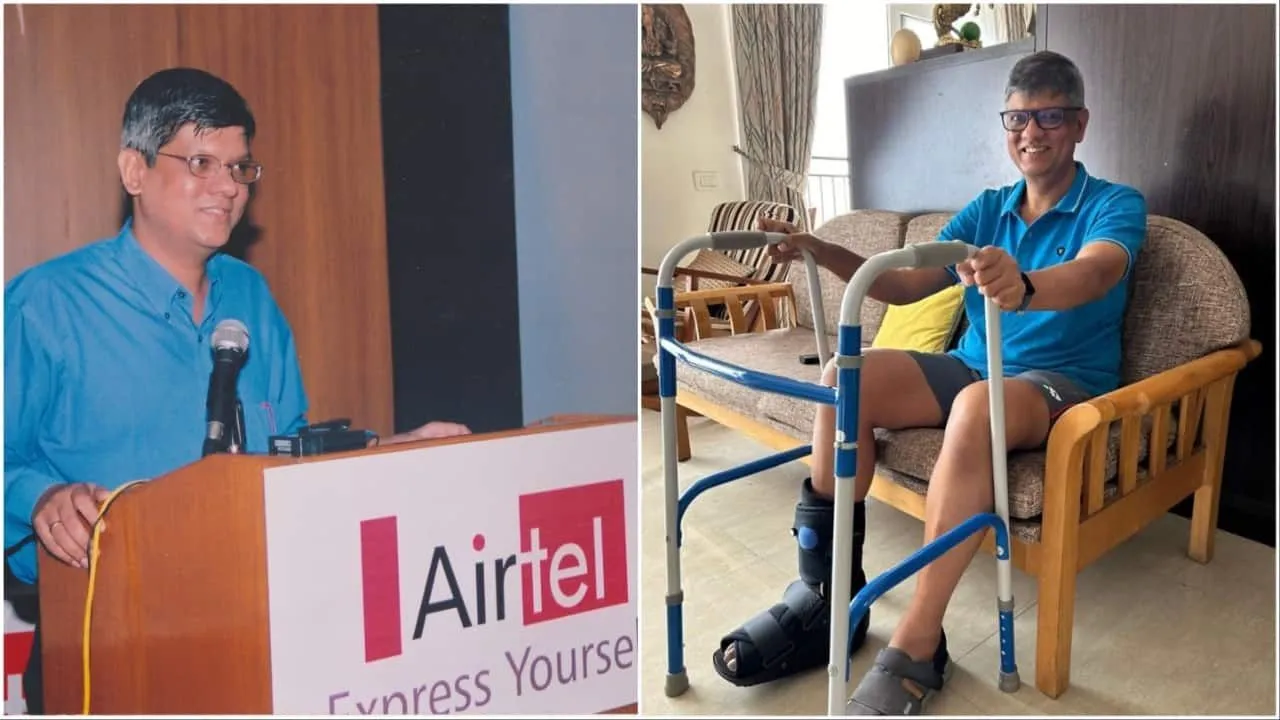
A former telecom executive who once dreamed of becoming a Fortune 500 CEO has opened up about how years of high-pressure leadership roles, relentless targets and workplace stress contributed to a debilitating autoimmune disorder that left him effectively paralysed by the age of 40.
RamG Vallath, former COO at Bharti Airtel and author said the pursuit of corporate success came at a steep personal cost, forcing him to eventually rethink what achievement meant.
In an interview with Moneycontrol, the 58-year-old recalled that his career began on a relatively balanced note. After graduating from management school, Vallath joined Titan in 1992, a company he described as one of the lowest-paying recruiters on campus but one that offered exceptional work-life balance.
"I had a fantastic work-life balance," he said.
That changed as he moved through the corporate ranks, first at Compaq and later in senior leadership roles at 3Com and Airtel.
'Every week was a war room'
According to Vallath, the pressure began mounting during his stint as country leader at networking giant 3Com, where weekly performance reviews became an intense exercise in accountability.
"There was an immense amount of pressure," he said, recalling weekly meetings called "war rooms" where leaders had to explain sales funnels, missed targets and projections.
The pressure continued at Airtel, where between 2001 and 2006, he helped launch a telecom circle from scratch in Tamil Nadu. Ambitious growth targets, operational challenges and mounting expectations created an environment where stress became a constant companion.
"We finally ended up at some 20 percent of that number," he said, referring to aggressive business goals that proved difficult to achieve.
As a business head, the pressure extended beyond revenue numbers.
"Rolling out a telecom operation is extremely complex. There are a lot of moving pieces, you could have litigations against you, you could have government officials trying to take bribes from you," he said.
Symptoms began in his 30s
Vallath said physical warning signs started appearing while he was still pushing himself to climb the corporate ladder.
At the time, he had set himself an ambitious goal. "I wanted to become a Fortune 500 CEO," he said. Around the same period, he began experiencing symptoms he initially struggled to understand.
"It started with feeling clumsy when I was walking," Vallath recalled. "I would get a terrible backache even if I walked 400-600 metres."
Soon, the symptoms worsened. He developed tremors in his hands, lost strength in his fingers, legs and core muscles, and found everyday tasks becoming harder.
"The body had become very unfit," he said.
Vallath was eventually diagnosed with Chronic Inflammatory Demyelinating Polyneuropathy (CIDP), a rare autoimmune neurological disorder. But reaching the correct diagnosis took years.
According to him, two highly qualified doctors initially misdiagnosed his condition, with one incorrectly telling him he suffered from an incurable inherited disease.
"The diagnosis took seven years," he told Moneycontrol.
'At 40, I was paralysed'
The executive said the condition deteriorated steadily as he continued moving between demanding corporate roles.
Even after leaving Airtel for Dell in 2006, a company he described as offering significantly better balance, Vallath continued accepting increasingly challenging assignments, including a later role at Hewlett Packard Enterprise.
Looking back, he admitted he repeatedly moved "from the frying pan into the fire". He quit Dell in 2008.
The following years were marked by repeated hospitalisations, falls and fractures as the disorder progressively weakened his body. "At 40, I was paralysed," Vallath wrote.
By 2011, when he was 43, his condition had become severe enough that he quitfull-time corporate work and travelled to the US for treatment.
Wife became his strongest support system
Throughout the crisis, Vallath says one person held everything together: his wife.
He revealed that his wife had already experienced the trauma of watching her own mother battle motor neuron disease. Her mother fell ill when she was 10, gradually lost control of her body over five years and died when she was just 15.
"It made my wife a very anxious person," Vallath wrote.
Just eight years into their marriage, Vallath began showing remarkably similar symptoms. "Imagine how stressed she must have been," he said.
Despite that, he said she kept the family afloat while he battled illness.
"Held up the family through the entire crisis, even while she watched my body go through the downward spiral," he wrote.
How the family managed finances
While stepping away from the corporate fast track significantly reduced Vallath's income, the family was able to navigate the transition through a combination of modest living, dual incomes and long-term financial planning.
Vallath said he and his wife deliberately maintained a middle-class lifestyle even during his years in senior corporate roles. Rather than upgrading to an expensive lifestyle as their earnings increased, the couple kept their spending in check, a decision that later proved crucial when his illness worsened.
"We always led a fairly middle-class life," Vallath said, adding that they avoided lavish homes and unnecessary lifestyle inflation.
The financial pressure eased considerably after his wife joined Google. According to Vallath, having two incomes not only improved the family's financial security but also allowed him to prioritise his health over career advancement.
"The fact that she was working and the two of us earning immediately reduced the pressure on me as an individual," he said.
Trading ambition for happiness
After stepping away from the corporate treadmill, Vallath devoted six months to rebuilding his health. He tracked daily workouts on spreadsheets, practised yoga, relaxed more and began writing.
That period led to an unexpected career shift.
He published a science-fiction book for children, started speaking at schools and later worked with the Azim Premji Foundation while co-founding a startup.
The change came with a financial sacrifice.
According to Vallath, his annual earnings dropped to roughly 15-20 percent of what he could have earned had he remained on the traditional corporate path.
"But I was okay with that," he said.
The experience also transformed his definition of success.
The executive who once wanted to become a Fortune 500 CEO says he eventually replaced that ambition with a different goal: impacting one million lives positively.
"The change from 'what can life give me' to 'what can I give life'," he said.
Today, Vallath conducts talks, writes books and mentors people on happiness, parenting and life lessons. He says the shift from chasing titles and pay cheques to helping others made him happier than any corporate promotion ever could.
"I claim I am the happiest person I have ever met in my life," he wrote. "None of these would have been possible if she hadn't shouldered the entire burden when I was down."