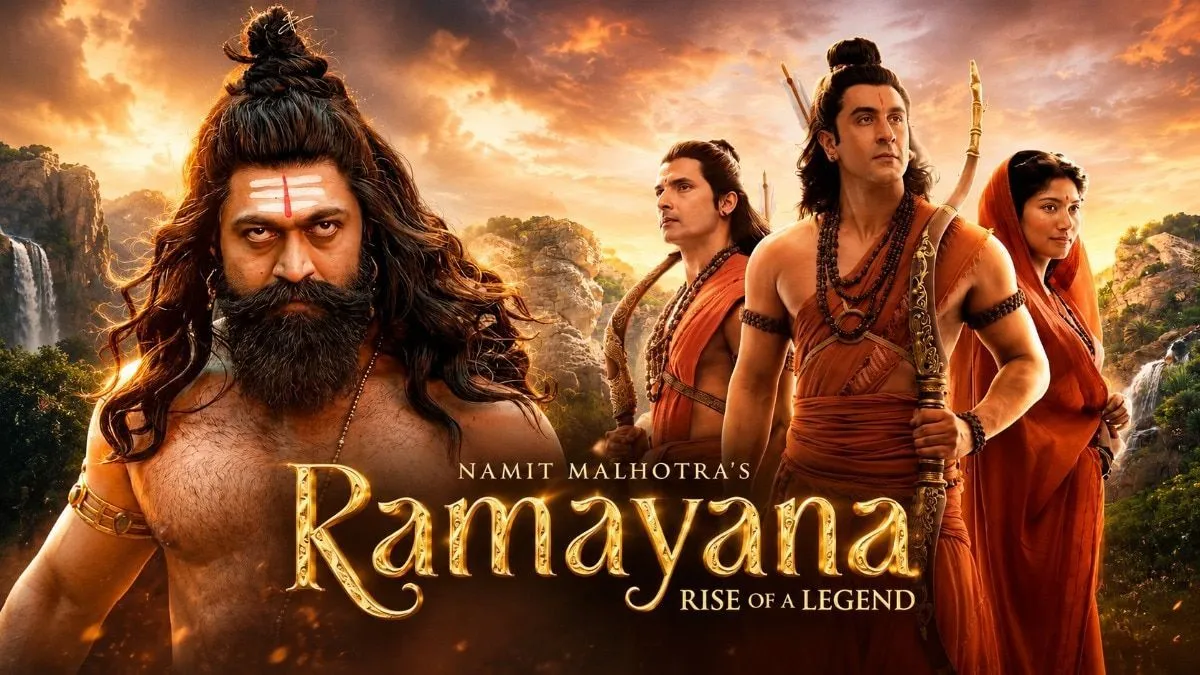
The internet had already made up its mind about Ramayana long before November 5. The VFX looked artificial, the reported Rs 4,000 crore budget invited ridicule, Ranbir Kapoor was supposedly the wrong choice for Rama, and Sai Pallavi had to endure scrutiny over her suitability to play Sita. Even the music, composed by AR Rahman and Hans Zimmer, was being dissected before audiences could experience it in context. To put it simply, a film that began as perhaps the most anticipated Indian cinematic spectacle, touted as India's answer to Hollywood, had become one of the most trolled and written-off films even before its release.
For a film carrying the weight of one of India's most revered epics, the expectations were enormous. Every promotional frame was scrutinised, and every creative decision became an invitation for another online argument.
But the theatrical release has forced a rethink. Those who saw merit in the film beyond the targeted noise now have reason to feel vindicated. The conversation around Ramayana has changed considerably, with several aspects receiving appreciation that seemed almost impossible a day before its release. This does not mean the film is without flaws or that every criticism was misplaced. However, there are things the internet got spectacularly wrong, perhaps almost as badly as Kaikeyi misunderstood Rama.
1. From AI jokes to jaw-dropping visuals
If there was one criticism that dominated the promotional campaign, it was the visual effects. Social media users questioned how a film reportedly mounted on a Rs 4,000 crore budget could have forests, creatures and backgrounds that looked artificial. Some even compared the footage to AI-generated imagery. The criticism was not entirely misplaced. Certain promotional shots looked unfinished, and the makers gave audiences enough reason to question the final output.
But watching the finished film is a different experience. DNEG, the eight-time Academy Award-winning visual effects company, has played a significant role in creating the film's visual world. And the difference is evident in some of its most ambitious sequences. The Jatayu-Ravana encounter, in particular, is a breathtaking piece of filmmaking. The scale, creature animation, movement and emotional stakes come together to create a sequence that can comfortably stand alongside international fantasy spectacles.
Many other action set pieces, including the Tadaka action set pieces and other forest confrontations are equally impressive. The film's attempt to create a mythological world with formidable creatures, elaborate environments and large-scale battles largely pays off.
Of course, not everything works. Certain Asuras still look artificial, and some CGI-heavy environments appear excessively polished. But reducing the entire film to cheap AI imagery is a criticism that the theatrical version has convincingly challenged. The promotional footage was not the finished product, and perhaps the internet should have waited before handing out its VFX report card.
2. Beneath the spectacle lies a heart
There was another concern surrounding Ramayana: would it be all spectacle and no soul? For an epic that has survived generations through its emotional relationships, the fear was understandable. The Ramayana is not merely about divine weapons, extraordinary creatures and spectacular battles. It is equally about duty, sacrifice, family and the difficult choices that define its characters.
The film does find that emotional foundation, even if it does not consistently explore it. Some of its strongest moments are surprisingly intimate. The confrontation surrounding Rama's exile and his relationship with Kaikeyi are among them. Lara Dutta's Kaikeyi is not reduced to a convenient antagonist, while Ranbir's Rama responds with an affection that makes their relationship more complicated than a simple victim-and-villain equation.
There is also a beautiful father and son moment between Dasharatha and Rama. As the king holds his son and seeks forgiveness, Rama gently holds his father's hand. It is a small gesture, but it communicates more than an elaborate monologue could. Rama telling Kaikeyi that she should feed him when he returns from exile is another understated detail that gives their relationship warmth.
The forest conversations between Rama and Lakshmana also offer welcome breathing space. These moments remind audiences that the characters are brothers before they become participants in an epic conflict.
Emotional writing is not equally effective everywhere, and certain relationships could have received greater depth. But the argument that the film is merely a VFX demonstration does not hold up when its quietest scenes are among its most affecting.
3. Sai Pallavi silences the casting doubts
Sai Pallavi's casting attracted considerable discussion even before the film's release. As often happens when actors take on characters embedded in India's cultural memory, the conversation moved beyond performance and into questions of appearance, styling and suitability.
The theatrical release gives a more convincing answer. Sai Pallavi brings grace and conviction to Sita without reducing her to an ornamental presence in Rama's journey. She is compassionate, but not passive; devoted, but not without agency. The forest sequences give her opportunities to demonstrate courage, while her interactions with Rama establish a relationship built on affection and mutual respect.
What works particularly well is her restraint. She does not turn Sita into an excessively theatrical character, nor does she rely on exaggerated expressions to communicate her strength.
There is always a danger of judging actors playing mythological characters against the performances that audiences grew up watching. Sai Pallavi largely avoids that trap by offering her own interpretation. She may not silence every debate about the character's portrayal, but she makes a strong case for the casting.
4. Beyond the big three, an ensemble shines
The pre-release conversation was understandably dominated by Ranbir Kapoor, Sai Pallavi and Yash. But an epic cannot function like a three-character drama. Its world depends on the people surrounding its central figures, and the film's extended cast deserves considerably more attention.
Arun Govil as Dasharatha is an interesting casting choice. The actor who became synonymous with Rama through Ramanand Sagar's 1987 television adaptation now plays his father. More importantly, he brings emotional weight to the king's helplessness and his separation from his son. Lara Dutta's Kaikeyi and Sheeba Chaddha's Manthara help establish the circumstances that lead to the exile. Ravie Dubey is another pleasant surprise as Lakshmana. He captures the character's loyalty, protectiveness and occasional impulsiveness, particularly in his interactions with Rama.
Rakul Preet Singh's Surpanakha brings intensity to an important character, while Kajal Aggarwal's Mandodari, Shobana's Kaikasi, Vivek Oberoi's Vidyutjihva and the actors playing Kumbhakarna and Vibhishana contribute to the larger world of Lanka.
Yash, however, deserves a separate mention. His Ravana is arguably the film's biggest crowd-puller. His screen presence, intensity and theatricality have become major talking points. There is an interesting contrast here: Ranbir's Rama is being judged against the expectations attached to a revered figure, while Yash's Ravana has more room for a dramatic interpretation. That does not automatically make one performance better than the other, but it explains why Ravana is dominating so much of the online conversation.
5. Ranbir Kapoor finds his Ram
Of all the casting decisions, Ranbir Kapoor's remains the most closely scrutinised. His off-screen image, previous roles and the expectations attached to playing Rama made him an easy target for pre-release criticism. There were doubts about whether he could shed his familiar screen persona and embody a character associated with restraint, dignity and righteousness.
Ranbir's answer is to play Rama differently rather than imitate earlier portrayals. His performance is built around stillness, with controlled expressions, measured movements and composed body language. What makes it work is that he never appears to be struggling to fit into an established image of Rama. Instead, he seems to have found his own interpretation of the character and simply inhabits it. He does not constantly try to communicate divinity. Rather, he portrays a prince who understands his responsibilities and accepts difficult choices without unnecessary theatrics. His interactions with Dasharatha, Kaikeyi and Lakshmana reveal the human side of the character, while the action sequences establish his capabilities as a warrior.
However, this is one debate where the internet has not entirely changed its mind. Some viewers find his restraint convincing, while others consider it emotionally distant. Yash's Ravana has also emerged as the more immediately celebrated performance. Ranbir's casting scepticism has been challenged, but declaring a unanimous victory would be premature.
The one note that doesn't quite land
For all the surprises, one criticism remains difficult to dismiss: the music. The collaboration between AR Rahman and Hans Zimmer raised expectations considerably. Yet the soundtrack has not generated the same excitement as the film's visuals. Mangal Rang divided listeners over its musical treatment, while Ravana Tandav attracted criticism from those expecting a more powerful and traditional sound.
The background score also struggles to consistently match the emotional and visual scale of the film. There are stretches where the music does not elevate the scene as much as it should. For an epic whose emotional language is so deeply connected to music, this is a significant shortcoming.
Ultimately, Ramayana has not proved that the internet was wrong about everything. It has, however, demonstrated that promotional footage is not a substitute for the finished film. Its VFX has exceeded expectations, its performances have found appreciation, and its quieter moments have given the spectacle an emotional foundation.
The film still has room to improve, particularly in its music, pacing and character development. But perhaps the most interesting takeaway is this: the internet spent months debating whether Ramayana could look like an epic. The theatrical release has shown that, at least visually, it can. Now comes the harder task of making audiences feel the epic as deeply as they see it.
- Ends