The warning from Bengal oncologists about passive smoking, household fumes and air pollution is not only a medical concern. It is also a test of how Kolkata and other Indian cities manage exposure in homes, public places, workplaces and neighbourhoods. The report, published around National Cancer Awareness Day, points to a growing number of lung-cancer patients who have never used tobacco, while also revealing that specialists do not agree on the precise role of pollution in causing cancer.
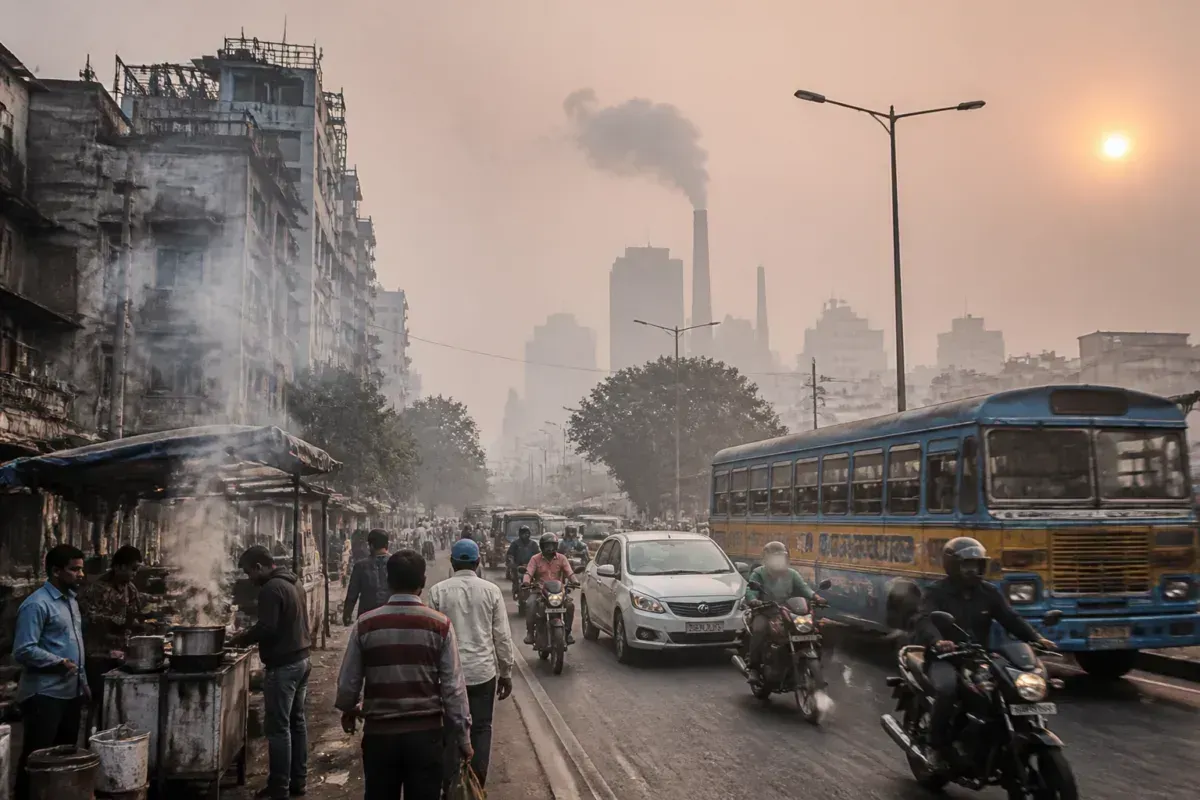
That combination matters for urban policy. Exposure does not occur through one source alone. It can come from cigarettes and bidis smoked by others, cooking with biomass fuel, incense sticks, mosquito coils, industrial dust and fine particulate pollution. These sources are governed by different institutions and rules. Tobacco restrictions involve public-health enforcement and local administration. Household fuel exposure is linked to cooking conditions and ventilation. Industrial emissions are regulated through environmental authorities. Ambient air quality is shaped by transport, construction, weather and the wider emissions profile of a city.
The result is a fragmented risk landscape in which residents may encounter several sources of smoke and particulate matter during the same day. The Times of India report says Bengal has among India’s highest reported secondhand-smoke exposure rates, citing National Family Health Survey-5 data. According to the figures quoted, 54.2% of women and 68.1% of men in the state report routine exposure to passive smoking in indoor or public environments. The figures do not establish how much exposure each person receives or identify the precise setting, but they indicate the scale of the public-health challenge described by the report.
The exposure is not distributed evenly. Oncologists cited in the report identify non-smoking women as a particularly affected group, linking this to household fuel smoke and passive smoking. The report also says that women in Kolkata are increasingly being diagnosed with lung cancer despite having no tobacco-use history. This does not mean every case has the same cause. It does show why an urban cancer-prevention strategy focused only on individual tobacco consumption would leave important exposure pathways unaddressed.
## The evidence points to multiple exposure pathways
The report cites lung cancer as accounting for approximately 14% of all cancer diagnoses in Bengal, compared with a national average of around 6%. It also attributes an estimate of 40% to 50% of regional lung-cancer cases among non-smokers to clinical observations across oncology centres, including Tata Medical Center and Chittaranjan National Cancer Institute, as cited by the Indian Cancer Society. These figures are presented in the report, but the underlying methodology, period of measurement and comparability between the regional and national estimates are not detailed in the supplied material.
That limitation is important. Cancer data can be affected by differences in diagnosis, referral patterns, hospital access, case definitions and the population being studied. The figures nevertheless provide a strong signal that non-smoking patients form a substantial part of the region’s lung-cancer burden. They also make the question of exposure more urgent for city authorities because many of the suspected sources lie outside a hospital’s control.
Doctors quoted in the report describe different but overlapping mechanisms. Ruby General Hospital oncologist Sanjoy Roy says passive smoke exposure has been associated in his clinical experience with faster cancerous growth among non-smoking women. He also identifies biomass smoke and environmental fumes as concerns. Pulmonologist Shyam Krishnan of CMRI Hospital points to prolonged exposure to fine particulate matter, particularly PM2.5, and says indoor sources such as cooking fumes, biomass fuel, incense sticks and mosquito coils can compound the problem where ventilation is poor.
The report also identifies occupational and neighbourhood exposure. Charnock Hospital pulmonology head Soumya Sengupta names workers in aluminium, metal-processing and cement plants, as well as people living close to such facilities, as potentially susceptible to lung problems because of fine particles and dust. These observations widen the policy question beyond outdoor air-quality readings. A city can record ambient pollution while failing to capture the exposure experienced inside homes, workshops, factories or poorly ventilated commercial premises.
At the same time, the medical evidence in the report is not uniform. Sengupta argues that particulate pollution may trigger chronic obstructive pulmonary disease or asthma but cannot cause cancer. Other doctors quoted in the article describe pollution as a major or increasingly important trigger and refer to chronic inflammation, DNA damage and cellular changes. Roy also points to genetic mutations and other factors. This disagreement should not be converted into a settled causal claim. It does, however, reinforce the need to distinguish between established tobacco risks, reported clinical observations and areas where further evidence is required.
## Enforcement is part of the urban health system
The oncologists’ calls for stricter tobacco controls include enforcing the rule against tobacco sales within 100 metres of educational institutions and prohibiting pan masala, according to the report. The recommendations place implementation at the centre of the discussion. A rule has limited public-health value if local enforcement is inconsistent, if violations are not monitored or if responsibility is divided between departments without effective coordination.
The same institutional problem appears in the debate over firecrackers. Doctors quoted in the report describe the Diwali period as a period of intense environmental smoke before winter, and call for restrictions on fume-emitting firecrackers. Roy specifically says certain light-emitting firecrackers release carcinogenic material that remains suspended in the air. The supplied report does not provide air-quality measurements, a citywide emissions assessment or an official response to the call for prohibition. It therefore establishes the doctors’ warning, not the scale of the resulting exposure or the likely effect of a specific restriction.
For municipal and state authorities, this creates a coordination challenge. Tobacco control, air-quality management, industrial regulation, hospital surveillance and public communication are usually handled through separate administrative channels. The report does not identify a single programme bringing these strands together. Nor does it establish whether cancer registries in Bengal routinely record patients’ exposure to passive smoke, biomass fuel, industrial dust or neighbourhood pollution in a consistent manner.
That information gap affects both prevention and accountability. Without reliable exposure histories, authorities may know that the number of non-smokers with lung cancer is rising but remain unable to compare risks across occupations, neighbourhoods, household conditions or pollution sources. Hospitals may document a patient’s tobacco history without having the tools to record years of indoor smoke, workplace dust or residence near an industrial facility. The absence of such information does not prove that those exposures caused a particular cancer, but it limits the city’s ability to understand patterns.
## What Kolkata’s experience reveals
The central urban issue is not simply whether pollution causes lung cancer in every exposed person. The evidence supplied in the report does not support that conclusion, and one of the quoted specialists directly disputes it. The broader issue is that residents can be exposed to several known or suspected respiratory hazards while the systems for measuring, regulating and communicating those hazards remain separate.
The report’s figures also show why non-smokers need to be included in public-health planning. Roy says around one-third of the lung-cancer patients he encounters have no tobacco-use history, while the report cites a regional estimate of 40% to 50% of cases among non-smokers. These are not presented as identical measurements, and they should not be treated as a single definitive statistic. Together, however, they indicate that tobacco-use history alone may not describe the full population at risk in regional oncology practice.
The risk is also connected to the built environment. Ventilation determines how long cooking fumes and indoor smoke remain in a home. The location of industrial plants affects nearby communities. Workplace design influences dust exposure. Street-level air quality is shaped by traffic, construction and other emissions. Public spaces and schools are relevant because tobacco controls depend on whether rules are visible and enforceable. These are urban planning and governance questions as much as clinical ones.
The source material does not provide a detailed prevention plan, a breakdown of cases by ward or occupation, or independent air-quality data for Kolkata during the Diwali period. It also does not resolve the medical disagreement over the causal role of particulate pollution. Those gaps should remain visible in any public discussion. What the report does establish is that doctors across several Kolkata institutions are observing a substantial burden among non-smokers and identifying passive smoke, household fuel use, industrial exposure and ambient pollution as important areas of concern.
The next stage of understanding will depend on better exposure data and clearer institutional responsibility. Until then, the evidence supports a broader cancer-prevention conversation—one that includes tobacco control but does not stop there. Kolkata’s challenge is to connect the places where people live, work and travel with the health information collected in hospitals, while avoiding claims that the current evidence cannot yet prove.