The United States is expected to lose its measles elimination status after 26 years. The Pan American Health Organization (PAHO) is expected to make an official announcement this week.
U.S. measles cases reached 5,412 in 2026, the highest total in 35 years, according to Centers for Disease Control and Prevention (CDC) data.
About 96% of this year’s measles cases were in people who were unvaccinated or had unknown vaccination status.
Two doses of the MMR vaccine are about 97% effective and offer the best protection against measles, according to the CDC.
The United States will likely lose its measles elimination status, a major public health achievement that was secured 26 years ago.
The Pan American Health Organization (PAHO), the World Health Organization’s (WHO) regional office for the Americas, determined that measles has spread continuously in the U.S. for more than 12 months. This marks the end of the country’s measles elimination status, which it has held since 2000.
Researchers familiar with the discussions told KFF Health News that the Pan American Health Organization (PAHO) determined this week that measles is once again spreading through sustained transmission within the country. PAHO is expected to make an official announcement on November 17.
PAHO’s review examined measles spread starting January 20, 2025, when the first person became ill in a large West Texas outbreak, according to the Centers for Disease Control and Prevention (CDC).
CDC data show 5,412 confirmed measles cases this year as of November 12. That’s the highest annual total since 1991 and more than double the 2025 count of 2,289 cases.
Andi Shane, MD, chief of pediatric infectious diseases at Children’s Healthcare of Atlanta, called the U.S. losing measles elimination status “a public health alarm that we are not being effective and we’re not controlling measles as well.”
The measles virus is highly contagious. It spreads through the air when an infected person coughs or sneezes. People can catch it in a room up to two hours after an infected person has left, according to the CDC.
“There’s really been very little measles in the United States over the past 25 years until January 2025,” William Moss, MD, a professor of epidemiology at the Johns Hopkins Bloomberg School of Public Health, told Healthline.
Losing the status itself doesn’t change much about daily life for most Americans, Moss said. The concern is the measles outbreaks, hospitalizations and deaths behind the loss, he said.
He called the loss “a big red flag” after “enormous efforts over the past 26 years” to keep the status.
A country loses its elimination status when there is “uninterrupted circulation of the same virus genotype and lineage for 12 months or more,” according to PAHO. Shane explained it this way: “For the past 12 months in the United States, we’ve had ongoing circulation of the measles virus and person-to-person transmission is occurring.”
Canada lost its elimination status in November 2025, and the U.K. and five European countries lost theirs earlier in 2026.
The U.S. can regain the status. “Other countries have done that,” Moss said. Brazil, which lost its status in 2019, regained it in November 2024. Venezuela, which lost its status in 2018, regained it in 2023, according to PAHO.
Before the measles vaccine, measles infected an estimated 3 million to 4 million Americans each year, according to the CDC. Among reported cases, about 400 to 500 people died each year, 48,000 needed hospital care, and 1,000 developed encephalitis, or brain swelling.
Here’s a timeline of measles elimination in the U.S.:
1954: Scientists isolate the measles virus during an outbreak in Boston (CDC).
1963: The U.S. licenses its first measles vaccine (CDC).
1968: An improved, more weakened live-virus vaccine goes into use. (CDC).
1971: The U.S. licenses the combined measles, mumps, and rubella (MMR) vaccine (CDC).
1978: The CDC sets a goal to eliminate measles by 1982. The country misses the deadline, though reported cases drop 80% between 1980 and 1981 (CDC).
1989: After outbreaks among vaccinated school-age children, national health groups recommend a second MMR dose for all children (CDC).
1994: The Vaccines for Children program, created by Congress in 1993, begins providing free vaccines to eligible children (CDC).
2000: The U.S. declares measles eliminated (CDC).
Jan. 20, 2025: The West Texas outbreak begins (CDC).
Nov. 2026: PAHO rules the U.S. has lost its elimination status.
Moss said elimination efforts “really intensified” after a large outbreak from 1989 to 1992. Part of that push was “really promoting school entry vaccination checks,” he said.
“That was one of the key policy changes that I think allowed for measles elimination in the United States.”
Every state and Washington, D.C., require children to be vaccinated against measles to attend school, though exemptions vary by state, according to the nonprofit health policy organization KFF.
Fewer kindergartners are getting the MMR vaccine, according to the CDC.
Kindergarten MMR coverage fell from 95.2% in the 2019–2020 school year to 92.4% in 2025–2026. About 280,000 kindergartners started the 2025–2026 school year without records showing they had completed the MMR series, the CDC reported.
Shane said “95 out of 100 people need to be protected against measles” for a community to get herd protection.
“So since we’ve been below that for many, many months, that is also contributing to the loss of our elimination status,” she said.
“It takes two things to have a measles outbreak,” Moss said. A community needs low vaccine coverage, and someone with measles has to enter it and “start the chain of transmission,” he said.
About 96% of this year’s cases were among people who were unvaccinated or had unknown vaccination status, up from 93% in 2025, according to the CDC.
Moss said many of those cases are adults.
“This is particularly true in Pennsylvania, where about two-thirds of the cases are in adults,” he said. Many never got vaccinated as kids and grew up while measles was rare, so they never built natural immunity, he said.
He noted that having so many unvaccinated adults puts pregnant people and adults with chronic conditions like lung disease at risk of serious illness. The U.S. has already seen “dozens of pregnant women actually getting infected during pregnancy,” he said.
Infected parents can also spread measles to young children and grandparents, Shane said. Shane traced much of the hesitancy to the pandemic. “With COVID there’s been an overall distrust in vaccines and vaccination that initially started with COVID but has now spread to other vaccines,” she said.
Moss pointed to the federal government. “We know what it takes to achieve and sustain elimination. We have the expertise. We have the resources,” he said.
He cited staff cuts at the CDC and said messaging from Health and Human Services Secretary Robert F. Kennedy Jr. and President Donald Trump has undermined vaccine confidence. He called federal messaging on vaccines “really mixed and weak.”
Moss also criticized the President’s August 10 executive order calling for the MMR vaccine to be split into separate shots for each disease.
“There’s no justification for that, and those vaccines don’t even exist in the United States,” he said.
Measles may cause ear infections, diarrhea, pneumonia, encephalitis and, in some cases, death, according to the CDC. The disease may also weaken the immune system for weeks to a year after recovery, raising the risk of flu, COVID-19, or RSV, Shane said. “It’s not a benign childhood disease,” Moss said.
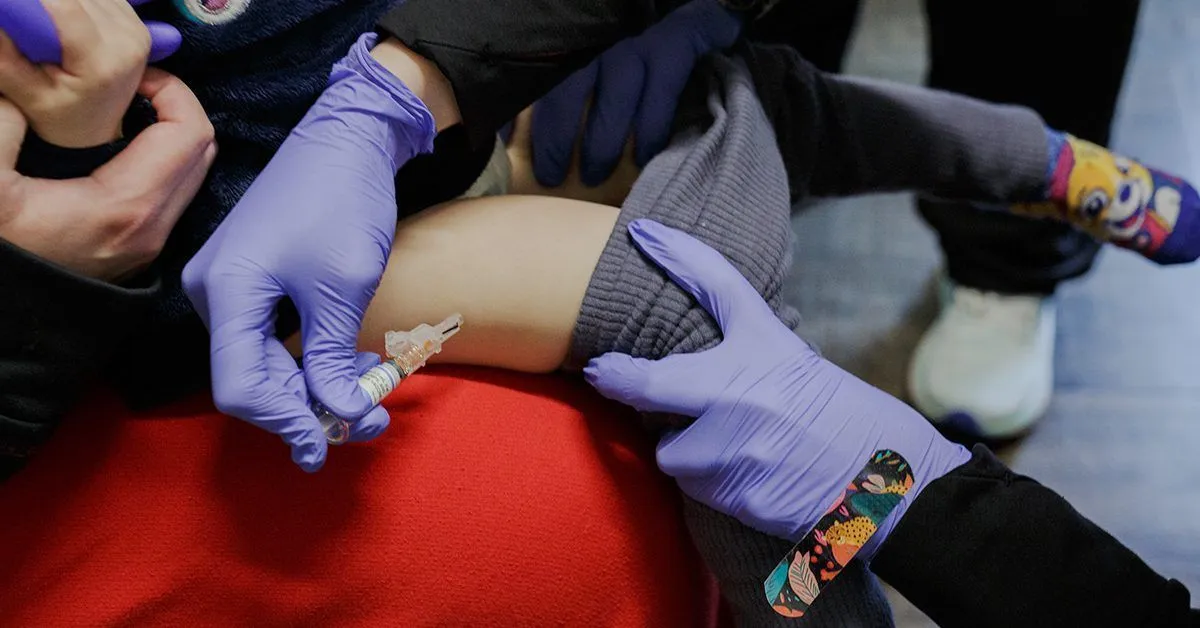
The best protection against measles is two doses of the MMR vaccine, which are about 97% effective, according to the CDC. Shane said, “There are not very many other things we do in life that give you such great protection.” People who missed doses can still catch up, she added. “If you just don’t know or can’t tell, there’s no harm — as long as you’re eligible — in getting another MMR vaccine.”
Shane added that “parents really want to do the right thing for their children.”
The CDC recommends a first MMR dose at 12 to 15 months and a second at 4 to 6 years. Babies 6 to 11 months old who will travel internationally should get an early dose, and adults without proof of immunity should get at least one dose, according to the CDC.
To stop the outbreaks, Moss said the U.S. will need to “increase vaccine coverage, particularly in those communities that have had long-standing low vaccine rates.”
So far, the response has been “more reactive than proactive,” Moss said. Public health teams scramble once an outbreak starts, he said, and he wants more outreach to at-risk communities before measles arrives.
“I am worried about the ability of the United States to regain measles elimination status in the current climate,” Moss said.