Pune’s dengue-prevention campaign found conditions favourable for mosquito breeding in 2,800 homes during October, with 3,582 containers containing contaminated water, according to a report by Sakal – Pune. The Pune Municipal Corporation (PMC) collected Rs 90,000 in fines and issued notices to 448 people, but the figures also reveal a larger urban challenge: dengue control depends on the municipal system reaching thousands of private properties and eliminating small, scattered water-holding sites before they become public-health risks.
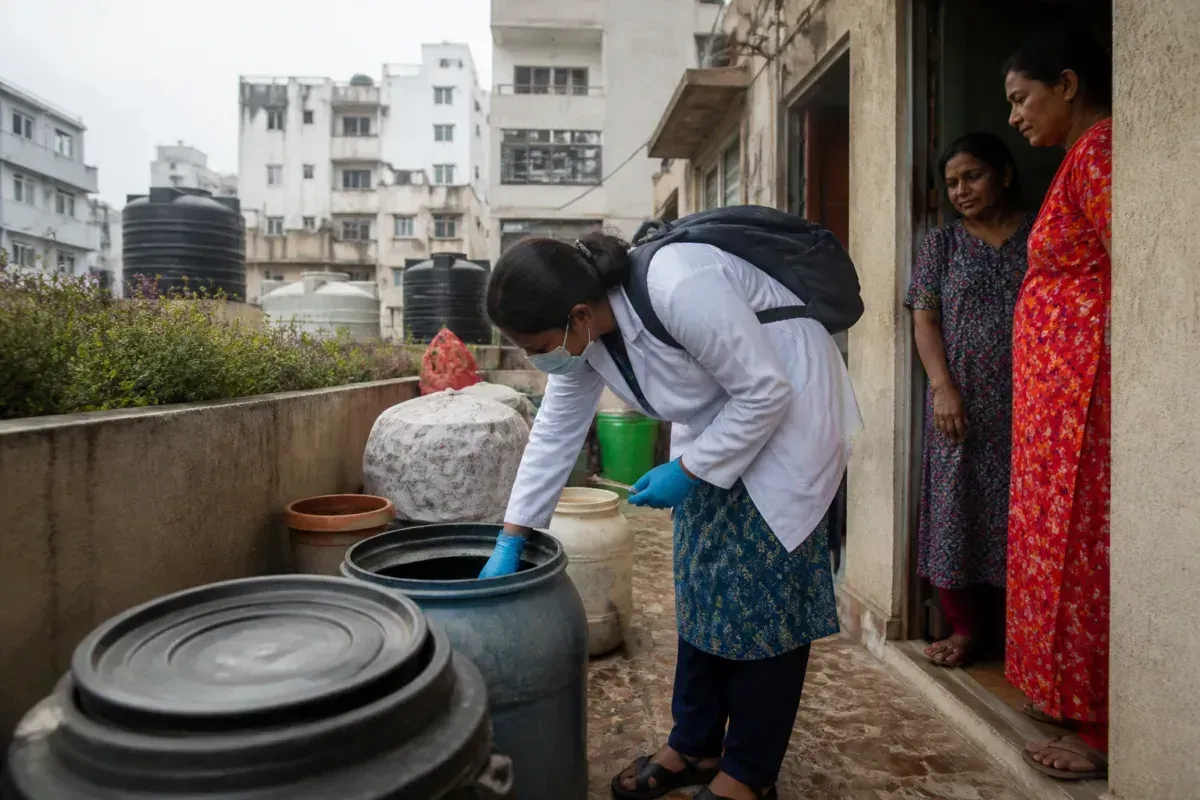
The PMC’s insect-control department carried out the October campaign across the limits of different regional offices. Its teams surveyed homes and inspected water tanks, flowerpots, vessels and other containers where stagnant water could support mosquito breeding. The operation was not limited to spraying. It combined property inspections, identification of breeding-friendly conditions, notices, fines and chemical interventions.
That combination matters because the locations identified in the report are largely embedded in ordinary urban life. Water tanks, pots, vessels and other containers are not unusual features of Pune’s housing stock. They are part of how households store water, maintain plants and use domestic spaces. The public-health task therefore extends beyond treating a visible outbreak. It requires repeated access to homes, identification of risks that may change after every rainfall or water-storage cycle, and cooperation from residents and property managers.
The reported numbers indicate the operational scale of the campaign. The PMC inspected 294,464 properties and 485,593 containers during October. On that count, the 2,800 homes where conditions favourable to mosquito breeding were found represented a small share of the properties inspected, while the 3,582 affected containers show how individual premises can contain multiple potential breeding points. The figures should not be read as a measure of dengue cases: the report concerns mosquito-breeding conditions and preventive action, not the number of people diagnosed with dengue.
This distinction is important for understanding what municipal surveillance can and cannot establish. A property inspection can identify stagnant or contaminated water and trigger corrective action. It does not, by itself, establish whether dengue transmission occurred at that location. The report supplied by Sakal – Pune does not provide a citywide dengue case total, a ward-wise breakdown of the 2,800 homes, or a comparison with October in an earlier year. It therefore documents the scale of preventive inspection rather than the full epidemiological position of Pune.
The enforcement figures show how the PMC is attempting to convert public-health advice into household-level compliance. The civic body issued 448 notices and collected Rs 90,000 in fines. Notices create a formal record that a property has been found with a condition considered relevant to mosquito control, while fines provide a financial penalty. Yet the difference between 2,800 homes with favourable breeding conditions and 448 notices also indicates that enforcement is not identical to detection. The available material does not explain the criteria used to decide which premises received notices or fines, whether the action was directed at owners, occupiers or institutions, or how many properties corrected the problem after inspection.
That missing administrative detail is central to evaluating the campaign. A civic inspection programme has at least three distinct stages: finding a potential breeding site, securing compliance and verifying that the site remains safe. The figures published for October clearly describe the first stage and some of the second. They do not establish whether the same properties were revisited, whether the 3,582 containers were emptied or treated, or whether repeat violations attracted stronger action. Without that follow-up information, the numbers demonstrate reach but not the durability of the intervention.
The PMC also reported extensive spraying activity. Smoke spraying was carried out in 73,360 homes and chemical spraying in 49,953 homes during October. These totals are considerably larger than the number of homes where favourable breeding conditions were identified, suggesting that spraying formed a broad preventive or control operation rather than being restricted only to the 2,800 affected properties. The supplied report does not specify the chemicals used, the precise areas covered, the frequency of repeat applications or the criteria for selecting homes for each type of spraying.
The scale of spraying also raises a question about how Pune balances source reduction with chemical control. Removing or managing stagnant water addresses the place where mosquitoes can breed. Spraying may help manage mosquito presence in targeted areas, but it does not replace the need to eliminate breeding sites that can recur in domestic and shared spaces. The report does not compare the outcomes of inspection, household correction and spraying, so it cannot establish which intervention produced the greatest reduction in risk. It does, however, show that the PMC is deploying both field surveillance and treatment across a large number of properties.
Institutionally, the campaign places the insect-control department at the intersection of municipal administration and household behaviour. The department must organise field teams through regional offices, maintain inspection coverage, record findings, issue notices and coordinate spraying. Residents, housing societies, landlords, commercial premises and other property users become part of the control system because many potential breeding points are located within or around buildings rather than on large public infrastructure. The effectiveness of the campaign therefore depends on a chain of responsibilities that extends from municipal officers to individual containers on private premises.
The report attributes the October figures to assistant health officer Dr Rajesh Dighe. That attribution gives the data an identifiable municipal source, while the report itself remains limited to the information released about the campaign. It does not identify the number of field workers involved, the cost of the operation, the number of properties in each regional office, or the share of inspections conducted in residential, commercial and institutional premises. These are not minor details when a city is trying to assess whether a campaign is evenly distributed or concentrated in particular localities.
Pune’s challenge is also one of continuity. Mosquito breeding conditions can be created by a relatively small amount of standing water, and domestic containers can be filled, neglected or emptied repeatedly. A campaign measured in monthly totals may therefore capture activity without showing how quickly conditions change. The October survey provides a snapshot of inspection and action during one month. It does not, in the material available, show whether the 2,800 affected homes formed a persistent cluster, were distributed across the city or were linked to particular types of housing and water storage.
That is why the most useful reading of the figures is not that fines or spraying alone have solved the problem. The evidence confirms that the PMC inspected nearly three lakh properties, checked nearly five lakh containers and identified thousands of locations requiring preventive attention. It also confirms that the civic response included formal notices, monetary penalties, smoke spraying and chemical spraying. What remains unclear is the outcome after these interventions and whether the campaign reduced repeat breeding conditions.
For citizens, the immediate urban issue is the condition of water-holding spaces within homes and buildings. For the municipal administration, the deeper issue is whether a large inspection drive can be converted into a reliable cycle of detection, correction and verification. The October figures show considerable administrative reach, but they do not yet provide the follow-up indicators needed to judge sustained impact. Future reporting would need ward-level data, repeat-inspection results, compliance records and dengue case information before the relationship between enforcement activity and disease control could be assessed more fully.