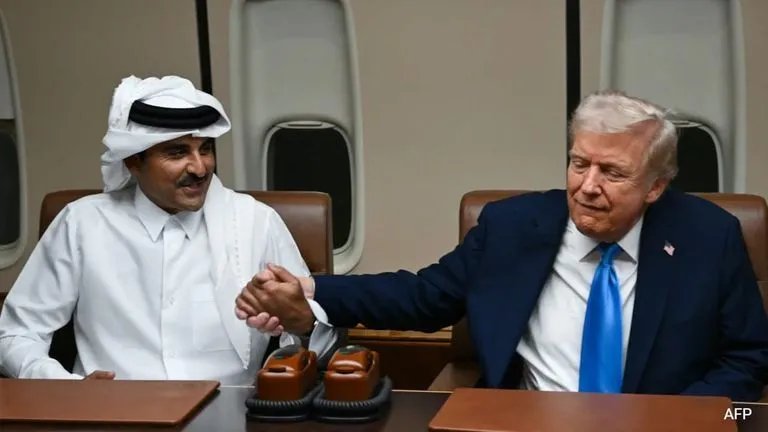
Israeli Prime Minister Benjamin Netanyahu’s office on Friday stopped short of denying US President Donald Trump’s announcement that Washington would completely end military assistance to Israel by the end of 2026.
Trump made the announcement on Tuesday, the day of the US midterm elections, saying the United States would stop providing Israel with $4 billion in annual military aid by the end of this year. The remarks reportedly caught Israeli security and financial officials off guard, as the existing US-Israel military assistance agreement runs until September 2028.
Under the current memorandum of understanding, Israel receives $3.8 billion annually in US military assistance.
Netanyahu has previously spoken about ending Israel's dependence on US military aid, but had outlined a gradual phase-out over the next decade rather than an immediate halt.
Dan Illouz, a lawmaker who recently left Prime Minister Benjamin Netanyahu's Likud party to join the opposition Yisrael Beytenu, has publicly criticised his new party leader, Avigdor Liberman, for signalling willingness to compromise on military conscription for ultra-Orthodox Jewish men, the Times of Israel reported. Illouz has suggested he could leave the party over the issue.
Illouz quit Likud over the advancement of legislation granting sweeping military service exemptions to most ultra-Orthodox men, a key demand of Haredi parties. He has maintained that there can be no compromise on the issue, stressing that “this was an explicit promise we gave voters before the election.”
Illouz is ranked 10th on Yisrael Beytenu's electoral list. The party won seven seats in last week's election, meaning he will not enter the next Knesset unless at least three of its lawmakers resign.
Some lawmakers could make way for replacements under the Norwegian Law, which allows ministers to resign from the Knesset and be replaced by candidates further down their party's electoral list. They can return to parliament if they leave their ministerial positions.
Yisrael Beytenu leader and Israeli opposition politician Avigdor Liberman has signalled a major shift in his long-standing position on military conscription for ultra-Orthodox Jewish men, saying he is willing to compromise on the issue to help form a government without Prime Minister Benjamin Netanyahu.
The announcement marks a departure from Liberman's years-long campaign against exemptions from compulsory military service for ultra-Orthodox Jewish men. He has repeatedly made the issue a key condition for joining governing coalitions.
However, with anti-Netanyahu parties struggling to secure a parliamentary majority following the 2026 election, Liberman has indicated that a compromise on military conscription may be necessary to prevent Netanyahu from retaining power.
Israel's anti-Netanyahu bloc is preparing a major legislative offensive to reverse key elements of Prime Minister Benjamin Netanyahu's judicial reforms before a new government is formed, the ynetnews reported. The campaign is expected to begin with an attempt to replace Knesset Speaker Amir Ohana when the newly elected parliament convenes on Tuesday.
The 26th Knesset is scheduled to be sworn in on November 10. Leaders of the anti-Netanyahu bloc, headed by Yashar! chairman Gadi Eisenkot, are holding intensive discussions on how to use their parliamentary strength to overturn legislation passed by Netanyahu's outgoing coalition.
The bloc's immediate priority is to replace Ohana, a senior member of Netanyahu's Likud party, with a candidate backed by opposition parties. Securing the Speaker's position would give the bloc greater control over the parliamentary agenda and help accelerate efforts to repeal laws that have already come into force or are scheduled to take effect in the coming months.
Prime Minister Benjamin Netanyahu called for the formation of a “broad government” led by him, saying a government dependent on parties that support terrorism would be unable to tackle the threat of radical Islam.
In a video statement, Netanyahu said that “A government dependent on terrorist-supporting parties will not be able to deal with the challenge of radical Islam that threatens us from within and without.”
"Only a broad national government headed by the Likud and under my leadership, which will include all components of the national bloc and all Zionist parties that wish to join, will be able to deal with this challenge,” he added.
-Inputs from Ynet Global
Ahmad Tibi, a senior member of Israel's Arab Joint List, has told The Associated Press that his bloc is prepared to break with decades of political precedent and cooperate with Jewish-led parties to end Prime Minister Benjamin Netanyahu's rule.
“We want to do things that we did not do in the past in order to remove this criminal government,” Tibi told The Associated Press.
Tibi said the Joint List was willing to support an anti-Netanyahu government without formally joining the coalition.
Only one Arab party, Ra'am, has previously served in an Israeli government, joining the coalition in 2021. Ra'am is considered more conciliatory than the Joint List and held fewer seats at the time.
Ra'am has also expressed willingness to join an anti-Netanyahu government as a coalition partner. However, any such arrangement would still require the support of the Joint List.
Tibi warned that if Jewish-led parties rejected such a partnership, it would prove that Israel was “an ethnocracy, not an absolute democracy for all citizens”.
He acknowledged that an alliance with Netanyahu's opponents would not necessarily end the wars or lead to the creation of a Palestinian state. However, he said a “repair government” could improve the lives of Palestinian citizens by ending Netanyahu's rule and addressing domestic concerns, including rising violent crime in Arab communities.
Meanwhile, Yashar leader Gadi Eisenkot has said that Arab-led parties must meet certain conditions to participate in a government partnership, including recognising Hamas as a terrorist group that must be destroyed.
Tibi said those conditions would not apply to parties such as the Joint List, which are offering support from outside the coalition rather than seeking cabinet positions.
During Israel's 2019 elections, Netanyahu, popularly known as Bibi, campaigned with the slogan “Bibi or Tibi?”, warning voters that opposing him could mean relying on Arab-led parties to form a government.
Tibi said on Tuesday that the latest election results had turned the slogan on its head.
“When he said ‘Bibi or Tibi,’ he incited against Arabs,” he said. “Now, it's ‘Tibi,’ because Arab voters went in a very massive way to take part in the elections. It's definitely our story this time.”
-Inputs from Associated Press
Benjamin Netanyahu, at risk of losing power, has seized on an investigation by election officials into possible vote tampering to cast doubt on the results, accusing Arab-led parties of stealing the vote. Critics accuse Netanyahu and his partners of trying to undermine the results, which he denies.
Israel's Central Election Committee said on Wednesday that the election's integrity had not been compromised. The head of the committee, Supreme Court Justice Noam Sohlberg, has called on Israel's elected officials to protect public trust, rather than shake it.
"This is a real danger. One of the foundations of democracy is the peaceful transfer of power," Sohlberg told Herzog at his residence on Wednesday. High voter turnout, including among the Arab minority, was a blessing, he said.
Netanyahu's allies on the far-right, including National Security Minister Itamar Ben-Gvir, have called for the immediate arrest and interrogation of Arab party leaders.
- Reuters
Israeli President Isaac Herzog will meet separately with Eisenkot and Netanyahu at his residence in Jerusalem on Thursday night, wrapping up party meetings he started on Wednesday after the announcement of official election results. Herzog has called on parties to do their utmost to avert another round of elections.
"Any reasonable person need only look at the security and diplomatic challenges before us, at the changing region around us, and remember the issues tearing us apart from within, to understand that an immense responsibility rests upon us," Herzog said.
He met with smaller factions on Wednesday and plans more meetings with parties in ascending order by size, culminating with Eisenkot's Yashar and Netanyahu's Likud.
Likud won the most seats of any single party with 27 in the 120-seat Knesset, but Netanyahu's wider religious-nationalist coalition garnered only 53 in total. (Reuters)
The race to form a new government in Israel has entered its next phase after the country’s Central Election Committee certified the October 27 general election results and submitted them to President Isaac Herzog after the commission found no evidence of fraud, as claimed by Prime Minister Benjamin Netanyahu’s Likud party in an effort to discredit the vote.
The general election results were submitted to the president on Wednesday, who has accepted them and is now poised to hold consultations for two days with leaders of the blocs before choosing the candidate who has the clearest path to form a government.
The development comes after the Netanyahu-led bloc won 53 seats; his rival Gadi Eisenkot’s opposition bloc got 48 seats, and Arab-led parties recorded 19 seats in the 120-member Knesset.
Reports stated that a round of consultations has begun at the president’s office, and Yesh Party chief Eisenkot is expected to present a higher number of recommendations than Netanyahu.
The Change bloc, which together holds 48 seats, is due to recommend Eisenkot as the candidate to form the next government, while Netanyahu is expected to win four of the five parties that ran alongside him in the elections, which have 46 seats altogether.
Read full story here
Knesset Speaker and Prime Minister Benjamin Netanyahu ally, Amir Ohana, said on Thursday that he is ready to schedule a discussion to elect his successor if a majority of lawmakers request a new speaker, in response to Yisrael Beytenu and the Democrats' demands that an election be held to replace the Knesset speaker at the inaugural session of the 26th Knesset.
"The customary time to elect a Knesset speaker is when the government is formed. We will respect the members of Knesset, and if a majority of them request such a debate, I will schedule it for an earlier date, no later than a week from now," Ohana, a member of PM Benjamin Netanyahu's party, said, according to The Times of Israel.
A veteran Arab lawmaker in Israel says his bloc is willing to break with decades of precedent and join forces with Jewish-led parties in a shared bid to end Prime Minister Benjamin Netanyahu's long rule.
"We want to do things that we did not do in the past in order to remove this criminal government," Ahmad Tibi, a senior member of the Arab Joint List, told The Associated Press.
But any such partnership could be politically fraught for both sides. For the Joint List, it would mean backing a government unlikely to end Israel's wars or curb settlement expansion in the occupied West Bank. For Netanyahu's opponents, it would mean aligning with parties that not only criticise Israeli policies, but reject its identity as a Jewish state.
After historic voter turnout delivered Arab-led parties a record share in Israel's parliament, Tibi said the Joint List is willing to support an anti-Netanyahu government without joining it. That could reassure Jewish-led factions that view them with suspicion and satisfy their own constituents. It would still give the Joint List major influence. (AP)
Palestinian Authority Foreign Minister Varsen Aghabekian was quoted as saying by Times of Israel that the PA would be willing to work with Yashar chair Gadi Eisenkot if he forms a government, provided he respects Palestinian rights.
Asked in an interview with the Saudi Al Hadath channel whether the PA could work with Eisenkot, Aghabekian says: “We can work with anyone who sees a Palestinian as a Palestinian who has rights, and who respects Palestinian rights and international law.”
“These are essential characteristics of any partner with whom we can enter into discussions about the future of the region and the future of the conflict and the occupation,” she says. “We want to see a partner who envisions a future for this region with peace, not wars.”
The political deadlock in Israel after the October 27 parliamentary elections continues as the question of who will emerge as the leader lingers, while the opposition leaders agreed in a meeting on Tuesday to back Prime Minister Benjamin Netanyahu’s rival and former military chief, Gadi Eisenkot, to form a new government and remained divided over Arab-led parties’ cooperation.
During a 70-minute meeting in Israel’s Herzliya, the first since the election last month, the five party heads, Yashar’s Eisenkot, Beyachad’s Naftali Bennett, Atid’s Yair Lapid, Democrats’ Yair Golan and Beytenu’s Avigdor Liberman agreed to immediately coordinate efforts in order to replace the Netanyahu-led government with a national emergency government, Al Jazeera reported. The Israeli election results left neither bloc with a majority in the 120-member Knesset. Eisenkot-led bloc won 48 seats in the election.
Read the full story here.
Oil prices fell for a fourth day on Thursday on expectations the losses US President Donald Trump's Republican Party suffered in Congressional elections this week may reduce the risk of further escalation of the US-Israeli war on Iran.
Brent futures fell 80 cents, or 0.85% to $93.82 a barrel as of 0426 GMT, while US West Texas Intermediate crude futures were down $1.2, or 1.36%, to $86.92.
Both benchmarks tumbled by more than 8% in the previous session to settle at their lowest since August 31.
A weakened Trump, facing a Democratic Congress able to constrain his military options, has greater incentive to seek a deal, two sources close to Gulf government circles said on Wednesday. A full-scale assault on Iran now looks less likely, they said.
A veteran Arab lawmaker in Israel says his bloc is willing to break with decades of precedent and join forces with Jewish-led parties in a shared bid to end Prime Minister Benjamin Netanyahu's long rule.
"We want to do things that we did not do in the past to remove this criminal government," Ahmad Tibi, a senior member of the Arab Joint List, told The Associated Press (AP).
But any such partnership could be politically fraught for both sides. For the Joint List, it would mean backing a government unlikely to end Israel's wars or curb settlement expansion in the occupied West Bank. For Netanyahu's opponents, it would mean aligning with parties that not only criticise Israeli policies, but reject its identity as a Jewish state.
Israeli President Isaac Herzog began consultations with party leaders on Wednesday to decide who gets the first shot at forming a government, following last week’s inconclusive election.
Over two days, politicians will meet Herzog at the president’s residence in Jerusalem. Each will argue that the mandate should go to Prime Minister Benjamin Netanyahu, his main challenger Gadi Eisenkot, or another candidate.
Herzog’s first meeting on Wednesday afternoon was with the far-right Religious Zionism party, led by Finance Minister Bezalel Smotrich. He then spoke with Avigdor Liberman’s right-wing Yisrael Beiteinu and the ultra-Orthodox Shas party. Parts of the talks were livestreamed.
Herzog urged the parties to soften some of their election demands to help end the political deadlock. With no clear winner, he said before the meetings, the country needs creativity, courage and goodwill from its politicians so that Israel as a whole comes out ahead, The New York Times reported.
US President Donald Trump has said Washington will stop providing nearly $4 billion in annual military assistance to Israel by the end of 2026, claiming that the country no longer needs the money. In a Fox News interview on November 3 (Tuesday), as Americans voted in the midterm elections, Trump said he had reached an agreement with Israeli Prime Minister Benjamin Netanyahu to end the funding. The US would still sell weapons to its Middle East ally and help them when needed, Trump said.
The announcement on the face of it sounds momentous, coming specially from a US President who is a steadfast Israel backer. But Trump offered no details on how the cutoff would be implemented, and the existing US-Israel military aid agreement runs until September 2028.
The race to form a new government in Israel has entered its next phase after the country’s Central Election Committee certified the October 27 general election results and submitted them to President Isaac Herzog after the commission found no evidence of fraud, as claimed by Prime Minister Benjamin Netanyahu’s Likud party in an effort to discredit the vote.
The general election results were submitted to the president on Wednesday, who has accepted them and is now poised to hold consultations for two days with leaders of the blocs before choosing the candidate who has the clearest path to form a government. The development comes after the Netanyahu-led bloc won 53 seats; his rival Gadi Eisenkot’s opposition bloc got 48 seats, and Arab-led parties recorded 19 seats in the 120-member Knesset.
Herzog to hold consultations with party leaders
Reports stated that a round of consultations has begun at the president’s office, and Yesh Party chief Eisenkot is expected to present a higher number of recommendations than Netanyahu. Read more
The race to form a new government in Israel has entered its next phase after the country’s Central Election Committee certified the October 27 general election results and submitted them to President Isaac Herzog after the commission found no evidence of fraud, as claimed by Prime Minister Benjamin Netanyahu’s Likud party in an effort to discredit the vote.
The general election results were submitted to the president on Wednesday, who has accepted them and is now poised to hold consultations for two days with leaders of the blocs before choosing the candidate who has the clearest path to form a government. The development comes after the Netanyahu-led bloc won 53 seats; his rival Gadi Eisenkot’s opposition bloc got 48 seats, and Arab-led parties recorded 19 seats in the 120-member Knesset.