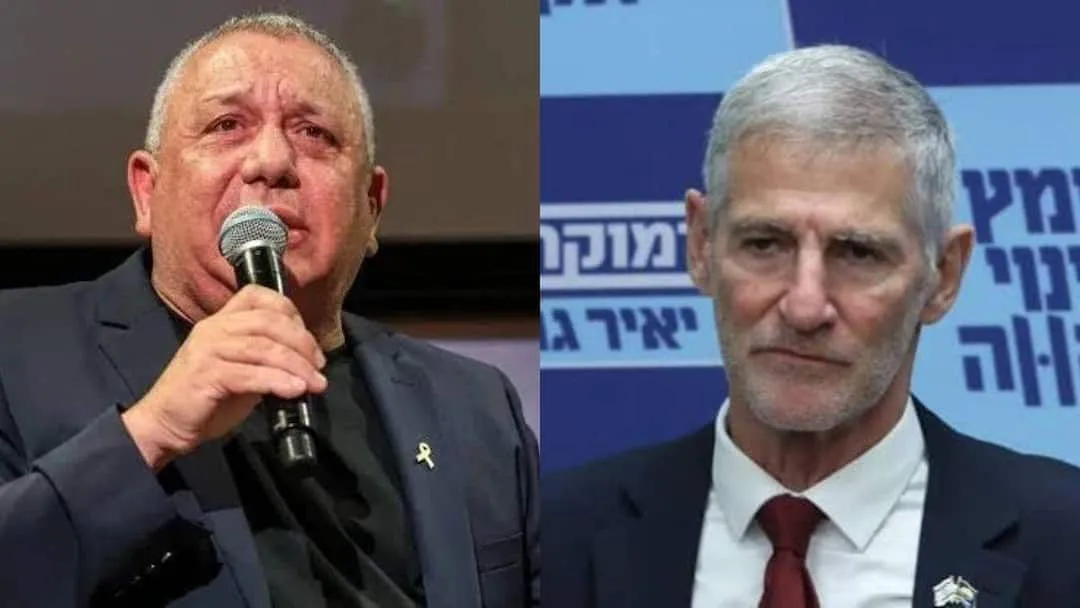
Tensions and mutual suspicion are emerging within the Gadi Eisenkot-led bloc over efforts to form a government, with sources questioning whether Democrats party leader Yair Golan and former prime minister Naftali Bennett are genuinely committed to forming a coalition with the haredi parties.
Sources within the bloc have raised doubts about Golan's willingness to pursue a 61-seat government that includes the ultra-Orthodox parties. According to them, Golan clearly favours a minority government backed by the Joint List and Ra'am and has little interest in forming a coalition with the haredi parties.
The sources maintain that Golan is not simply keeping both possibilities open but is leaning decisively towards the minority government option.
Against this backdrop, they view the liberal legislation on religion and state introduced by the Democrats as a reflection of the party's actual ideological position. In their assessment, the bills are not merely symbolic gestures, attempts to appeal to voters or tools to pressure the haredi parties.
The disagreement is emerging as one of the first major points of contention within the Eisenkot-led bloc.
Questions Raised Over Bennett's Coalition Intentions
Bennett's conduct has also become a source of suspicion within the bloc. His faction did not hold a meeting open to the media and instead issued a brief statement without taking questions from journalists. Bennett himself has continued to maintain a low media profile.
Sources within the bloc have questioned whether Bennett is genuinely interested in forming a government or believes that another election could improve his political standing.
According to them, his position on equal participation in military service, along with the anti-draft-evasion messages he emphasised during his campaign, could work to his advantage if another election is held.
Statements by members of Bennett's electoral list about their willingness to advance military conscription legislation have further fuelled these concerns.
Closed-door discussions within the bloc have also highlighted apprehensions that prospective coalition partners may not share a common vision for forming a government or agree on the compromises needed to make it happen.
Haredi Parties Place Greater Trust In Liberman
Meanwhile, the haredi parties increasingly believe that the negotiations are unlikely to produce the agreements needed to form a government.
Haredi sources maintain that their willingness to engage with the Eisenkot-led bloc is genuine and that they remain open to considering proposals. They insist they have neither ruled out the bloc nor entered the discussions as part of a political manoeuvre.
However, they believe the chances of reaching an agreement remain slim because of several areas of disagreement.
At a faction meeting, Avigdor Liberman clarified that Eisenkot's negotiating team was conducting the talks. He said he fully supported Eisenkot, remained in coordination with him and met him regularly, but was not personally negotiating with the haredi parties.
Despite this clarification, several haredi sources told Maariv that they trust Liberman and believe he could reach an understanding with them. Their confidence in Liberman, they said, is considerably greater than their trust in Eisenkot and his negotiating team.