Advertisement
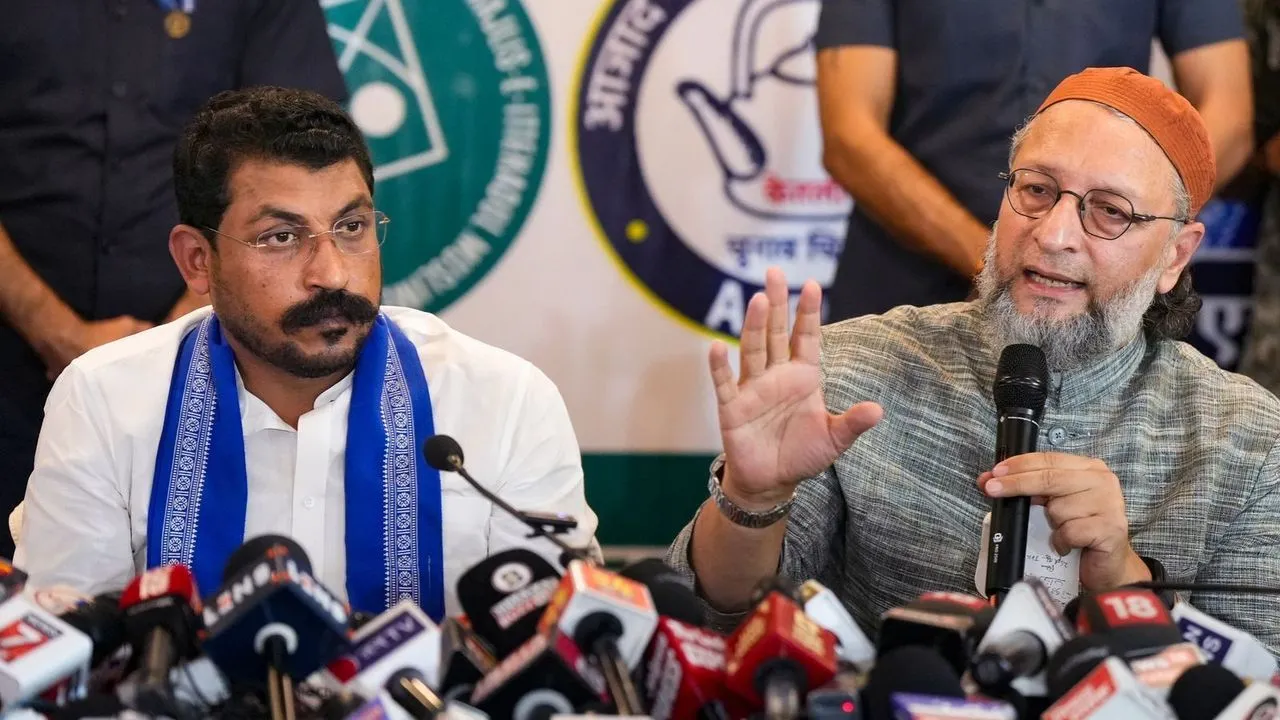
Aazad said the alliance should not be viewed by bigger Opposition parties such as the SP and the Congress as the BJP’s B-team, a charge often levelled at the AIMIM in the past. “If contesting elections independently makes a party the BJP’s B team, why did the Samajwadi Party contest 70 seats in Madhya Pradesh, 54 in Uttarakhand and 20 in Jammu?” he asked. Aazad questioned why the Congress and the Trinamool Congress contested against each other in West Bengal, and why the Congress and the AAP fought separately in Delhi and Haryana.
“I can say with confidence that this will be a strong alternative in Uttar Pradesh to stop the BJP from coming to power for the third time,” Owaisi said, adding that the alliance would focus on issues concerning the backward and Dalit communities, the oppressed and marginalised sections, irrespective of their caste. He alleged that political parties had so far used these communities merely as vote banks. The new front would raise issues such as the deteriorating condition of education, unemployment among the state’s youth, and farmers’ problems, said the AIMIM chief.
“I am happy to announce that our brother Chandrashekhar Aazad will be the chief president of the SPM and its chief ministerial candidate in Uttar Pradesh,” Owaisi said.
Sources in both parties said the seat-sharing arrangement would be announced after the November 26 rally and that the parties might exchange seats based on local caste and community equations.
No bigger alternative than PDA: Akhilesh
Responding to Aazad’s remarks, SP president Akhilesh Yadav welcomed the alliance, but added the caveat that “real success will come only when the ‘Political Change Front’ is active”.
The SP chief said a genuine political coalition against the BJP could cost the ruling party “another 2-3%” of votes and leave it “with virtually nothing”. But he emphasised it could only happen if such a coalition was a genuine one.
“The public understands those whose sole purpose is to create a political buzz through mere words and statements,” Akhilesh wrote in a post on X. “The truth is that such fronts strengthen democracy further, provided they are driven by a genuine intention to work for the welfare of their own community and not by some third party’s sinister agenda. If someone ends up becoming a political puppet, the electorate can even ensure that they forfeit their election deposit. Hopefully, the practice of political parties claiming a monopoly over communities’ votes will come to an end, and everyone will work sincerely for the interests of their respective communities.”
Extending his best wishes to the new front, the SP chief said people who seek a change in government would turn to whoever has the larger core vote and that there was simply no alternative bigger than his party’s ‘PDA’” coalition, referring to the Pichhda (Backward), Dalit, Alpsankhyak (minorities) social groups that the SP is trying to bind together.
Congress watchful
Apart from the combined strength of Dalits and Muslims — who account for around 21% and 19% of Uttar Pradesh’s population, respectively — the alliance hopes to draw the support of the Other Backward Classes (OBCs) and other marginalised communities to build a broader social coalition. If the alliance gains traction, it could potentially harm the SP, which is also banking on its PDA strategy to expand its social reach and unseat the BJP from power.
The success of Mayawati-led Bahujan Samaj Party’s (BSP) in 2007 is the template before the Social Change Front. “With the consolidation of Dalits and Muslims, and additional support from OBCs and Brahmins, the BSP had formed a government in 2007. If a majority of both communities come together, OBCs will also support us, and that will bring this alliance to power. Even if the alliance fails to get that support, it will still dent the votes of the SP-Congress alliance and the BSP,” said an AIMIM leader.
Dismissing the new front, SP spokesperson Faizan Kidwai said people from all sections “had made up their mind to support Akhilesh” and that “people are aware that Owaisi has an understanding with the BJP”.
A senior Congress leader, however, said the alliance could not be dismissed as just another pre-election formation. “We have been closely watching Aazad’s rallies. While Owaisi is trying to create a narrative by pointing out how INDIA bloc partners do not give Muslims adequate political space, Aazad has been attracting crowds. Together, they will certainly draw attention. Sometimes in politics, people contest to win, while others contest to spoil the game. Only time will tell,” the leader said.
Congress working president Imran Masood said political alliances were a matter of democratic choice. “In a democracy, everyone is free to form an alliance. Whoever is coming together is free to do so. We will assess the situation and work according to our own strategy,” he said.
BJP leaders said the alliance could work in their party’s favour. “Owaisi, in his speeches in Uttar Pradesh, is raising issues concerning Muslims, while Aazad is focusing on Dalits and Muslims. If the AIMIM-ASP (K) alliance succeeds in splitting the Muslim vote, and non-Jatav Dalit votes that shifted from the BJP to the SP-Congress alliance in the 2024 Lok Sabha elections move towards it, the INDIA bloc would be weakened,” he said.
Since launching the AIMIM’s campaign with a rally in Matera, Bahraich, on June 14, Owaisi has addressed eight more public meetings across the state in constituencies with sizable Muslim populations and which the SP had won in 2022. The AIMIM chief has been urging Muslims to “stop looking towards a Gandhi or a Yadav” for political leadership, arguing that AIMIM offers them an opportunity to become leaders themselves.
AIMIM’s ambitions and past results
The AIMIM has made efforts to stitch together alliances with parties representing Dalit-Bahujan interests in the past too.
Aazad and Owaisi teamed up for the first time in the Bihar Assembly elections last year, along with OBC leader Swami Prasad Maurya’s Apni Janata Party. The AIMIM contested 28 seats and won five, securing 15.24% of the votes. The Azad Samaj Party (Kanshi Ram), which fielded candidates in 18 seats, failed to win any and forfeited deposits in all of them, polling 2.68% of the votes.
In the 2022 UP elections, the AIMIM had allied with the Bhagidari Parivartan Morcha, which consisted of the Jan Adhikar Party led by former minister Babu Singh Kushwaha and the Bhartiya Mukti Morcha headed by Waman Meshram. The alliance failed to win a single seat. The AIMIM had contested 95 constituencies, securing around 2% of the votes and losing the deposit in every seat.
In 2019, Owaisi had allied in Maharashtra with the Vanchit Bahujan Aghadi led by Dr B R Ambedkar’s grandson Prakash Ambedkar, but it failed to leave an impact. “The AIMIM’s philosophy is to represent downtrodden people. This includes Muslims. We are not a Muslim party or a party that represents Muslims alone,” a senior AIMIM leader said.