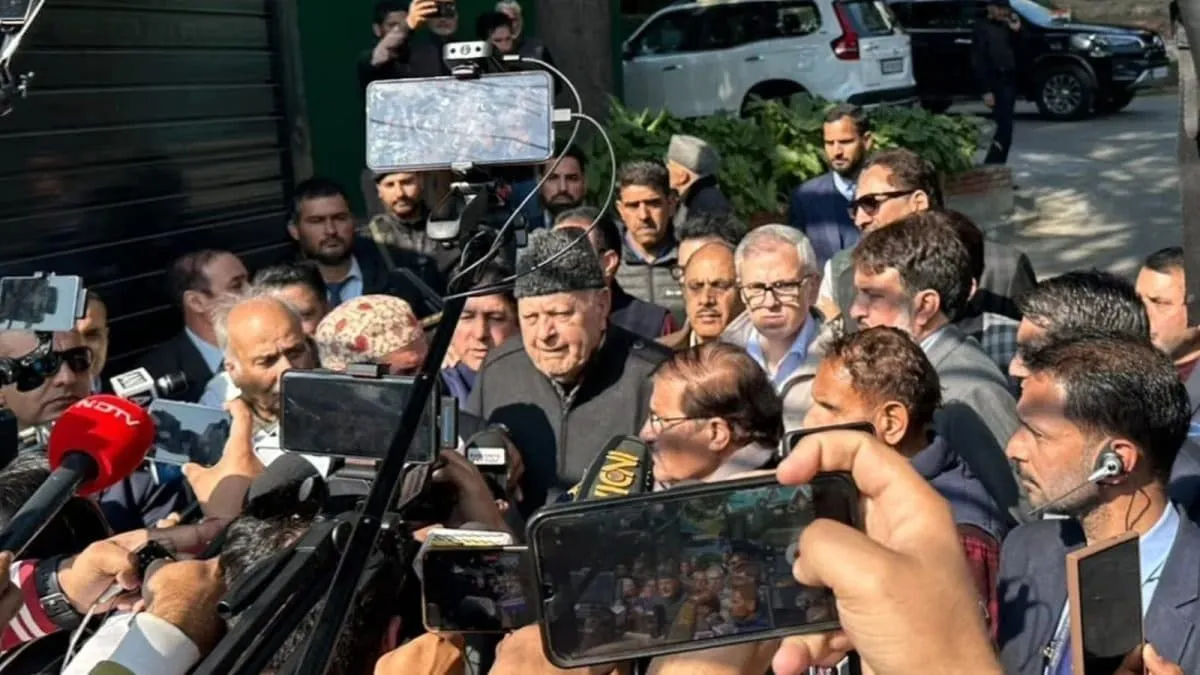
The NC witnessed something it had not seen in 42 years – its own MLAs openly challenging its leadership, questioning their decisions, and targeting the CM's closest aide by name
When National Conference president Farooq Abdullah stood flanked by the dissident MLAs at his Gupkar residence on Friday (November 6) and declared that there is no rift in the party, the cameras captured smiles, handshakes and unity.
But inside the meeting room, for more than two hours, the NC witnessed something it had not seen in 42 years – its own MLAs openly challenging its leadership, questioning their decisions, and targeting the chief minister’s closest aide by name.
Those who were present described the meeting not as a reconciliation, but as a temporary ceasefire. A pause in a battle that is far from over.
The crisis, which had been building over a sufficient period of time, exploded after last month’s cabinet expansion when the ruling NC inducted four new members. It was the first expansion since the party returned to power after the 2024 assembly elections.
More than a dozen MLAs felt ignored, sidelined and humiliated. They began holding separate meetings over the past few days to chalk out a course of action. By Friday, at least 15 out of the 25 disgruntled MLAs had arrived at Gupkar Road to meet Farooq Abdullah and Chief Minister Omar Abdullah.
What they said inside shocked even senior leaders. The target: Nasir Aslam Wani.
The sharpest and most repeated attack was not on a policy, but on a person – adviser to the chief minister, Nasir Aslam Wani. Again and again, MLAs raised his name.
Their complaint was blunt: a man who had lost the 2024 election was now taking all the important decisions of the Omar Abdullah government. They alleged that access to the chief minister had become difficult, files moved only through Wani, and elected representatives were being treated as outsiders in their own government.
For the dissidents, Wani had become a symbol of everything wrong – a coterie culture, a disconnect between the government and the MLAs, and a disregard for the mandate that the legislators had brought from their constituencies.
According to sources privy to the meeting, the frequent targeting of Wani deeply irked Omar Abdullah. They construed the criticism of his adviser and his cabinet ministers as a direct question on his own leadership.
At one point, Omar offered to resign. Not once, but several times during the meeting and was described as adamant about his decision. He walked out of the meeting at least thrice before being persuaded by the MLAs to return.
The message from Omar was emotional and political at the same time: if you do not trust my team, you do not trust me. If you do not trust me, I have no moral right to continue. The MLAs, however, refused to accept his offer and insisted they were not against him but the system that had developed around him.
WHAT DID THE LEADERSHIP SAY?
While Farooq Abdullah tried to play the role of a mediator, the leadership also delivered a stern rebuke to the dissidents.
The MLAs were told in clear terms that holding separate meetings and leaking their grievances to the media had spread a wrong message. It had created an impression that the NC was divided, on the verge of a split, and unable to govern.
Farooq reminded them that the party was fighting a larger battle – restoration of statehood and Article 370 – and internal bickering would only weaken that fight. The leadership warned that such parallel groupings would not be tolerated in future.
At the same time, he, in a careful balancing act, termed the MLAs’ demands as “genuine". He acknowledged that their pain was real, that they had waited patiently, and that their concerns about governance needed to be addressed.
It was classic Farooq – one hand scolding, the other hand soothing.
WHAT CAME OUT OF THE MEETING
After two hours of heated arguments, the meeting ended with a set of confidence-building measures but without resolving the core demands.
The rebels’ key demands – replacing all eight ministers, including deputy CM Surinder Choudhary, and removing Wani – remained unresolved.
What was agreed instead was procedural: setting up consultative committees of MLAs for each cabinet minister, and a separate manifesto committee to monitor the implementation of the party’s election promises, including the restoration of J&K’s special status.
The leadership also reportedly agreed to consider a cabinet reshuffle within a year. For the MLAs, it was something, but not enough.
Outside, Bijbehara MLA Bashir Ahmad Veeri described the meeting as fruitful and said some measures will be implemented soon, while others will be taken up gradually. Farooq told the media that reports of division were completely wrong. But inside, the mood was different.
SO, WHAT NEXT?
After the meeting, several dissidents privately admitted that this was only a temporary ceasefire. They said they will wait for some time, but not longer.
They said their patience has a limit. If the consultative committees remain on paper, if Wani continues to dominate decision-making, and if the promised reshuffle does not happen, they will return and, more aggressively.
This is why the meeting is being described as historic. It is the first time in 42 years that NC leadership has come under such a direct attack from its own party MLAs.
For four decades, the party was known for its iron discipline. Differences, if any, were settled behind closed doors at Gupkar, not in press conferences or separate group meetings. The Abdullah family’s word was final, but that tradition broke on Friday.
The timing makes it even more significant. The crisis comes at a moment when the party is already under pressure over the resignation of MP Aga Ruhullah Mehdi, which was accepted by the Speaker, and growing public impatience over the slow pace of statehood restoration.
For Omar, the challenge is now two-fold: to run a government, and to keep his flock together. He has managed to avert an immediate split, but he has not yet won back the full trust of his MLAs.