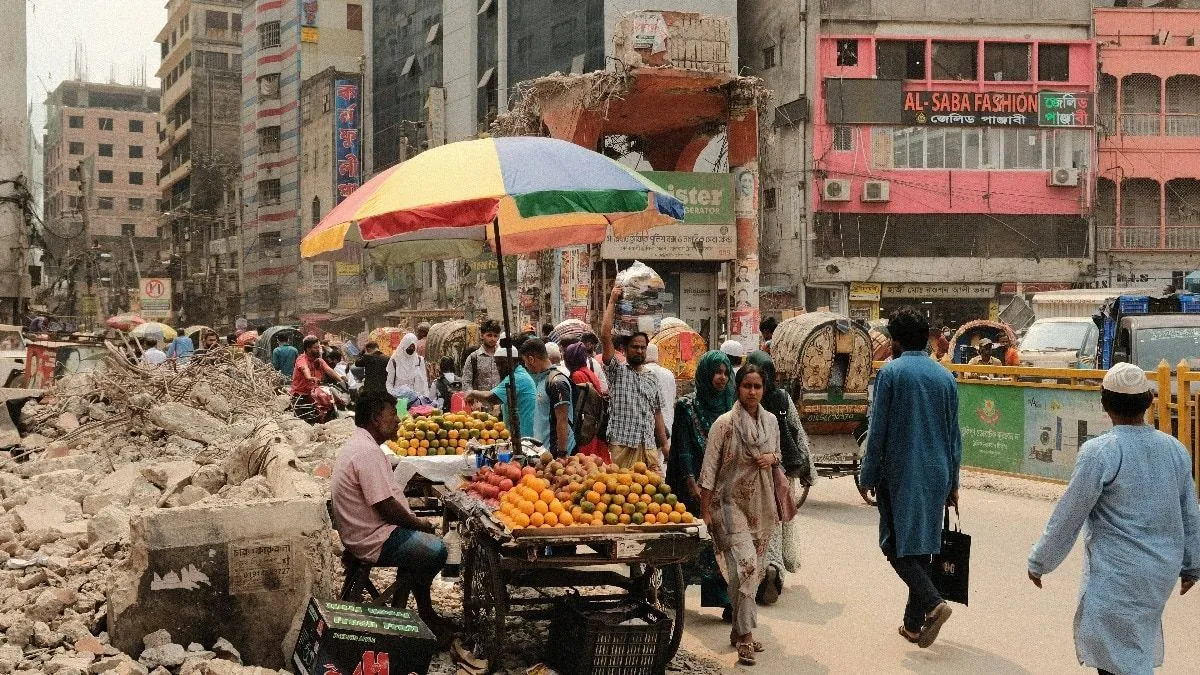
Around 150 Chinese vloggers have descended upon Dhaka, with many of them livestreaming and passing off footage shot in Bangladesh's impoverished neighbourhoods as scenes from New Delhi, portraying the poor living conditions of residents as representative of India to audiences in China. An investigation by Dhaka-based outlet Prothom Alo revealed a pattern in the content of the Chinese vloggers.
According to an investigation published on November 6 by Prothom Alo, Chinese nationals have been filming in the narrow lanes of Tekpara and Uttara, neighbourhoods in the Bangladeshi capital, and livestreaming the footage on Chinese social media platforms while claiming that they were broadcasting from India's capital, New Delhi.
In May, another Dhaka-based outlet, The Business Standard, also documented Chinese vloggers filming in low-income neighbourhoods like Dhaka's Tekpara.
One Chinese national identified as 'Mianmian', who said she was from China's Sichuan province, was seen livestreaming beside a canal in Uttara's Sector 12 on November 1. While showing viewers the neighbourhood, she introduced it as New Delhi, and described its homes as dirty, underdeveloped and unhygienic, reported Prothom Alo.
Another Chinese national, filming at tea stalls at Tekpara, said in his livestream that the tea being drunk by the locals was made from "cow urine".
The videos feature disparaging descriptions of residents' living conditions, with allegations about poor hygiene, sanitation and claims about Indian lifestyles.
Foreign audiences, especially those from the west, have long held a fascination with poverty in South Asia, particularly in India. This is evident from the numerous documentaries exploring the country's informal settlements and the steady stream of foreign tourists visiting its slums on guided tours.
However, the recent trend of Chinese vloggers passing off footage of Dhaka's most impoverished neighbourhoods as scenes from New Delhi, while making disparaging remarks about the living conditions and lifestyles of Indians, raises a more troubling question: could this be part of a wider disinformation campaign aimed at shaping perceptions of India among Chinese audiences? In July, a report by the Dhaka-based outlet, Kaler Kontho, had quoted one such streamer as saying that the filming was part of a product promotion campaign being made for Chinese audiences.
Though the Chinese economy is bigger than India's, the Indian economy is the fastest-growing in the world. India is also trying to woo manufacturers with bases in China.
FOOTAGE FROM DHAKA PASSED OFF AS BEING FROM NEW DELHI
Prothom Alo's investigation examined the livestream commentary of Chinese nationals filming in Uttara's Sector 12 and adjoining Tekpara. The newspaper translated the commentary using Google Translate and verified the translations with four Bangladeshis familiar with Chinese.
'Mianmian', one of the Chinese live streamers identified by Prothom Alo, who was was seen livestreaming in Uttara, introduced the area as a part of New Delhi and described its homes as dirty, underdeveloped and unhygienic.
"This is New Delhi. Their homes are extremely dirty. There isn't even a fan inside the tin-roofed houses. This place is quite underdeveloped, dirty and unhygienic, and the law-and-order situation is poor," Prothom Alo quoted her as saying.
Another Chinese national, identified as 'Wang Wei', seen filming tea stalls at Tekpara, told viewers that the tea being consumed by locals was made from "cow urine" and dirty river water.
"Look, they are drinking tea. Do you know what kind of tea this is? This is cow urine tea. They drink cow urine tea," Prothom Alo quoted the streamer as saying.
Some Chinese women livestreaming from the area also claimed that they lived there with their husbands and families because they had married in India, Prothom Alo reported.
The investigation found that the Chinese nationals were livestreaming on platforms such as WeChat and Douyin, China's version of TikTok. One Chinese national, identified as 'Fangyou', told the newspaper that the broadcasts were part of product-promotion activities but refused to answer further questions about why the neighbourhood had been selected.
A PATTERN OF FILMING POOR NEIGHBOURHOODS
The activity is not limited to isolated livestreams. An earlier report by the Dhaka-based outlet The Business Standard, published on May 28 this year, documented Chinese vloggers filming in the dense neighbourhoods and low-income settlements of Dhaka's Tekpara. The report noted that the vloggers carried iPhones equipped with cooling fans, suggesting extended filming sessions.
The Business Standard also examined videos available on Chinese platforms Bilibili and Youku. It found that several videos featuring Chinese vloggers in Bangladesh followed a recurring format, with titles using words such as poor, dirty and slum. The footage frequently focused on the lives of impoverished Bangladeshis, with vloggers presenting themselves as benevolent individuals helping people in need.
A separate report by the Bangladeshi news outlet, Kaler Kantho, published on July 6 this year, also highlighted the growing presence of Chinese nationals in Uttara's Sector 12. Residents told the outlet that their numbers had increased considerably and that they had been regularly filming in the area for several months.
One resident told the outlet, "We don't understand their language or what they are saying. We don't know why they come here. We see them moving along Tekpara Road and making videos."
Another resident complained about the frequency of the filming, saying, "They have been doing this continuously for three or four months. They go into every shop and record videos. We don't know what their real plan is."
A report by Bangladesh Pratidin also showed Chinese nationals recording footage in narrow lanes, residential neighbourhoods and local shops. Residents interviewed by the outlet expressed discomfort over the repeated filming and the presence of groups of Chinese nationals in the area.
QUESTIONS OVER PURPOSE OF THE VIDEOS
Beyond the misrepresentation of locations, the filming has also raised concerns about privacy and consent. Reports in Prothom Alo and The Business Standard documented allegations that Chinese nationals were entering homes without permission and recording people in private spaces.
Residents told Prothom Alo that some vloggers had entered houses and even bathrooms while filming. The Business Standard separately reported allegations that vloggers had entered kitchens and other private areas without consent.
Both newspapers also found that Bangladeshi women were assisting the Chinese nationals. Prothom Alo quoted one local guide as saying she earned Tk 700 to Tk 800 a day for helping them, while The Business Standard reported that some women accompanying the vloggers received between Tk 500 and Tk 1,000.
Kaler Kantho also reported an incident in which a Chinese national called a Bangladeshi man after being approached by its correspondent. The phone was handed to a local pharmacy owner, who was reportedly instructed by the person on the other end to collect the journalists' phone numbers and ask them to leave the area.
Despite the scale of the activity, its purpose remains unclear. Prothom Alo quoted the officer-in-charge of Uttara West Police Station as saying that the police had seen Chinese nationals filming in the area but did not know why they were doing so. He said senior authorities had been informed and work was underway.
To be fair, foreign audiences have long held a morbid fascination with poverty in South Asia. India, in particular, has seen foreign tourists and content creators flock to its slums, often turning the living conditions of impoverished communities into material for online entertainment.
An India Today Digital report from March 2026 found that residents of Mumbai's Dharavi, one of the world's largest informal settlements, had found a lucrative source of income guiding wealthy foreign tourists through some of India's poorest neighbourhoods, charging up to Rs 15,000 per visitor.
It is possible that the Chinese vloggers are attempting to cash in on this phenomenon among Chinese audiences by filming in Dhaka's impoverished neighbourhoods. But beyond the concerns over turning poverty and suffering into spectacles for online consumption, the deliberate portrayal of footage from Bangladesh as scenes from India raises a more consequential question: could this be part of a coordinated disinformation campaign targeting India?
Neither Prothom Alo nor The Business Standard established whether the vloggers were acting independently or as part of an organised operation. However, the repeated misrepresentation of locations, coupled with disparaging commentary about Indian living conditions, warrants closer scrutiny.
- Ends