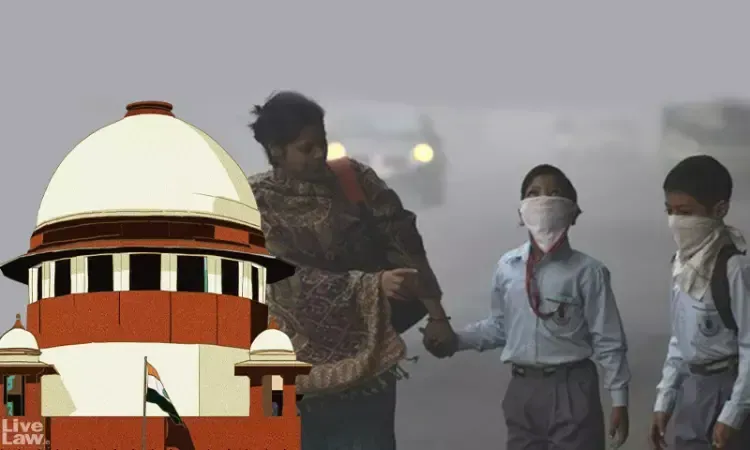
In the matter relating to air pollution in Delhi-NCR, the Supreme Court recently expressed that Court intervention on the issue should be limited, else people would be tempted to violate the laws. Instead, pollution awareness programmes can be made part of Diwali programmes.
During the hearing, the Court was told about the report of a Ganga Ram Hospital chest surgeon that in Delhi, even the lungs of children are not pink. However, it said that it was not inclined to go into "anecdotal" opinion. The Court said that it will go by expert view and GRAP opinion, unless any research work to the contrary, from a peer-reviewed journal, is presented.
"We have reason to believe that CAQM takes into consideration all expert opinion, including health professionals...whether the lungs of a young child is better in adaptation, we have no [knowledge]. Whatever GRAP says, unless you can rebut it with peer reviewed research papers, we are not going to go into these persuasive arguments", said Justice Joymalya Bagchi.
A bench of CJI Surya Kant, Justice Bagchi and Justice V Mohana initially expressed that it will issue certain directions and call for compliance by the states/UTs. Later it said it will call for reports and updates from the concerned authorities.
At the outset, the CJI remarked, "We hope all of you are enjoying Delhi weather".
Senior Advocate Aparajita Singh (Amicus) submitted that the air quality was already hovering around 'severe' category. "We are losing our voice as well. It's like smoking 30 cigarettes a day", she added.
The Amicus informed that as on November 5, contribution of stubble burning to the air quality was 14%. She urged that Delhi is already polluted and stubble burning is only a part of the problem. With stubble burning, the already bad air quality only "tips over". Therefore, entire focus being on stubble burning creates problems.
In response, the CJI observed that stubble burning would start going down at this point, as farmers resort to sowing. The Amicus then highlighted another part of the problem - that is - the Centre making equipment available for stubble management but fuel being expensive. She also highlighted that this solution does not work for small farms.
Justice Bagchi observed that the Centre had proposed to formulate a policy for acquiring stubble from farmers. CJI suggested that the government can notify a rate in advance, so the farmers know what they will get if they preserve and sell the stubble to the government.
The CJI further recalled his earlier suggestion that the machine/equipment for stubble management be given to Gram Panchayats, not individual farmers, as farmers would not be able to afford it. "Kind of education of farmers is required. When they will start understanding the economics of stubble...once they will understand, then when they find it's incentivized or beneficial for them, they will retain it, not burn it", the CJI observed.
Another suggestion which fell from the CJI was to take assistance of agricultural produce procurement corporations, which can provide warehousing etc. for stubble in exchange for money.
On behalf of the Union, ASG Aishwarya Bhati informed that various steps had been taken to tackle air pollution and a scheme had already been put in place to make subsidized equipment available to farmers.
The Amicus also argued that transport is a major part of air pollution problem and despite the court's orders, vehicles are being stopped at Delhi borders, resulting in their idling and creating more pollution.
The CJI then questioned the ASG on what was being done to tackle the contribution of heavy vehicles and high-end cars to the pollution problem. He further said that public transport was lacking. "Major part of the problem...this vehicular pollution. Look at the roads in Delhi. Look at the roads connecting NCR with Delhi. The kind of bumper-to-bumper vehicles are going...that's the major cause" the CJI said.
"people may have their own justification because if they have to go, how to go? there is no public transport system to facilitate them. Unfortunately, we are lacking in that", the CJI remarked.
The ASG responded that directions have been issued for the winter season (November to January end) and apart from BS-VI vehicles, entry into Delhi is not being permitted. She informed that the framework is addressing pollution from the angle of 5 categories, including industrial pollution, vehicular pollution etc. It was stated that incidents of farm fires were much less this year. On vehicular pollution, the ASG put before the Court a note on directions of the CAQM as well as other policy plans, including phasing out of diesel-operated autorickshaws by January 1, 2027 (with transition to CNG or electric).
Later, the Amicus raised the issue of commercial and other vehicles idling at toll plazas and Delhi borders when they are stopped by the authorities. She recalled that the Court has passed three orders on the issue, requiring NHAI and MCD to work in tandem, and asked the bench to enquire as to what steps had been taken on this aspect. It was also claimed that the Delhi government had passed an order as per which NCR vehicles are being stopped at Delhi borders. Though the intention is to de-congest Delhi, the idling of the vehicles is leading to more emissions, she contended.
The ASG acknowledged that implementation of the efforts on this issue was not complete. The MCD counsel on the contrary claimed that there was no idling of vehicles at 9 toll plazas (out of 126) through which 90% of the traffic flows.
The CJI then questioned whether there was any scientific assessment on why vehicular pollution was taking place, despite such measures. When it was highlighted that Delhi has the most number of vehicles (half of the country's total), the CJI said that it was not only a question of numbers, but also of the "free-for-all", as vehicles from any state can come to Delhi and there can be no monitoring of what fuel they are using and how much pollution they are generating.
On this, the Union's response was that efforts are being made to control polluting vehicles, including geo-tagging of pollution certificates, denial of fuel without pollution certificate, immediate action on complaint of visibly polluting vehicle etc.
The hearing also witnessed the Amicus reflecting on the impact of pollution on poor people living on streets, who have to leave the city during Diwali. The CJI said that the bench would not give opinion on this, but this is also the time when people earn their livelihood. He also commented that the people who can afford and make celebrations part of their status symbol are creating the problem, while poor people are the sufferers.
The CJI also queried if there was any other scientific method contemplated to tackle pollution, other than temporary stopping of vehicles, construction etc., which were "old, tried and failed" tactics. The ASG referred to the GRAP framework, which relates to AQI levels. When the CJI noted that AQI had already hit 400, the ASG lamented that every human activity tends to generate pollution. She referred to other developments in the field, saying no industry in Delhi was now using unclean fuel.
When the ASG was referring to GRAP framework, Justice Bagchi observed that poor and very poor are "normal" (for Delhi) and it's more of a question of "severe" and "very severe". "Let's not talk of a eutopia of 100 or less", remarked Justice Bagchi. The Amicus highlighted that the city is hovering around category 3 and still, minor children are outside playing competitions. She referred to the Court's earlier advisory on schools running on hybrid modes and pointed out that GRAP only takes an average (therefore, pollution may actually be "severe" in a particular area, which GRAP records "very poor" for entire Delhi).
A counsel sought parity in the treatment of "primary" and "secondary" class children under the GRAP framework (which contemplates hybrid mode for primary students in GRAP 3 and for secondary children in GRAP 4). "The lungs of a 5th grader are not different from that of a 6th grader", she urged.
"We don't know, neither do you", responded Justice Bagchi, saying the Court has to defer to the decision of the expert body (CAQM), expecting that they have taken into consideration pediatric suggestions. "Let's not second guess an authority's classification. By age classification is a reasonable one", the judge emphasized.
Justice Bagchi also expressed strong disinclination to restricting children's going to school, observing that online teaching mode sounds good but in reality, the quality of education suffers. Online access and quality of education in online classes are all questionable issues, the judge remarked.
Justice Bagchi also probed if the counsel had taken a pediatrician's suggestion before claiming that lungs of a 1-year old would be the same as that of a 6-year old. Justice Mohana, on the other hand, urged the Union to enhance awareness efforts so people know the consequences of pollution levels on their health. "We will give more impetus", replied the ASG.
The Amicus also urged the Court to seek a response from the NCR states and Punjab on the implementation of measures to tackle pollution and further as to why pollution is taking place if such measures are in place.
As the hearing came to a close, Justice Bagchi expressed that Diwali programmes should have pollution awareness programmes as a part. "Diwali celebration should be with pollution awareness", the judge observed, suggesting that the local Counsellors and Mohalla Committees can impress upon people that their Diwali celebration must not contribute to pollution.
"No restrictions are going to work. More the court will pass orders, it will multiply the violations. It is the tendency of people", said the CJI.
Later, the counsel who raised the issue of minor children pointed to a 2012 research report as per which there was 43.5% lung function reduction in school children of Delhi. Justice Bagchi observed that CAQM has considered the research and then put in a graded response. He further said that the Court did not want to impinge on education, which like commerce, industry etc. should have free access. "It will only be a proportionate minimal intervention" the judge stated.
Case: In Re: Curbing Air Pollution in the National Capital Region, SMW(C) No. 11/2026