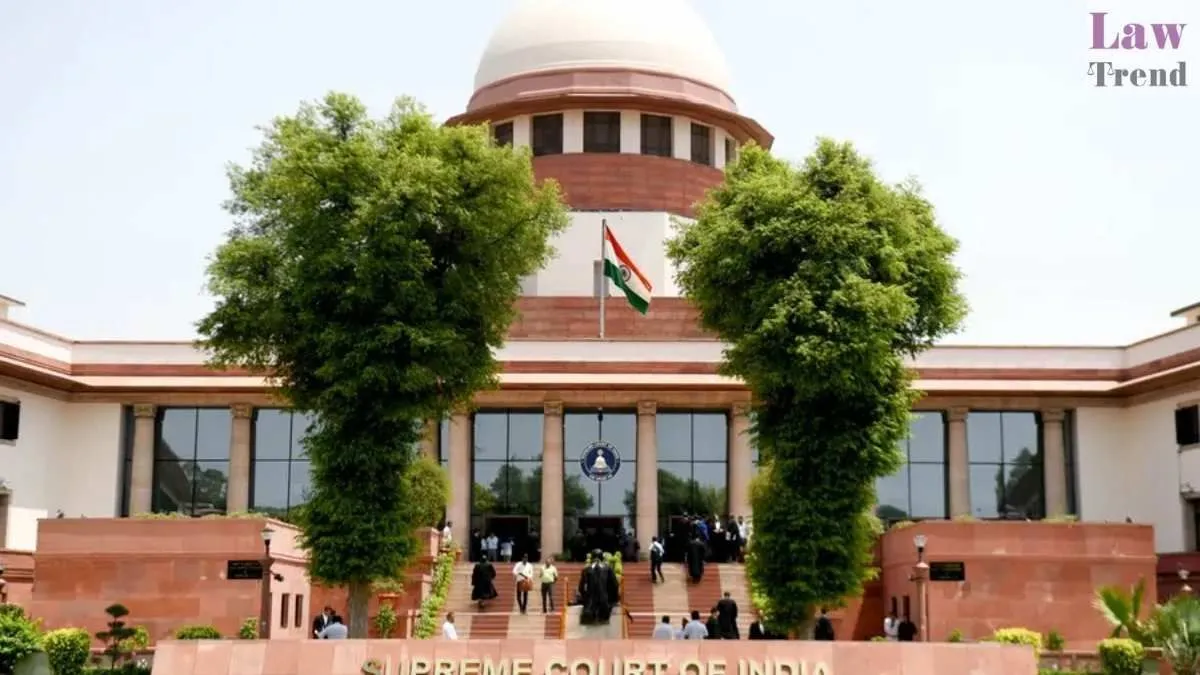
The Supreme Court has held that a grandson gets no right by birth in property his father inherited under Section 8 of the Hindu Succession Act, 1956. Once that property is divided in a partition among Class I heirs, the share becomes the father’s exclusive individual property. It is not coparcenary property.
A Bench of Justice Augustine George Masih and Justice Sunita Agarwal dismissed an appeal by a grandson who claimed a half share in land his father received in a family partition. The Bench upheld the High Court’s decision setting aside the trial court’s preliminary decree of partition.
Background
The dispute concerned 1,811 sq. ft. of land that originally belonged to the appellant’s grandfather, the late N. Ramakrishnan. In 1993, the first defendant’s sister, G. Lalitha, filed C.S. No. 1728 of 1993 seeking partition of her father’s property. The suit was decreed on the basis of a compromise dated 03.02.1994, under which the appellant’s father received the suit land.
The appellant was born on 06.01.1994, before the compromise decree. In April 1997, his father sold the property to defendant nos. 2 and 3 by two sale deeds. The same year, the appellant, a minor at the time, filed Original Suit No. 1698 of 1997 through his mother, seeking partition and possession of a half share. He did not challenge the compromise decree or the sale deeds.
The II Additional Judge, City Civil Court, Chennai, passed a preliminary decree of partition. In the first appeal filed by the purchasers, the High Court set that decree aside. It held that a son’s son is not a Class I heir under Section 8 and gets no right by birth in such property.
Arguments
Advocate K. Paari Vendhan, appearing for the appellant, relied on Section 29-A of the Hindu Succession (Tamil Nadu Amendment) Act, 1989. He argued that the compromise decree did not turn the father’s share into self-acquired property. He submitted that the appellant became a coparcener at birth, before the decree was passed, yet was not made a party to the partition proceedings. Citing Rohit Chauhan v. Surinder Singh and Arshnoor Singh v. Harpal Kaur, he contended that ancestral property allotted in a partition remains coparcenary property as regards the allottee’s son. He added that the purchasers could not acquire a greater right than their vendor.
Advocate K.K. Mani, appearing for the respondents, argued that the case was governed by Section 8, which excludes a grandson from Class I heirs. He submitted that neither Section 6 nor Section 29-A applied. Relying on C.W.T. v. Chander Sen and Radha Bai v. Ram Narayan, he argued that a divided son gets absolute ownership with full power to sell the property. He also called the suit collusive, since the father never contested it.
Supreme Court’s Findings
The Court relied on Chander Sen, Bhanwar Singh v. Puran and Radha Bai. It noted that a son’s son is not listed as a Class I heir and so gets no right in his grandfather’s property under Section 8. The Bench observed that the grandson’s right under pre-1956 personal Hindu law “was not saved expressly by the legislature while enacting the Hindu Succession Act, 1956.”
The Court held that “Section 8 of the Hindu Succession Act, 1956 is to be read as a self-contained provision laying down the scheme of devolution of the property of the Hindu male dying intestate.”
On the effect of the compromise decree, the Bench said: “With the partition, the property of N. Ramakrishnan the grandfather of the appellant ceased to be joint family property, inasmuch as, all heirs succeeded the same as tenant in common and not as joint tenant, and joint coparcenary did not continue.”
Rejecting the appellant’s reliance on the unamended Section 6 and on Section 29-A, the Court noted that succession opened with N. Ramakrishnan’s death, which came before the appellant’s birth. It held that “the appellant cannot become a coparcener as he was not a “surviving coparcener” on the death of N. Ramakrishnan.”
The Court also noted that the suit was filed while the father was alive, without any challenge to the partition decree or the sale deeds. It concluded: “There is no question of devolution of the property once partitioned and became exclusive individual property of the first respondent upon the appellant herein so as to recognise his right on the premise of attaining coparcenary rights with his birth.”
Outcome
Finding no infirmity in the High Court’s judgment, the Supreme Court dismissed the appeal with no order as to costs.
Case Title: J. Rajesh (Minor) Thr. His Mother and Natural Guardian J. Gomathi v. M. Kumaran (Dead) Thr. LRs. & Ors.
Case No.: Civil Appeal No. 7020 of 2012
Bench: Justice Augustine George Masih and Justice Sunita Agarwal
Date: 06.11.2026