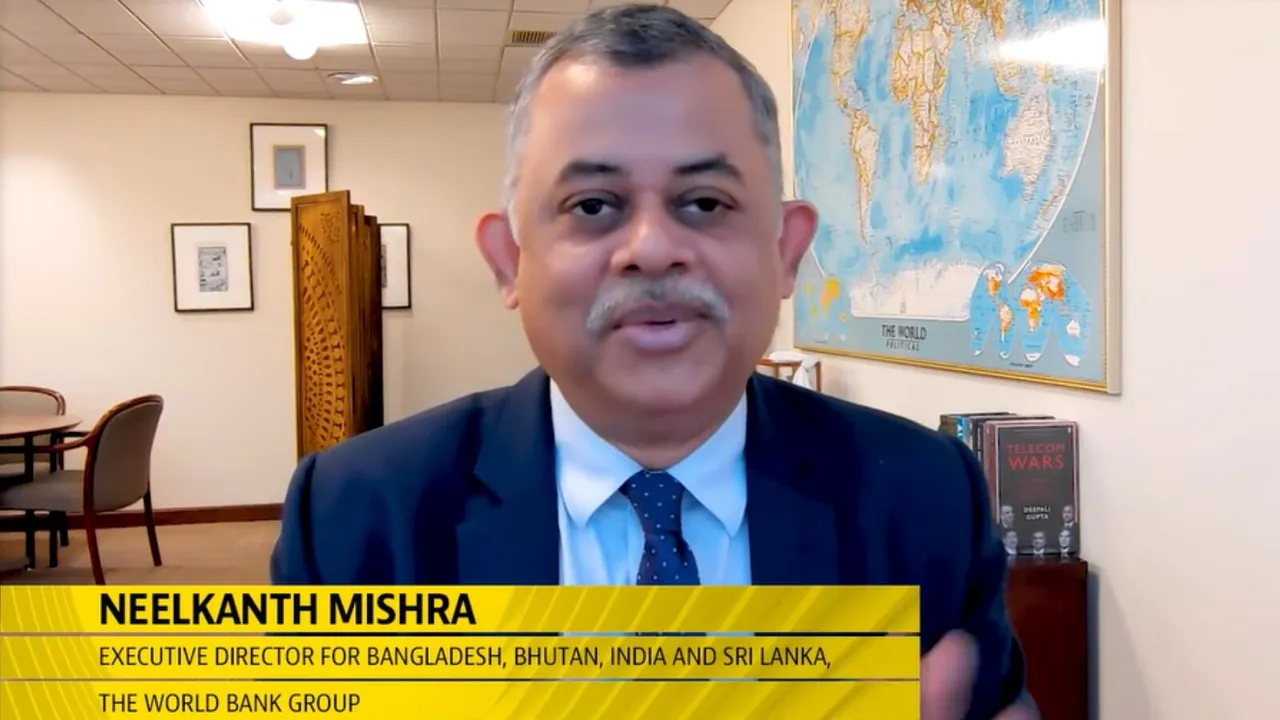
Neelkanth Mishra, Executive Director for Bangladesh, Bhutan, India, and Sri Lanka at The World Bank Group, said at the Hindustan Times Leadership Summit that “very few economies have gone from low income to rich without controlling their own sources of energy.” He added, “And I think we need to get that right.”
“Renewables are an option, but only 16, 17 per cent of our energy consumption in final form is in the form of electricity, maybe 17 per cent. China used to be here 20 years back. Now they are 27. Japan is 32. So we need to electrify as much as possible,” he said.
“So there is a lot of import dependency on dense energy, which I think is a huge vulnerability. The second is that, unlike the growth of Taiwan, Korea, and later China, the problem with India is going to be a resisted rise. There was an assisted rise,” he said.
“We need to be doubly mindful of building our own expertise on technology. I think we also need to get our politics right. So if our growth, see, growth at this stage of development tends to be somewhat unequal because, you know, labour is in surplus, capital is in shortage,” he added.
World Bank's Neelkanth Mishra was asked about critics questioning India’s electronics manufacturing progress “being still in the assembly stage.”
He said that the assembly stage is where one begins to build an industry. “So if you look at how Japan started in the 60s, Korea did it in the 70s, Taiwan did it in the 80s, and China did it in the 90s, and now of course they're doing so much better than anyone expected,” he said.
“Today the two nanometer chips, the cutting-edge GPUs of many of the best companies in the world are now all getting designed in India. Why don't we have Indian companies? It is partly because of the capital problem that, you know, risk capital is not available at scale. It wasn't, and now it's starting to become available,” he said.
He said that he advised on a report by the Convergence Foundation about three years back, which has now led to the creation of the Global Access for Talent from India (Gati) foundation.
“It's not just in Europe, but in Korea, in Taiwan, in Japan. They need human bodies to provide many of the services. Not everything can be automated,” he said at the Hindustan Times Leadership Summit on Friday.
Regarding immigration concerns, Mishra highlighted the importance of government-to-government contracts in addressing them. “...If you allow immigration to happen because you just need hands and bodies, and you have no control over it, then you get into problems of assimilation, problems of cultural change, and then resistance to immigration. If you can control it, meaning that you say that, you know, I'll have 200,000 people a year, or 200,000 people over three years,” he said.
Neelkanth Mishra, speaking at the HTLS summit 2026, highlighted the problem of “significant disguised unemployment in agriculture”, saying that “people pretend to be farmers because they don't have work.”
Mishra also raised the “very low female labour force participation rates” as well as a “significant gap versus China or Taiwan.”
He said, “I do think that jobs will be created. And the job creation, look, if you're growing at 7% to 8%, 7%, 7.5%, it is very unlikely that all of this is coming from productivity, even if you're deploying significant amounts of capital. So there will be, I think, 2% plus job creation.”
“Many of those jobs may not be the highest quality, but the jobs will get created. I am, for economies like ours, I'm actually a lot less worried about AI at a net level. There will be disruption; there will be jobs that become redundant at large scale,” he added.
He said that Odisha is making “significant improvements” in the devolution of power from level-two governments to level-three governments due to the “freedom given to local governments and the involvement of public-private partnerships.”
“You know, so there are limitations in terms of how much capital exists with the central and state governments. I think it's very important to involve private capital. And for that to happen, you need to have revenue sources, you need to be able to make the politically hard decisions of charging for water, charging for solid waste…putting in place sewage management. And I think all of those require the state to devolve power to the municipal corporations and the municipalities. And I think that's something that Odisha seems to have done,” he said.
Speaking at the Hindustan Times Leadership Summit on Friday, Neelkanth Mishra, Executive Director for Bangladesh, Bhutan, India, and Sri Lanka at the World Bank Group, said that the reforms should be focused on the “devolution of power from level two governments to level three governments”.
“Unless we get our cities right, there is going to be a cap on how fast we can grow our productivity and how sustainably we can grow our productivity. And that's a very deep problem,” he said.
He acknowledged that states are starting to build “muscle on economic policy”, and some are even setting up economic advisory councils.
But, he said, a lot more needs to happen. “This is important from the perspective of managing housing and urbanisation. This is important from the perspective of the right type of capital formation. It is also important from the perspective of attracting foreign capital, because those are the areas where a significant amount of private and foreign capital will be needed. So if I were to highlight the most important reform, that would be it,” he said.
The second most important, or maybe competing with that in terms of priority, would be taxation, Mishra said.
On Thursday, two virtual sessions were held with VFS Global founder Zubin Karkaria and Anima Anandkumar, a professor at the California Institute of Technology (Caltech).
Zubin Karkaria said that Indian students have traditionally travelled to the US, Canada, Australia, and the UK; however, a shift towards Europe is being witnessed now. There’s a growth of students travelling to Europe by almost 70% every year, he said. Karkaria also said that whatever geopolitics or environmental conditions there are in the world, travel will always return, and it will return with a vengeance.
Anima Anandkumar, Bren Professor of Computing and Mathematical Sciences at the California Institute of Technology, said that local languages and accessibility are important for frontier language models. “I saw a lot of startups—and not necessarily only in the language model space,” she said, pointing to space, batteries and similar hard engineering as India’s competitive strength in the age of artificial intelligence (AI). She also said that speed is only a part of the artificial intelligence story, and that AI also allows for better accuracy and reliability in scientific modelling.
Neelkanth Mishra is an economist who currently represents Bangladesh, Bhutan, India and Sri Lanka as an executive director at the World Bank Group in Washington DC.
Before moving to the World Bank, he held important positions in both the Government of India and the private sector. He served as a part-time member of the Economic Advisory Council to the Prime Minister from 2019, and also served in leadership roles in the Unique Identification Authority of India (UIDAI), the Telecom Regulatory Authority of India, the India Semiconductor Mission, the Confederation of Indian Industry’s Economic Affairs Council, Gati Shakti Vishwavidyalaya, and the National Council for Applied Economic Research.
He also served as Chief Economist at Axis Bank, Head of Global Research, and Board Member at Axis Capital before spending nearly 20 years at Credit Suisse in Singapore, Taipei and Mumbai as an analyst and later as Co-Head of Asia Pacific Strategy and India Strategist.