For a woman who has been a witness to some of the most significant political moments in modern Indian history, Sonia Gandhi likes to insist her life has been far from remarkable. “Oh, I don’t know that I would say it’s an extraordinary story,” she says, shifting uncomfortably.
It’s hard to reconcile this modest characterisation with the course her life has taken over the last 79 years. Born to a working-class family in a small town in northern Italy, today she sits at the heart of Indian political power, having weathered assassinations and personal tragedy to become one of the country’s most influential figures. She held Indira Gandhi’s bloodied body after the then-prime minster, her mother-in-law, was gunned down at their home in Delhi in 1984. She then became India’s first lady when her husband, Rajiv Gandhi, took his mother’s place as prime minister. And when Rajiv, too, was killed, she threw aside her distaste for politics to step up and lead his fragmenting party. In 2004, having taken Congress to electoral victory, she famously turned down the prime minister post. She can still boast of being the longest-serving president of Congress, both when India’s oldest political party was in power and later, when it became the flailing opposition. When Gandhi stepped down in 2017, her son Rahul was appointed her successor.
Gandhi’s entrance into Indian politics began in Cambridge in the 1960s when, at 18, while she was studying at a language school, she fell in love with a bright-eyed boy at a Greek restaurant. At the time, she had no idea that Rajiv was heir to India’s most consequential political dynasty. “It was a coup de foudre,” she says. “After that, nothing else really mattered. He was, first of all, a handsome man. But I think his eyes told of the way he was – of his inner self. He was loving, he was comforting, he was caring. Everything I could have possibly dreamed of.”
Only later would she learn that Rajiv’s grandfather was Jawaharlal Nehru, Indian freedom fighter and the country’s first prime minister, and his mother was Indira Gandhi, who in 1966 became India’s first female prime minister.
Does she still recognise herself in that innocent Italian girl who was swept off her feet and transplanted to an alien land and culture? “Not really,” she says quietly. “Too much has happened, too much has changed.”
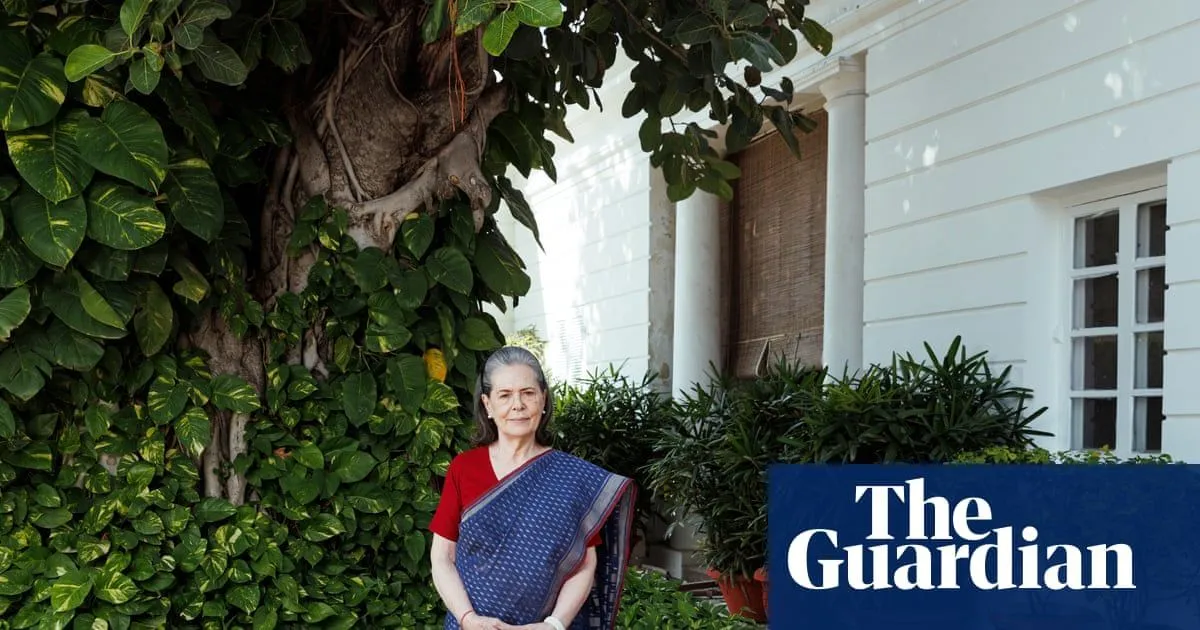
We meet at the grand white Delhi bungalow she has lived in for 36 years – a relic of British colonial rule, where peacocks roam the grounds. It was in this house in 1991 that Gandhi heard her husband had been assassinated by Sri Lankan Tamil separatist terrorists. Over the years, as she took on the mantle of Congress leader, her home became the centre of party operations.
The ghosts of Congress leaders past loom large in her study. A painting of Nehru, photographs of Rajiv, a carved stone bust and portraits of Indira line the walls, while a painting of Mahatma Gandhi, the freedom fighter who shaped the ideology of Congress, also hangs prominently. Heavy gilded tomes fill the floor-to-ceiling wooden bookshelves, and a long meeting table dominates the space, but the vibrant rugs, patterned blinds and scattered antiques suggest Gandhi’s own light touch.
In a dark blue sari and maroon blouse, her signature neat grey hair pushed back with a black headband, Gandhi looks every inch the composed Indian political matriarch as she sits on the sofa. The only hint of her heritage is softly accented English and recognisably Italian gesticulation.
She has, she confesses, been very nervous and tense about our meeting. Gandhi has not done an interview in a decade, and throughout her life in the public eye, has tried fiercely to maintain her privacy. She has only agreed to this rare meeting to discuss her forthcoming memoir, a strikingly personal account of her life, and has asked her daughter Priyanka, also a senior Congress leader, to sit in for moral support.
India’s media has often cast her as cold and aloof, yet today she seems warm, open and often a little unsure of herself. She’s anxious about how personal the book is, worried it will be eviscerated by the Indian media, but suggests that after years of “horrible and crazy things written about me”, it will be comforting for people to know “the truth”.
Gandhi has good reason to be nervous of the press. In today’s India, the mainstream media landscape has been crushed into submission by the hardline, rightwing Modi government and is largely devoted to promoting the prime minister’s agenda, while mercilessly attacking the Congress party, in particular the Gandhi family. She does not hold back on criticism of Narendra Modi – accusing him of being an “authoritarian force bent upon changing the very nature of our country” – and of his party, BJP, which she says has “systematically dismantled our democratic institutions”.
The Hindu nationalist vision of India that Modi has enacted over his 12 years in power is directly opposed to the pluralistic, secular India that was championed by successive Congress leaders and which remains enshrined in India’s constitution. It has led to well-documented oppression of the country’s minority groups, in particular its 200 million Muslims.
“More than disappointing, it’s very painful, having known a different India,” Gandhi says. “In parliament, we are not allowed to debate. In the past, there were discussions, there were meetings between the opposition and the government, there was consultation. Now the opposition counts for nothing.”
Since Modi came to power, she has had barely any interaction with him; he tends to avoid eye contact when they’re in a room together – a stark contrast to the past, when opposition leaders would often meet the government and “treat each other with cordiality”.
A “Congress-free India” is one of the openly declared goals of Modi’s BJP, resulting in highly personal attacks on Gandhi and her children, who have found themselves with numerous police cases filed against them. As we talk, Gandhi’s phone lights up with a call from her son Rahul – later, we learn a judge has just cleared him of defamation in one of these many cases, this time for criticising Modi’s home minister back in 2018. “They are very vindictive and vicious. There doesn’t seem to be a heart there,” Gandhi says.
So effective is the BJP’s crackdown on any form of dissent or criticism – what Gandhi describes as an “atmosphere of fear” – that her memoir almost didn’t see the light of day in India. Penguin Random House India were originally meant to release the book domestically, but after she sent them the manuscript she was met with a deafening silence. Gandhi says simply that Penguin were “uneasy in general with the criticism of the government” and that after she refused to make certain suggested edits, the publisher dropped the book, just a week before it was due to be announced. It will now be published by another imprint. In a statement, the publisher denied dropping the book, adding, “Any suggestion that Penguin Random House India decided not to publish Belonging because the author declined editorial changes does not accurately reflect the circumstances.”
Gandhi admits she was disappointed, though not altogether surprised, at what she sees as an attempt to censor her book. It is far from an isolated incident. In the days before we meet, Gandhi’s 26-year-old grandson, who is an artist and curator, is forced to take down dozens of his photographs depicting political protests that had been due to go on show in Delhi.
Gandhi had an early insight into the difficulties and loneliness of being a female leader in India’s deeply patriarchal society. When she arrived in India in 1968, she and Rajiv moved in with his mother, who at that time was two years into her first term as prime minister. Her husband, also a politician, had died years before.
They lived all together in another crumbling colonial Delhi bungalow, in relatively close and modest quarters. To outsiders, Indira was often seen as severe, an “iron lady”, and Gandhi admits that, to begin with, she was deeply intimidated by her formidable mother-in-law. Yet while Indira was imposing in public, she could be vulnerable in private, once confiding to Gandhi how terrified she was when she first bcame prime minister.
“In the newspapers she was portrayed as tough or harsh, but at home she was just like any other mother,” Gandhi says – although Indira’s notoriously explosive temper, frequently directed at political colleagues, would erupt through the house on occasion. Gandhi’s memoir recounts one incident where Indira lost her temper during a family dinner and threw her thali plate across the table.
Gandhi’s book documents the hostility Indira grappled with, both from political opponents and rightwing groups, but also from the old guard of her own party. “I saw her work day and night, constantly under pressure, constantly attacked,” Gandhi says. “It did affect her, like it would anyone. And of course, in that position, there is a loneliness. She had many interests and many friends, but it is a lonely kind of life.”
For several years, Gandhi says, her own life was “carefree”. She and Rajiv were madly in love, often embarrassing their children with public displays of affection that were highly unusual in Indian households at the time. “For this man, I was ready to do everything, to lose even my Italian identity,” she says. Rajiv was working as a commercial airline pilot, and as relations warmed with her mother-in-law, Gandhi set about redecorating the austere Delhi bungalow with some Italian flair, and learning how to cook Kashmiri food. After a traumatic miscarriage, she gave birth to two children, who were doted on by Indira. Even her pangs for fresh Italian ingredients, impossible to find in India in those days, eventually ebbed.
But in 1975 Indira would make the most controversial decision of her political life. Amid mounting political unrest, economic hardship and a concerted effort by the opposition to bring down the Congress government, Indira decided to impose a state of emergency on the country, in a bid to instil order. The repercussions were profound: the constitution was suspended, civil liberties and democratic freedoms abandoned, the media silenced and opponents detained en masse without trial. It lasted for almost two years, and is still seen as the darkest period of India’s democracy; it is regularly used to tarnish the Congress party today.
According to Gandhi, the family was split on the decision. Rajiv was against the move, telling his mother to wait for the next election, but her hotheaded younger son Sanjay pushed for it, arguing at one family dinner that the opposition would destroy his mother and telling her, “They must be stopped.” Sanjay’s forceful influence over his mother was a great source of public controversy at the time. Gandhi recalls that it inflamed tensions within the family, too; Rajiv attempted to confront his mother, but she refused to listen. “Keeping Sanjay in check could have prevented much of the damage that followed,” Gandhi writes in her book.
Today, she says it was a mistake for Indira to call the emergency, and that she believes her mother-in-law came to feel the same. “I always feel that Mrs Gandhi was a democrat at heart,” she says. “I know that many would laugh at this, but I believe she was never comfortable in the course of the emergency. I think it was sitting heavy on her.”
In the following years, Indira would lose one election and be returned to power in another. Rajiv would also be persuaded to enter politics after the premature death of Sanjay. But by 1984, darkness came to their door again.
Months of escalating violence had stricken the north Indian state of Punjab. As separatist militants prepared to declare an independent Sikh state, Indira authorised a military operation at one of the holiest sites in Sikhism, the Golden Temple in Amritsar, where the group were hiding out. The operation caused cataclysmic damage, killing Sikh pilgrims as well as militants, and led to desecration of the temple by tanks and heavy weaponry. Gandhi says that when her mother-in-law was shown images of the devastation, tears rolled down her face.
For Sikhs in India, it was a profound and painful attack on their religion, and Indira was inundated with threats. “She told us what to do in case she died – so she knew,” Gandhi says. “She was making preparations for her death. She told Rahul he must be brave and not to cry.” That summer Indira took her grandchildren on a trip to her ancestral home of Kashmir; Gandhi believes this was to “say goodbye”. Indira also defied advice to remove her Sikh bodyguards – something that turned out to be a fateful decision.
Gandhi was at home on 31 October when she heard what sounded like fireworks going off. Sprinting over to Indira’s office next door, she was confronted by her mother-in-law’s bloodied body, riddled with bullets, lying on the ground. Indira’s own Sikh bodyguards had opened fire on her in retribution for the attack on the Golden Temple.
What came next remains seared on Gandhi’s memory. After Indira was put into a car, she held her bleeding body and tried to revive her mother-in-law as they raced to the hospital. “There was blood everywhere and I realised she wasn’t replying to my questions. It seemed as if she had already gone,” she says.
Even after so many years, the story is clearly painful to recount and she speaks hesitantly, her soft voice growing even quieter. “I remember the drive from the house to the hospital was excruciating. There wasn’t much traffic, but it felt so slow. I also knew that because she wasn’t speaking, it must be over.”
Gandhi admits there are still parts of that experience she can’t bring herself to discuss. “I never talk about it. Only if I’m asked, then I struggle to.” Indira would be declared dead at the hospital. Her body was still lying there, cold, when Rajiv broke the news that he had been asked to step in as prime minister. Gandhi had begged him to stay out of politics and describes that conversation as a “knife going into my heart”.
In the aftermath of Indira’s death, she was traumatised and depressed, living “like a ghost”. Rajiv, too, had no time to grieve. Newly announced as prime minister, he immediately had to deal with deadly anti-Sikh riots that erupted after Indira’s death. He would later be accused of not doing enough to stop the bloodbath. “Rajiv never really showed his pain,” Gandhi says. “I remember seeing him in his mother’s study, on one of the chairs where she sat, with tears. But in public he felt he had to hide it.”
Fear took over their lives. The house became a fortress, with uniformed commandos stationed in the children’s bedrooms. Rahul and Priyanka were pulled out of school and no longer allowed to roam freely. She would worry if Rajiv didn’t come back from an engagement on time. He, meanwhile, would always want her by his side. “Fear was a very real thing,” she says. “My thought was always: he will be killed next.” By 1991, her premonition had come true.
A silence settles over the room as Gandhi struggles to recall how she went on living after Rajiv’s death. A Sri Lankan separatist militant had set off a suicide bomb while he was on the election trail, killing him instantly. Throughout our conversation, she still refers to Rajiv as “Papa”, as he is known to their children.
Priyanka, who sits on the sofa with us, interjects gently. She tells me how her mother would sit in the dark all day, listening to Mozart’s Requiem, engulfed by grief. “You were angry at him,” she says, speaking to her mother. “When you used to cry, you used to shout: how has he left me, why did he leave?”
Gandhi sits quietly for a moment. “After my mother-in-law was killed, we thought that, as we were always together, if something happens to one, it will happen to the other one,” she says. They had even written notes on how they wanted their funerals.
Yet when Gandhi’s sister pleaded for her to return to Italy, the thought was unfathomable. “India was my home, my children’s home,” she says. Gandhi last went back to Italy four years ago, when her mother died.
She found out later that, prior to the attack, Indian intelligence had intercepted death threats against Rajiv by the Sri Lankan separatist Tamil Tigers, angered over India’s intervention in the country’s civil war. However, these had been ignored by the newly elected government, who instead took away his top-level security. She still believes the truth of a wider conspiracy behind his death has yet to come out. The most recent commission to investigate it was shut down by the Modi government. “I don’t think we will get the truth now,” she says with a sigh.
Crucially, just as the foundation of her world was shattered, a wind of change was blowing across north India. A claim that a mosque in the city of Ayodhya was built on the ruins of an ancient Hindu temple had been gaining traction among hardline, rightwing Hindu nationalist organisations and political groups. In December 1992, supporters of the movement – including BJP figures – violently tore down the mosque.
Gandhi recalls crying as she witnessed the demolition on television. She says she knew then that they faced “a long battle for the secular nation that Mahatma Gandhi, Nehru and their colleagues had strived to build”. She accepts that failures of her own party in part contributed to the rise of the BJP and its hardline Hindutva politics. “I think we have been too complacent in many ways. There was a laissez-faire kind of an attitude,” she says. In 2024, Modi delivered on the BJP’s longstanding promise and inaugurated a vast Hindu temple in the place where the mosque had once stood.
Throughout her memoir, Gandhi is open about her distrust of politics, describing it as “menacing”, driven by “ambition, greed and hypocrisy”. But with Congress facing an existential threat and looking likely to fracture, Gandhi succumbed to mounting pressure and agreed to become its president in 1998. It was a decision, she says, driven by a sense of duty to her lost husband. Not only did she have to fight against her own ingrained shyness, she also had to take on political opponents in Hindi, her third language.
She insists she never had political ambition. Despite helping the party to win the most votes in the 2004 election, she shocked everyone by refusing to become prime minister. “It was clear in my mind I would never do it,” she says. “It was just not me.” Nonetheless, until she stepped back from the day-to-day of Congress leadership a few years ago, she had little time for herself. She would carry books to political events, history and autobiographies, to read on the way home. Music, both Indian classical and European operas, also became her solace. Having previously studied art restoration, “once in a while, I would slip away to an art exhibition”.
Today she stays out of the messy day-to-day of politics, though is still kept in the loop by her daughter and attends the occasional meeting. She finds joy in her small vegetable patch, but more than anything in spending time with her children and two grandchildren. Theirs has always been a dog-loving family (Priyanka once had seven golden retrievers) and Gandhi is devoted to her two jack russells, Noorie and Lapo, who were gifts from her son.
Nonetheless, the fortress of security that surrounds her home is a stark reminder of the restrictions still imposed on her freedom. Armed police man the barricades on the road outside, and my car is thoroughly inspected by security before I am allowed to drive through a towering metal gate and into her driveway.
While she was once credited with reviving the fortunes of Congress, over the past decade the Gandhi family have overseen its calamitous decline. Their previous government, in power till 2014, was marred by allegations of rampant corruption. (“In almost every single instance, the ministers resigned,” is Gandhi’s defence.) After taking over from his mother, Rahul lost the last three general elections to Modi, and Congress remains in power in only a few states. Meanwhile, the BJP’s Hindutva has become the country’s dominant political ideology. As the family has maintained its control, Congress has been unable to shake off allegations that it is nepotistic and run by political elites.
Why can’t Congress free itself from the Gandhi family’s leadership, I ask? She is dismissive, perhaps a nerve touched. “You would have to ask the party,” she says. Gandhi also skates over the question of nepotism, simply saying, “We all fight elections: we win them, we lose them. All of us have.” But after so many losses, can a Gandhi-led Congress still be a credible alternative to the BJP? While she is adamant they can, many in the country remain unconvinced.
It is true that we are meeting at an interesting moment, for both Modi and the bruised opposition. As gen Z youth erupted on to the streets in protest against the government over the summer – satirically calling themselves the “Cockroaches” after an online joke transformed into a serious political movement – the long-crushed space for dissent has opened up.
In recent weeks, young Indians have once again been taking to the streets against the government, despite being met with draconian state force. The question of whether they can shake the BJP’s grip on power remains to be seen; so far, the Cockroach movement has kept its distance from the opposition alliance. But “what encourages me is young people are coming out and demonstrating,” Gandhi says. “With determination, they’re calling out the government on things that are not right. I feel like this is a real shift.”
Congress, too, has become more energised than it has been for many years. Images of Rahul and Priyanka being manhandled by police as they tried to protest against the government have gone viral in recent weeks. After once pleading with her children to stay out of politics, Gandhi now says, “It’s good that they’re there. Now more than ever before.” The Gandhi family, it seems, are not done just yet.