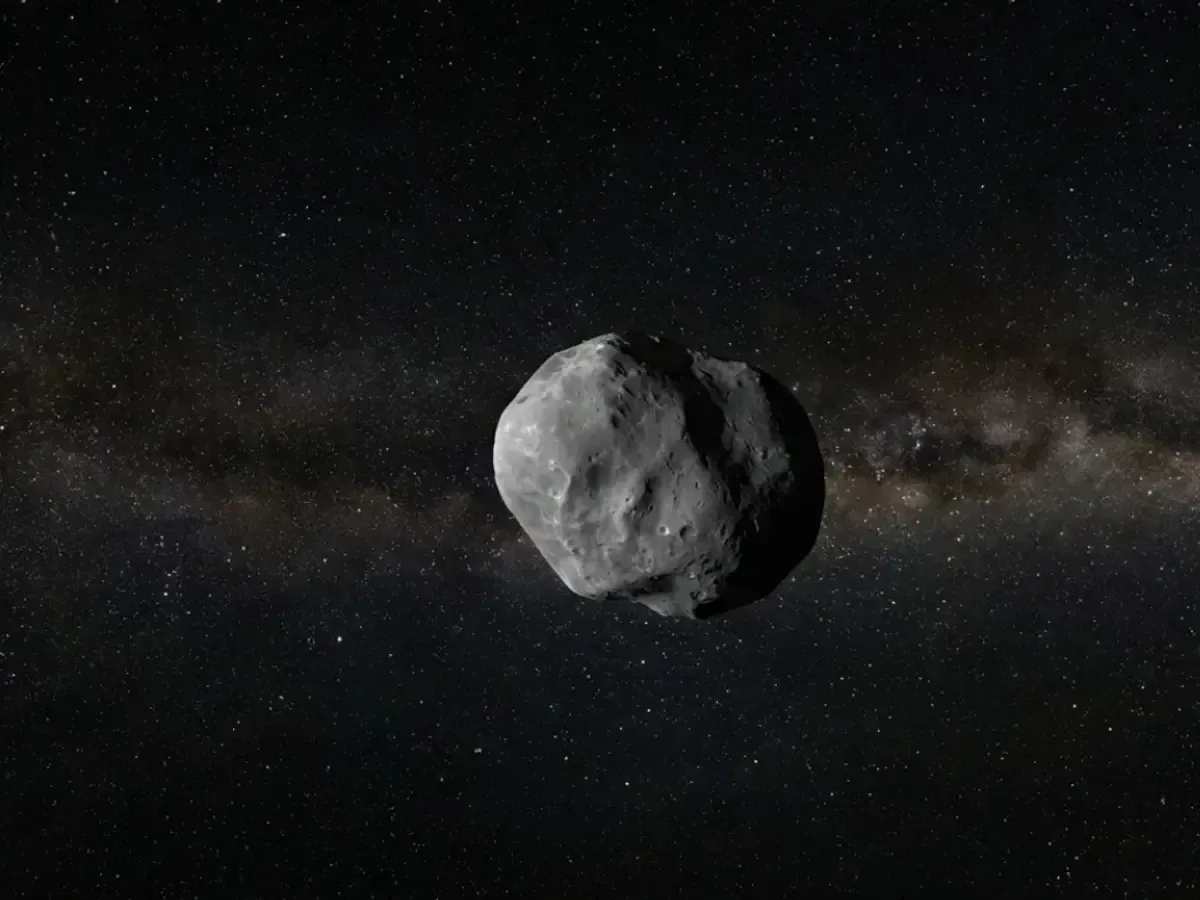
Earth got a new moon in April this year, and it was first observed in August. Astronomers suspected 2026 QQ8 could also be a piece of space debris. But further analysis confirmed that it was likely an asteroid that got caught in Earth's gravity. It is only about three feet and goes around our planet in a weird and loopy orbit. It will stay with us until December before escaping.
Hungarian astronomer Krisztián Sárneczky first spotted 2026 QQ8 on August 20, according to a statement from the Minor Planet Center on October 29, 2026. She determined that the object entered Earth's orbit in April this year. But doubts remained that it could also be of technological origin from an old piece of rocket. Astronomers scanned data from the University of Hawaii 2.2-meter telescope and the Lowell Discovery Telescope. This revealed that it was a natural cosmic object.
Also Read: Could quasi-moon 2025 PN7 be of technological origin? Scientists raise doubt
Could the mini-moon pose a threat?
Astronomers have calculated that 2026 QQ8 will remain about 0.0038 astronomical units (AU) away from Earth, about 1 and a half times farther than our own moon. Since it is quite small, even if it were to enter the atmosphere, it would burn up into a fiery ball.
Orbital data also revealed that 2026 QQ8 comes near Earth every 10 years or so, although it doesn't always become a mini-moon. It came quite close in 1965, EarthSky reported, but still managed to stay out of the Hill radius. This is a theoretical boundary inside which Earth's gravity dominates, and outside of which the Sun becomes overpowering. But this time, 2026 QQ8 managed to breach this boundary, and ended up becoming a mini-moon.
Trending Stories
Also Read: Earth has had two moons in the past. One of the mini-moons has visited twice and will return in 27 years
Other mini-moons
Earth previously got a mini-moon in 2024 when asteroid 2024 PT5 was captured on September 29. It was discovered on August 7 by the Asteroid Terrestrial-Impact Last Alert System (ATLAS) by Carlos and Raúl de la Fuente Marcos, researchers at Spain’s Universidad Complutense de Madrid. It is a resident of the Arjuna asteroid belt. The 37-foot space rock left us on November 25 of the same year.
Also Read: When will Earth get its next mini-moon? A 1981 and 2022 visitor returns in…
Quasi-moon
We also got a quasi-moon in 2025. Asteroid 2025 PN7 was discovered by the Pan-STARRS observatory on Haleakala in Hawaii on August 29, 2025. A quasi-moon is different from a mini-moon, because it is not orbiting our planet. It instead goes around the Sun, sharing Earth's orbit. Data scoured from past observations revealed that 2025 PN7 has been in this place for 60 years and won't go away for another 60 years. Earth has had other quasi-moons as well, including Cardea, Kamo‘oalewa and four others.