In this column, I’ll talk about the visible planets, a new dwarf planet discovery, the stars, and the passing of two Star Trek actors in the franchise’s 60th year.
Our days are ending way too early, and as the sun inches further south, our hopes for a few more warm days recede with it. With nights that are already more than 14 hours long, it doesn’t seem helpful that the next few months also tend to be the cloudiest of the year.
Nights begin with the large so-called Summer Triangle star pattern high in the west. It lowers to the west in mid-evening as Orion emerges from the east-southeast horizon — a celestial signpost warning us that winter is on its way.
In addition to the stars, the planet Saturn starts the night in the southwest, arcs across the south and sets in the west in the wee hours. In the meantime, bright Jupiter climbs into the east after midnight. Just above it glows dimmer Mars, whose reddish tint is not too hard to detect. You may detect its slightly. Regulus, the brightest star in the constellation Leo, shines a bit farther below Jupiter.
Jupiter and Mars appear close along our line of sight, but Jupiter is actually about four times the distance to Mars. In a few days — on the morning of Nov. 15 — the two will pass within 1.2 degrees (two moon-widths) of each other.
Venus is above the east-southeast horizon before 5 a.m. these mornings, but most people will have a hard time spotting it until it climbs higher. In an hour, it is 15 degrees up but battling the growing light of day. Watch Venus become more prominent as it rises earlier and ascends higher into darker skies.
In the coming week, dimmer Mercury can be found about the width of your outstretched fist to the lower left of Venus. It then reverses course and again drops from view. Mercury is often called “elusive” because it orbits closest to the sun, and hides its glare.
Bepi-Colombo is a joint mission to Mercury by the European Space Agency (ESA) and the Japan Aerospace Exploration Agency (JAXA). It consists of two probes that will enter orbit around Mercury later this month and begin full operations in April 2027. Specially shielded to endure the strong solar radiation, they will give us our best look at the innermost planet of our solar system since 2015, when NASA’s MESSENGER spacecraft ended its mission there.
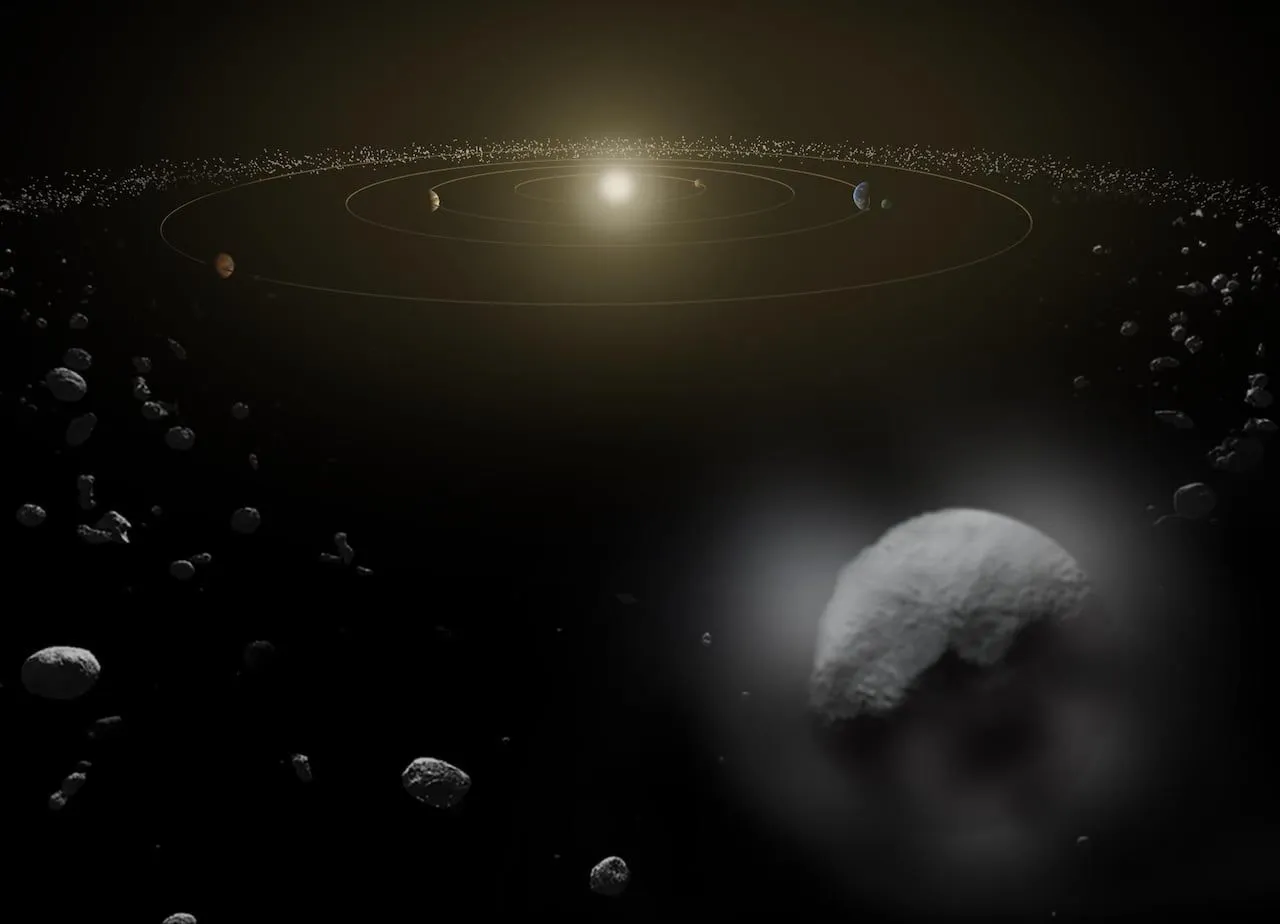
Astronomers recently discovered a new member of our Solar System using data collected by the Vera Ruben Observatory in Chile, which saw first light last winter. The object, which is out past the orbit of Pluto, is big enough to qualify as a dwarf planet.
Currently designated 2026 ED138, the object is estimated to be somewhere between 400 and 900 miles across. Its high orbital inclination (tilt) of 25 degrees carried it well off the plane of the ecliptic, which helped it avoid detection up to now. Its official naming as the solar system’s sixth dwarf planet by the International Astronomical Union will need to wait for follow-up observations and confirmation.
Starting with the closest and moving outward from the sun, the current dwarf planets are Ceres (in the asteroid belt between Mars and Jupiter), Pluto (once considered the ninth planet), Haumea, Makemake and Eris in the Kuiper Belt and the scattered disc far beyond. The discovery that Eris is about as large as Pluto led to Pluto’s reclassification as a dwarf planet.
A few more bodies in the outer Solar System — Quaoar, Gonggong and Sedna — await the International Astronomical Union’s formal recognition, but are considered dwarf planet candidates by most astronomers.
Faint objects like these are detected when multiple observations reveal their motion against the much more distant background stars. Stars move relative to each other too, but are much farther than the planets orbiting the sun. Even more precise observation and measurement is needed to determine their relative motion from year to year.
The ones we can see with our own eyes at night are the brightest and closest, which range from a few light years to a couple thousand, yet even these have essentially looked the same from year to year through human history. In dark skies, we can see the collective glow of millions more in our galaxy stretching far beyond those is what we call the Milky Way as well as the glow of another galaxy 2 million light years away, the Andromeda Galaxy.
In our little corner of the universe, planet Earth orbits the sun and the seasons come and go. Each trip brings new possibilities to learn a little more about our home, and what lies beyond. Our duty as a global species is to make the best of that.
Discoveries accelerate and our view of the Earth as a lifeboat in a vast cosmic sea is coming into sharper focus. Humanity is in high gear, but our initial reconnaissance of the solar system does not mean we’ve gained access to the stars any more than the first sailors did the planets.
As a child, I saw the sky before any manmade satellites orbited Earth. Human beings walked on the moon a little more than a decade after the first satellites were launched, and in the next half a century, robotic probes visited every planet in the Solar System.
Now I wonder about amazing views available to the crew onboard the International Space Station as I randomly spot it passing some 200 miles overhead, marvel at the images routinely delivered by two active Mars rovers and look forward to what NASA’s Dragonfly rotocraft will find flying around on Saturn’s moon Titan in less than a decade.
Our species tends to expand outward, but the stars are so much farther than the planets that their distances defy easy comprehension. Scientists do not expect that we will have the technology to build machines to reach even the nearest stars for a very, very long time.
Humanity got its first look at Earth from space 80 years ago. It was a grainy black and white image from a movie camera on board a Q-2 rocket that flew about 400 miles up, then came right back down, on Oct. 24, 1946.
On Feb. 13, 1990 — just 44 years later — Voyager 1 snapped its famous “pale blue dot” image of Earth from about 3.7 billion miles away. Now Voyager 1 is more than 16 billion miles away — the farthest spacecraft from Earth.
We absorb these new perspectives as best we can, but the current onslaught presents challenges. The stories we tell help us assimilate new ideas, and few have had the impact that the Star Trek series has, so here I honor the passing of two actors who I consider fellow cosmic travelers:
Walter Koenig played Ensign Pavel Chekov in the original Star Trek series and all six original-cast Star Trek films. He died Oct.25, 2026 at aged 90.
Patrick Stewart played Jean-Luc Picard, the commanding officer of the Federation starship USS Enterprise in Star Trek: The Next Generation. He died on Oct. 28, 2026 at the age of 86.
The strong relationships and trust among characters that made Star Trek so palatable might also work on spaceship Earth.
Find rise and set times for the sun and moon, and follow ever-changing celestial highlights in the Skywatch section of the Weather Almanac in The Republican and Sunday Republican.