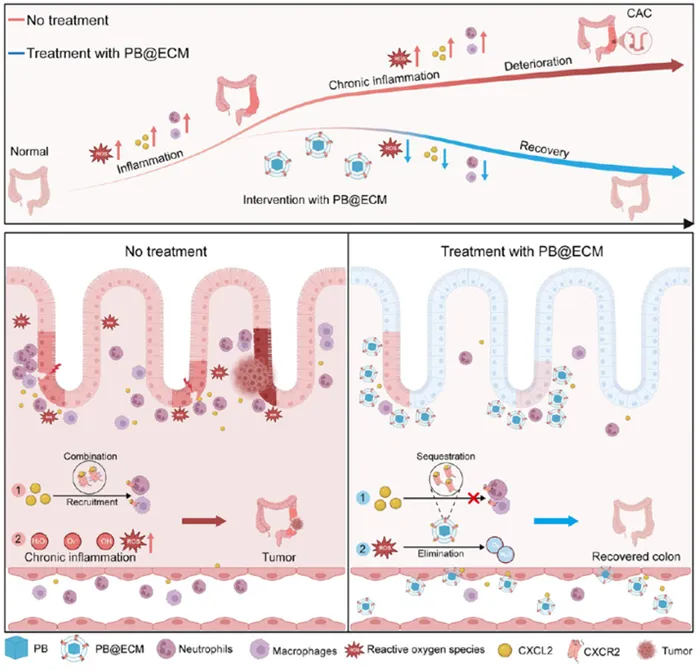
Chronic gut inflammation can become self-reinforcing: damaged tissue produces reactive oxygen species (ROS) and inflammatory signals, which draw in immune cells that can cause further injury. Over time, this cycle can contribute to colitis-associated colorectal cancer (CAC). A study in ACS Nano reports a nanoparticle designed to interrupt two parts of the cycle.
The construct, PB@ECM, pairs a Prussian blue nanozyme with a membrane from genetically engineered macrophages. The core has superoxide dismutase-like and catalase-like activities that help remove ROS. The membrane displays CXCR2, a receptor that binds the chemokine CXCL2, allowing the particle to capture this signal before it recruits neutrophils and macrophages to inflamed tissue.
The membrane therefore does more than cloak the particle: it provides a receptor-based decoy. The platform combines catalytic ROS scavenging with molecular capture of a chemokine in one construct, an approach the authors describe as a biomimetic nanozyme-decoy.
Analyses of human intestinal samples and public gene-expression datasets supported CXCL2 as a target. CXCL2 was elevated in the CAC tissue samples examined, and larger datasets linked its expression with neutrophil and macrophage infiltration. The tissue comparisons were small, however, and do not show that CXCL2 alone drives human disease.
Fig 2. The figure summarizes the study’s clinical-tissue and public-dataset analyses of CXCL2. CXCL2 was significantly elevated in the CAC tissue samples examined; dataset analyses showed positive associations with neutrophil and macrophage infiltration in IBD, and with neutrophil infiltration in colon adenocarcinoma data. The tissue ELISA comparisons used small sample numbers (n = 3). Image Credit: Nanjing University
In laboratory assays, PB@ECM captured CXCL2 and reduced CXCL2-driven migration of neutrophils and macrophages; a CXCR2 antagonist weakened this effect. The team then tested the formulation in chemically induced mouse models at early, intermediate and late disease stages.
In the late-stage CAC model, tumor incidence was 20% with PB@ECM, compared with 100% in the model-control, membrane-only and nanozyme-only groups. Treated animals also showed lower inflammatory signals and immune-cell infiltration, and significantly longer survival. The tumor analysis included five animals per treatment group and four model controls; the survival analysis included six mice.
Fig 3. In the late-stage AOM/DSS mouse model, PB@ECM treatment was associated with reduced tumor burden, lower inflammatory markers and improved survival. Tumor incidence was reported as 20% in the PB@ECM group versus 100% in the AOM/DSS model-control, ECM-only and PB-only groups. The tumor-incidence analysis included n = 5 in the treatment groups and n = 4 in the AOM/DSS group; survival analysis included n = 6. Image Credit: Nanjing University
The study offers preclinical evidence that combining ROS scavenging with chemokine capture can alter a disease-associated immune environment; it does not establish efficacy in people. The authors identify membrane stability, batch consistency, scale-up, long-term immunogenicity and the relative contributions of the two functions as questions for further study.