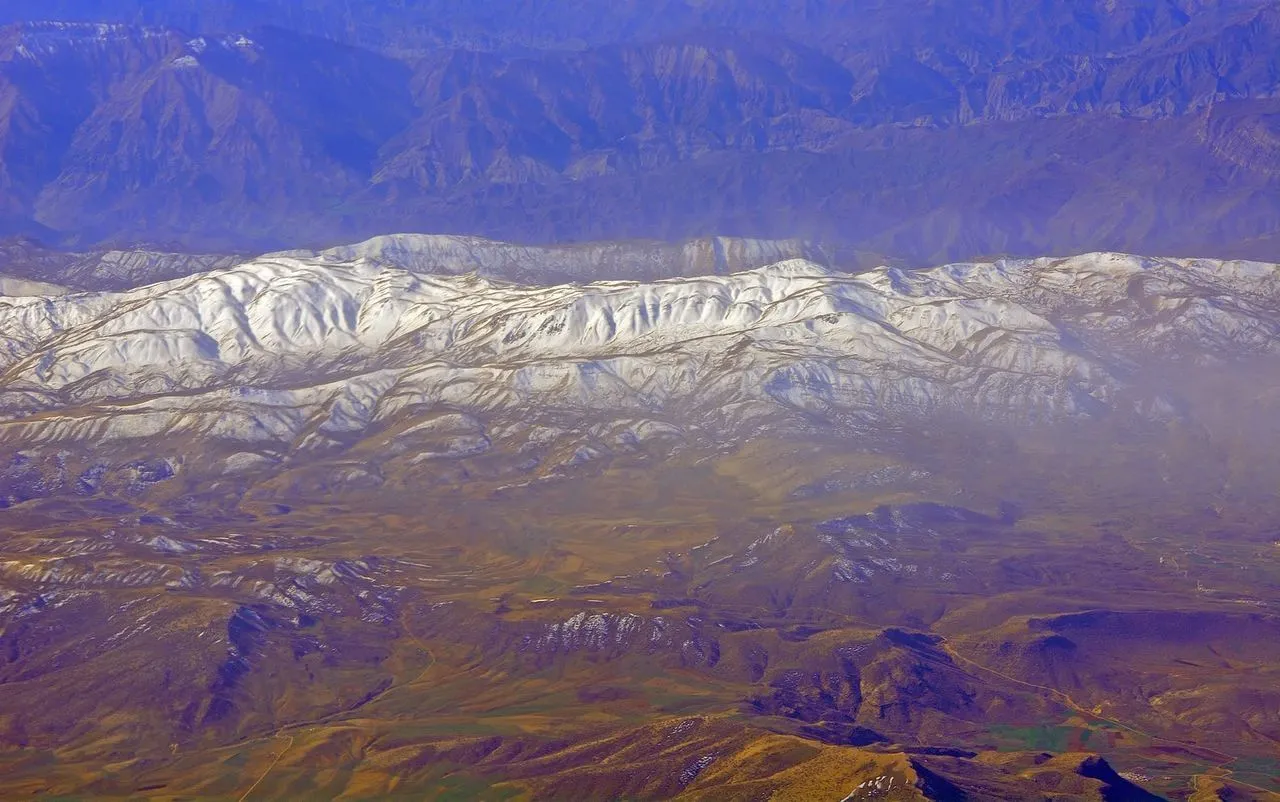
Two enormous tears are developing within the Arabian Plate beneath southeastern Iran, and researchers say the ruptures could eventually meet. The discovery offers a rare look at what happens deep underground when an ocean closes and continents collide.
Here's what to know
A team headed by scientists at the Chinese Academy of Sciences identified the ruptures in research appearing in Nature Geoscience, ScienceAlert reported.
Near the Makran Trench, the smaller, shallower rupture runs vertically. The horizontal tear lies at the junction of the Zagros collision and Makran subduction zones.
In Makran, oceanic rock has descended at least about 280 miles (450 kilometers). To the west, in Zagros, continental rock has reached no deeper than about 186 miles (300 kilometers).
More background
A collision does not affect both rock types in the Arabian Plate the same way, and that contrast helps explain the tears.
According to ScienceAlert, its oceanic portion originated in the ancient Neo-Tethys Ocean. Its descent beneath a neighboring plate is known as subduction; this section consists of relatively thin, dense basalt.
Mountains form when the continental portion encounters resistance rather than sinking readily underground. Its rock is thicker, less dense, and granite-like, making it resistant to being pulled down.
The researchers suggest that plate movement drives the second, shallower tear more than differences in rock density do.
That rupture likely began near the junction of the Makran Trench and a boundary where plates slide past one another. It then spread southward as continental rock advanced northward.
What's being done?
Vibrations from distant earthquakes gave researchers a way to examine structures they could not otherwise access.
The team analyzed recordings collected by 69 seismic monitoring stations between March 2017 and September 2018. Scientists can reconstruct activity deep underground from those waves because their speed varies with rock temperature and density.
The resulting models indicate that the ruptures have developed over millions of years, according to ScienceAlert. As they advance, the ruptures gradually consume the boundary between oceanic and continental rock, making an eventual merger likely.
Hot magma appears to be filling some of the gaps opened by the ruptures. Understanding how the tears connect could help scientists investigate how this underground movement affects volcanism in the region.
The Wilson Cycle describes how oceans form, expand, and disappear.
"The transition from oceanic subduction to continental collision is a key stage in the Wilson Cycle. Yet, key processes governing this transition remain unclear owing to sparse observations of structure at depth," the researchers wrote in their paper.
Where can I learn more?
The tears beneath Iran offer a glimpse of how Earth's crust breaks and moves.
• In Italy, the crust is unzipping beneath the Apennines, helping drive seismic activity along the mountains.
• In New Jersey, scientists traced an earthquake felt by millions to a previously unmapped fault.
• Norway's biggest earthquake in a century triggered an avalanche that buried an Arctic glacier.