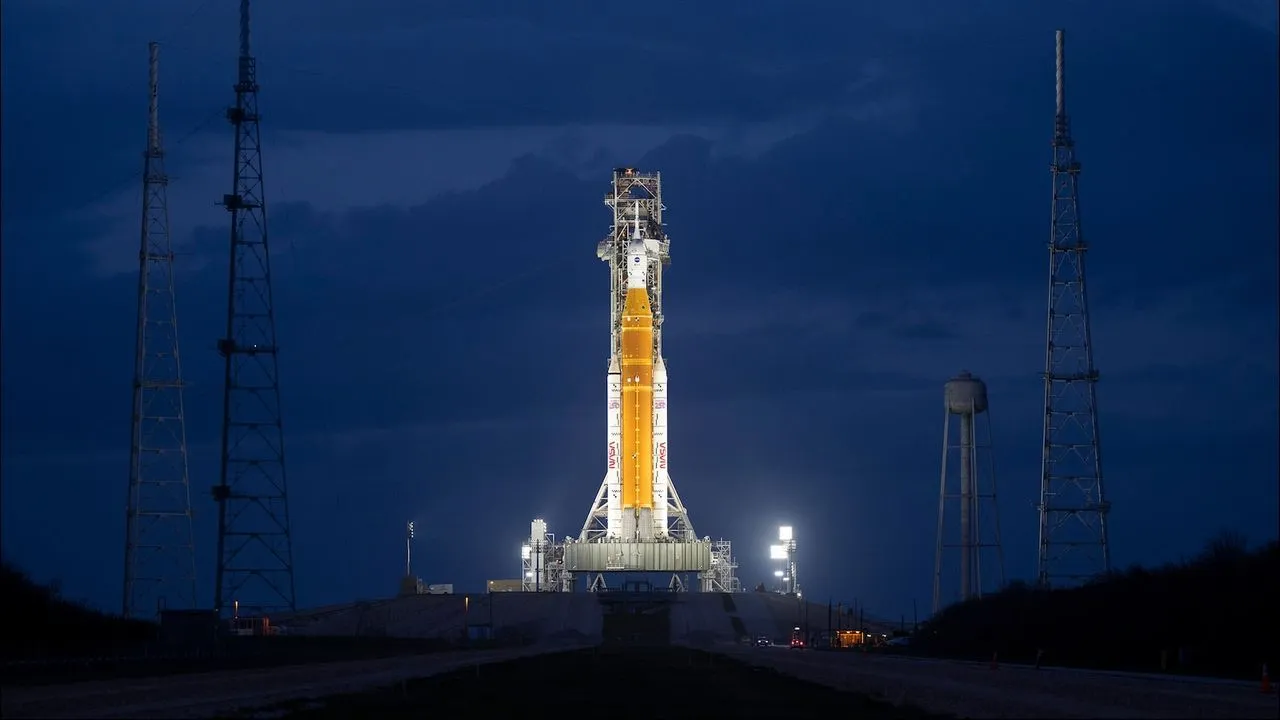
The Artemis II mission launched in April this year created a temporary 'hole' in Earth's upper atmosphere, a recent study has found. Published in the scientific journal Geophysical Research, researchers at National Cheng Kung University in Taiwan said the spacecraft's launch and later rocket exhaust burns caused three separate disturbances: one during lift-off, another about two hours later, and a third over 24 hours later.
Launched on April 1, Artemis II, carrying Reid Wiseman, Victor Glover, Christina Koch and Jeremy Hansen, was the first manned mission to the Moon in more than five decades.
"The launch at 2235 UT on 1 April 2026 from Kennedy Space Center, USA, induced shock-acoustic and gravity wave modulations. Subsequent Apogee Raise Burn performed at 0023 UT on 2 April triggered shock waves and unprecedented large-scale disturbances that elongated ~50° longitude across North America," the study highlighted.
"The third orbital maneuver conducted as part of trans-Lunar injection burn at 2349 UT on 2 April, about 25 hours after liftoff, again yielded similar, but weaker large-scale ionospheric perturbations."
These holes stretched across the American continent from East to West like giant 5,000-kilometer (3,100-mile) contrails.
"This is the first time a single space mission produced three instances of ionospheric disturbances over the same region during successive orbit maneuvers," the study stated.
The disturbances occurred in the ionosphere, a region of Earth's upper atmosphere through which GPS signals travel. Changes in this region can impact the speed of GPS signals, which, in turn, alter positioning accuracy.
“It could have a strong impact not only on self-driving cars but also on drone positioning,” study co-author Charles Lin was quoted as saying by Space.com.
While researchers found changes in the part of the atmosphere that can affect GPS accuracy, they didn't report a widespread GPS outage caused by the mission.
Also Read | Teen Girl Kidnapped For 500 Days Rescued After Playing Among Us To Alert Another Child
Artemis II Mission
During the mission, the crew set a record for the farthest distance humans have ever traveled from Earth, surpassing the record of 248,655 miles previously set by the Apollo 13 crew in 1970, according to NASA. The crew was also able to capture images of the far side of the Moon.
The mission acted as a crucial test flight for the Artemis programme to enable a lunar landing by 2028. The crewed mission evaluated the SLS rocket and Orion capsule, paving the way for sustained human lunar exploration and future Mars missions.