Synopsis
A comprehensive study on fish collective movement has found that this behavior has independently evolved across numerous species over time. Surprisingly, about 79 percent of fish utilize collective movement, while others favor solitary habits. However, certain species have abandoned collective traits, likely due to the challenges of heightened food competition and disease risks. This research highlights the intricate evolution of social behavior within marine ecosystems.
Listen to this article in summarized format
Loading...
×
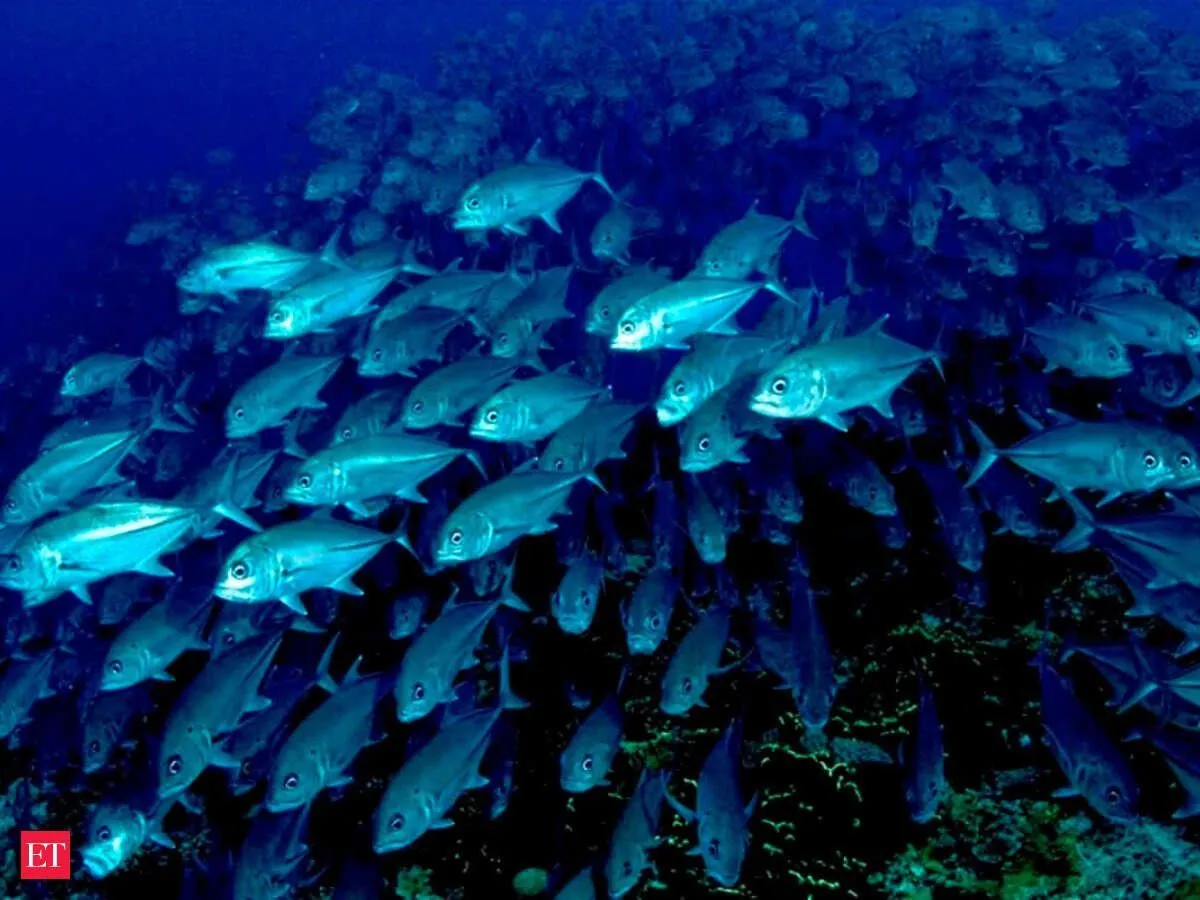
Have you ever chosen a restaurant based on the queue, or scrolled past a post because it had thousands of likes? While following the herd seems to be a modern trend enabled by group chats and the ‘trending’ tab, the concept is actually much older. Fish have been experimenting with following the herd. According to the Cornell Chronicle, a new study titled “Evolutionary dynamics of collective behavior across the tree of ray-finned fishes,” by J. Love et al., published in the Proceedings of the National Academy of Sciences on Nov. 6, 2026, looked into how collective movement in fish evolved using machine learning. Independently, lineages of fish gained the capacity for collective movement around 60 times, and lost it around 320 times, over the past 350 million years. If collective movement was always beneficial, we would expect it to always be used. What the researchers found is below.
A study bigger than your average fish tank
As per the Cornell Chronicle article, the researchers looked into collective movement amongst 2,839 species (nearly 10 per cent of the total 39,000 living species). This is one of the largest studies done on the evolution of behaviour within a group of species. They trained a text transformer (the same technique utilised in large language models) to read textual descriptions of species. They also utilised machine learning to look at images taken by citizens from iNaturalist and other sources to see if the fish were moving cohesively.
Graph showing schooling response time for schooling fish (red line) and solitary fish (green line) in the face of predators. Image credits: Wikipedia
However, it should be noted that each species was labelled either as “solitary” or “collective,” with confidence scores, per a separate April 2026 paper titled “Collective behavior drives diversification across the tree of ray-finned fishes,” first published as a preprint on bioRxiv from the same research team. This means the model is estimating which label best fits each species, not counting how many individual fish within a species move collectively. From the preprint, we can see that 79 per cent of the species in this dataset move collectively.
The plot twist: leaving the group
Live Events
According to the Cornell Chronicle, senior author Andrew Hein said that the experts expected collective movement to rarely be lost, but they found hundreds of examples of collective movement evolving in a lineage and then being lost in a solitary daughter species. The obvious reason for group movement is that it is safe. Species at the bottom of the food chain were more likely to move collectively.
Schooling behaviour in bluestripe snappers. Image credits: Wikipedia
But this was not always the case, with many species at the bottom not moving collectively and many species at the top moving collectively. Predators that move collectively almost always hunt prey that also moves collectively. Lineages where all species moved collectively had greater diversity; however, the researchers cannot tell if this is due to increased speciation rates or decreased extinction rates.
So why quit? This is currently unknown. The researchers suspect that collective movement comes with three downsides: false alarms causing the whole school to scatter, increased competition for food, and increased risk of disease on longer time scales. Funding for the study came from the National Science Foundation.
The false-alarm problem, up close
One of these three downsides, the false-alarm problem, already has some earlier evidence behind it. Cornell Chronicle’s coverage of a 2023 PNAS paper titled “Wild animals suppress the spread of socially transmitted misinformation” noted that footage of wild coral reef fish in French Polynesia revealed individuals within schools scattering to seek shelter in the absence of a threat approximately every 8 minutes.
They found that fish in high-density schools decreased their sensitivity to startle cues from nearby fish, lowering the odds that a false alarm would spread through the group. This suggests that other animals, maybe even humans, could have similar mechanisms, although further research is required. Imagine mimicking a crowd crossing the road and finding out the light is still red.
Although this was a study looking into fish evolution, and the researchers do not claim it to be anything else, it is a good reminder that even creatures who have practised ‘everyone’s doing it’ for 350 million years have never had a perfect strategy.
(You can now subscribe to our Economic Times WhatsApp channel)
(Catch all the US News, UK News, Canada News, International Breaking News Events, and Latest News Updates on The Economic Times.)
Download The Economic Times News App to get Daily International News Updates.
...moreless
(You can now subscribe to our Economic Times WhatsApp channel)
(Catch all the US News, UK News, Canada News, International Breaking News Events, and Latest News Updates on The Economic Times.)
Download The Economic Times News App to get Daily International News Updates.
...moreless
Explore More Stories
Sass Jordan cause of death: How did ‘Racine’ singer die after cancelling shows over ‘serious medical condition’?
Canadian rock singer Sass Jordan, voice behind ‘Make You a Believer’ and ‘Tell Somebody,’ dies at 63
Helicopter crash on Montreal’s South Shore leaves 4 dead; Transport Minister expresses condolences as probe begins
Nova Scotia teacher charged with sexually assaulting student at school as police identify more victims
Nova Scotia Crime: Teacher faces multiple serious charges, prohibited from public places after alleged assaults at Riverton school
Psychology explains why people who dislike being interrupted may be protecting more than just their train of thought
Powerball jackpot climbs to $313 million for September 21 drawing - Here's what Monday night's winner could take home
Quote of the Day by Malala Yousafzai: ‘One child, one teacher, one book, one pen can…’ - How one person can spark global change with the simplest tools
Quote of the Day by Thomas Mann: ‘Whoever loves the more is at a disadvantage and must suffer’ - Nobel-winning novelist on why the person who care more may have more to lose
Quote of the Day by Anton Chekhov: ‘Every happy man should have someone with a little hammer at his door to knock and remind him that there are unhappy people, and…’
Gary Myers death: NASCAR legend dies at 76; sons mourn ‘hero’ who shaped four generations of racing
Quote of the day by Rita Wilson: ‘Be fearless in trying new things, whether they are physical, mental…’ – Sleepless in Seattle actress on turning fear into growth
Manager keeps booking 4:45 PM Friday meetings despite team logging off at 5, employee calls it a ‘Friday ambush’ and asks if it’s a power move
1
2
3