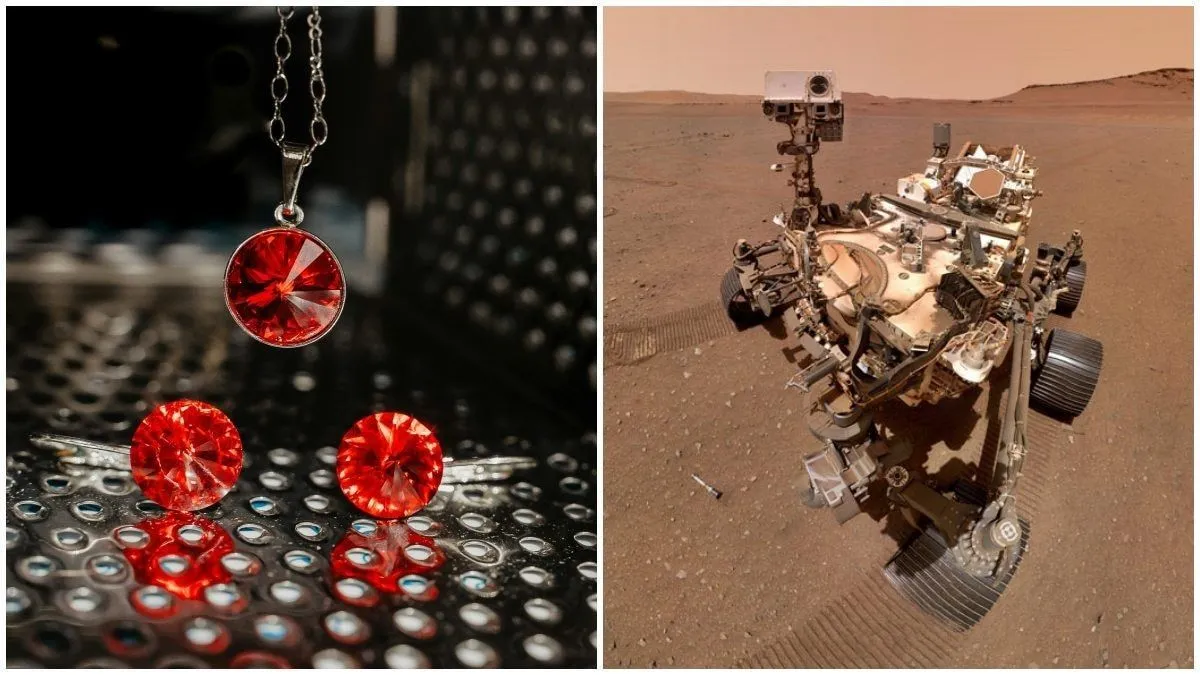
Could Mars be hiding tiny ruby crystals beneath its dusty surface? NASA's Perseverance rover has made an intriguing discovery that could offer new clues about the Red Planet's violent geological past.
The rover has detected a distinctive red luminescence signature in light-coloured rocks on Mars, pointing to the presence of chromium-bearing corundum, the mineral family that includes rubies.
The discovery was made using SuperCam, one of the advanced scientific instruments aboard Perseverance. The instrument is designed to study the chemical and mineral composition of Martian rocks using a laser and several spectroscopic techniques.
Scientists were particularly surprised when SuperCam detected strong, narrow luminescence peaks at wavelengths of 692.7 and 694.1 nanometres while analysing a light-coloured Martian rock.
These emissions are associated with chromium atoms present within the crystal structure of corundum. On Earth, chromium-containing corundum is known as ruby, the precious gemstone famous for its brilliant red colour.
SuperCam's ability to perform time-resolved luminescence measurements allowed researchers to examine the delayed emission of light from these atoms and establish the mineral's identity.
The findings, published in the journal Geophysical Research Letters by a team led by Ann Ollila, demonstrate how an unexpected capability of the instrument is helping scientists investigate Martian geology.
However, this does not mean Perseverance has discovered large ruby deposits or gemstone-quality crystals on Mars. Scientists have identified tiny corundum crystals, which are scientifically valuable because of what they reveal about the planet's geological history.
The discovery is particularly interesting because corundum is generally associated with metamorphic and pegmatitic geological environments. Mars, unlike Earth, does not have an active plate tectonic system that drives many of these geological processes.
Scientists believe ancient asteroid and meteorite impacts could provide an alternative explanation. Powerful impacts can generate intense heat and pressure, triggering localised metamorphism in surrounding rocks over extended periods.
Perseverance is exploring an ancient geological terrain near the rim of Jezero Crater, where evidence of such impact-related processes could be preserved.
Researchers are now using SuperCam's luminescence capabilities more frequently on light-toned rocks to search for additional evidence of these processes.
While Mars may not yet have revealed a treasure trove of rubies, these microscopic mineral clues are helping scientists uncover a much bigger story: how the Red Planet evolved billions of years ago.
- Ends