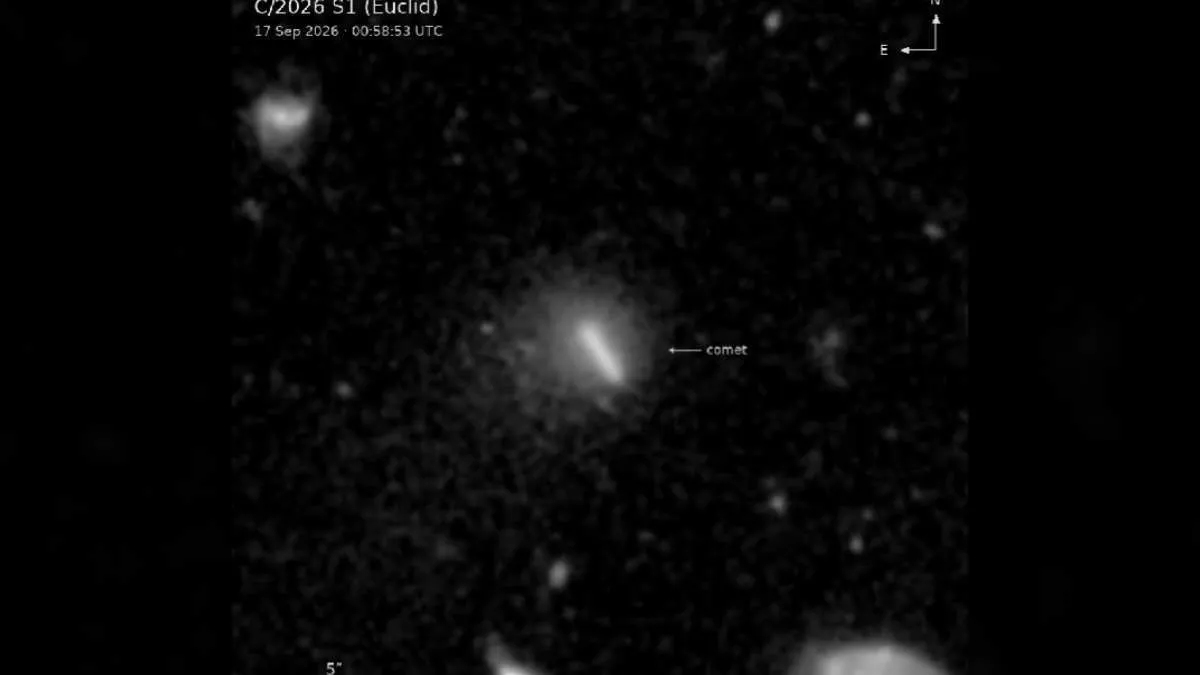
The European Space Agency's (ESA) Euclid space telescope has discovered a comet, the first in the mission's history. The comet is about 807 million miles (1.3 billion km) from Earth. Euclid spotted it in observations made between September 16 and 24. The comet is speeding between the orbits of Jupiter and Saturn. Euclid launched in 2023 with contributions from NASA, and hunting comets was never part of its brief. The team checked existing comet records before confirming this one was new.
The Streak
Mikko Pöntinen, a scientist at the University of Helsinki, made the initial find with the Solar System Objects Science Working Group within the Euclid Consortium. His software flagged a streak smeared across several images, the mark of a blazing fast-moving object. He predicted its position and picked it out in five image sets in total. A fuzzy cloud around it pointed to an active comet shedding dust and gas. "I was excited to see my software flag a 'streak,'" Pöntinen said in a statement.
Euclid’s Core Mission
Euclid is designed for a perpetual slow gaze at distant galaxies, with the aim of studying dark energy and dark matter. The comet’s discovery means the telescope could be pointed at comets in the far reaches of the solar neighborhood. This will help researchers recognize comet trails as noise in Euclid's field of view. Will this detect any interstellar interlopers? We’ll see.
Euclid’s Treasure Trove
Euclid's first big data release, DR1-Foundation, was released on November 12. It is the first release to show the telescope working as a sky surveyor, with 1,900 square degrees of sky in visible and near-infrared light and 1.7 million GB of data. The data holds over 900 million galaxies and around 15,000 strong gravitational lensing candidates. It also has over 60 million quasar candidates and spectra from more than 160 million sources. The full Euclid Wide Survey is planned to cover 14,000 square degrees.
See Also: ESA's Euclid Telescope Renders Incredible Images Of Gravitational Lensing & More: Check Pics
Cover: ESA