A few musicians can hold a beat together, but an orchestra with no conductor tends to drift apart. Physicists have now built a sheet of material that does the opposite, and ends up making unified waves.
Nudge it, and dozens of small motorized cells begin to twitch on their own, each at its own pace. Over a few seconds the twitches merge into one slow pulse that the whole sheet keeps, and there’s no clock telling it when.
The team at the University of Amsterdam and the University of Birmingham calls the merging process wave coarsening.
The final state is what physicists call a time crystal: matter that repeats a motion in time the way an ordinary crystal repeats a pattern in space.
“Our research provides a striking example of spontaneous organization – tiny vibrations organizing themselves until an entire material moves in a coordinated way,” said Jack Binysh of Birmingham, a co-lead author who began the work in Amsterdam.
“Like musicians gradually finding the same beat, individual parts of an active material can organize their movements until the whole structure moves together.”
Cells that push back unevenly
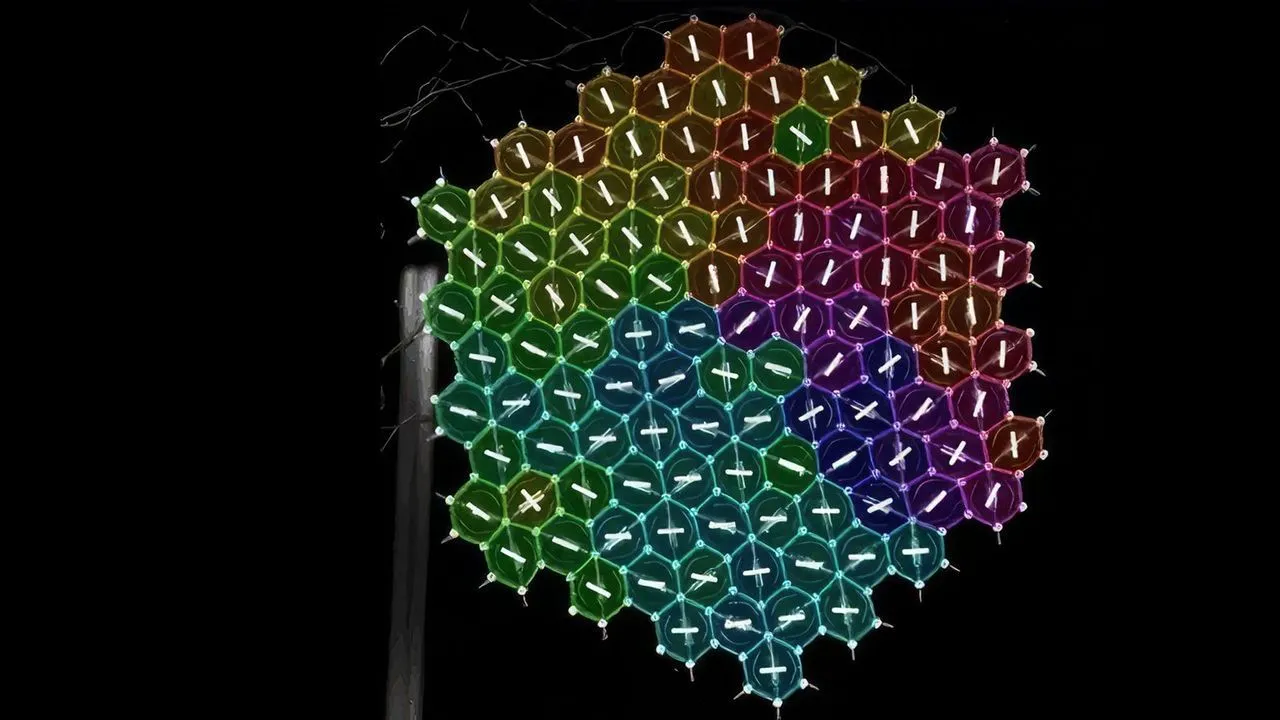
Each cell of the material is a trio of elastic hexagons wired to a small circuit board. A sensor reads how each hexagon is squeezed, and a voice-coil actuator, the kind found in a loudspeaker, pushes on it.
The board follows one rule. When a hexagon is compressed, its clockwise neighbor is compressed too, and its counterclockwise neighbor is stretched.
The rule breaks a symmetry that ordinary materials obey. Push on a spring and it pushes back the same way whichever end you push.
These cells respond differently depending on direction, which physicists call non-reciprocal. They can only do it because each one has its own power.
The team built 37 of these cells into a honeycomb and set it on a glass plate slicked with Teflon so it could slide freely. Then they turned the pushback strength past the point where a single cell starts to oscillate on its own.
Twitches that grew into a pulse
Given a shake, each cell began vibrating at about 30 times a second. Then something slower took over.
A longer wave crept around the edge of the material in one direction, growing in wavelength, in period, and in size, until it drowned out the fast twitching. A few seconds in, every cell was shearing back and forth together on one steady rhythm.
The team ran the experiment six times, each from a different random jolt. Each time, the distance over which cells moved in step grew by a power law while the vibration’s energy rose.
A mathematical model of the sheet reproduced the same growth on a line and on a grid. In the model, energy is pumped in without pushing or spinning the sheet as a whole.
The last step is what makes the words time crystal apply.
In simulations, the team subjected the final oscillation to noise. The larger the sheet, the longer its rhythm held, a sign that the order survives at scale rather than being washed out by small disturbances.
A ring did the same thing
To check that the effect was not a quirk of one design, the team built a second material. It was an elastic ring carrying 24 small torque motors that twist in response to their neighbors, floated on an air table.
Any small disturbance of the material set off short waves around the ring, which merged into longer ones.
The ring’s shapes took turns. A six-lobed pattern grew first and briefly dominated, then a five-lobed one caught up and overtook it, then four, each dying as the next longer shape took over.
In the end the ring settled into a slow cycle around a flattened, pancake-like shape.
“Wave coarsening could be exploited as a way of controlling shape changes and directed motion – proving useful in robotics, active matter and optomechanics,” Binysh said.
“Our discovery could form a key step towards the development of biology-inspired multifunctional robots.”
Friction stops the merging
The coarsening stops if the material can push against something. When the team removed the Teflon so the honeycomb rubbed on the glass, the short waves kept circling and never merged into the whole-sheet pulse.
In the model, friction sets the wavelength at which the waves get stuck.
The team also simulated a much larger disc of 5,813 cells. There, coarsening started everywhere at once, but waves along the rim soon took over.
They ran in one direction around the edge, the way currents run around the edge of certain quantum materials.
On a ring-shaped disc, the inner and outer edges carried waves in opposite directions and, with friction added, the two stayed at the edges instead of invading the middle.
Many questions remain
Both the model and the simulations of growing size confirmed the time crystal. The physical sheets of material had 37 and 24 cells. The honeycomb is flat and only shears.
What wave coarsening does in a three-dimensional material that can bend and twist is untested, and that is what the team wants to build next.
The applied question is whether one material can hold several stable rhythms and switch between them. Co-lead author Jonas Veenstra, now at ENS de Lyon, said the group has started to think about it.
Each pattern could get a different job, such as a shape change or a direction of travel, and a single material could then do the work of several machines.
Such a material would be a step toward robots that coordinate the way flocks and fireflies do, with no central controller, a direction the Amsterdam group has already explored.
Corentin Coulais leads that group, with Anton Souslov of the University of Cambridge as co-corresponding author and co-authors at Delft University of Technology and Leiden University. The materials, Coulais said, carried more than 100 sensors and actuators.
The full study was published in the journal Nature.
—–
Like what you read? Subscribe to our newsletter for engaging articles, exclusive content, and the latest updates.
Check us out on EarthSnap, a free app brought to you by Eric Ralls and Earth.com.
—–