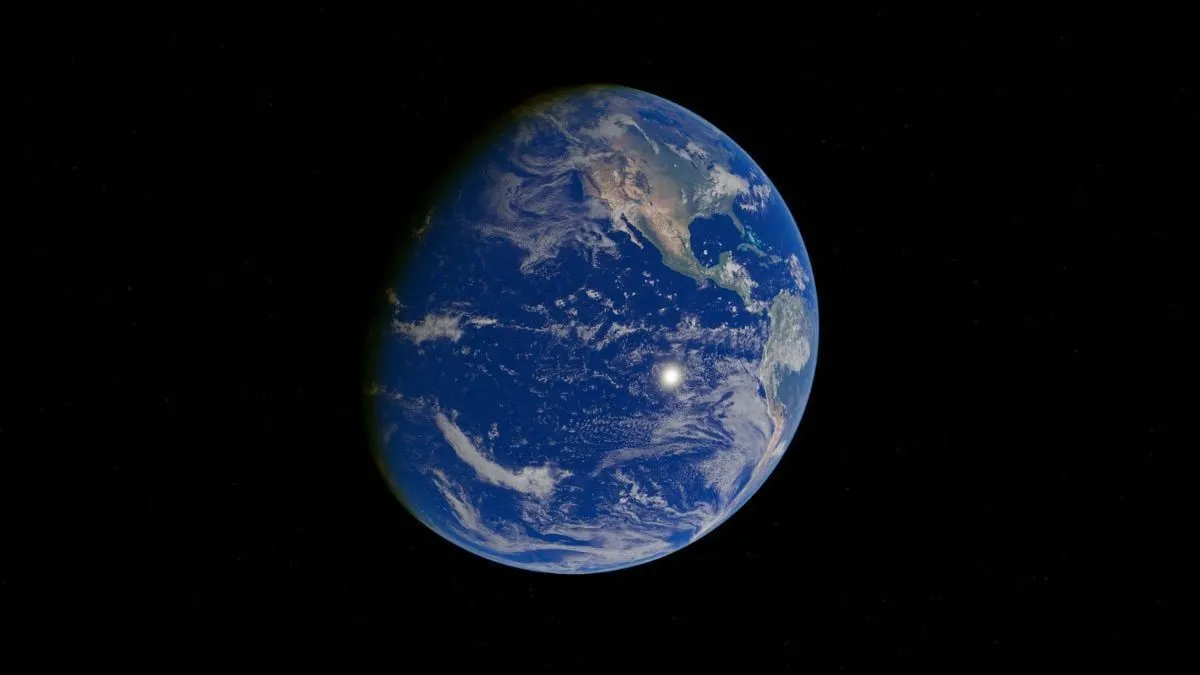
New Delhi: Scientists at the University of Washington have developed a computer simulation of Earth without life, demonstrating that a planet could potentially maintain habitable conditions for billions of years without any living organisms.
Published in The Planetary Science Journal on 18 September, the study simulated Earth’s evolution over five billion years, from its early history to approximately 500 million years into the future.
The researchers developed a model that tracks the movement of heat, water and chemicals between the planet’s core, mantle, crust, surface and atmosphere.
Despite excluding biological activity, the simulation reproduced 19 key properties of preindustrial Earth, including surface temperature, ocean mass, and heat flow from the planet’s interior.
Can a planet remain habitable without life?
Earth is currently the only planet known to support life. Scientists searching for extraterrestrial organisms typically focus on planets with conditions suitable for liquid water.
However, finding a habitable planet does not necessarily mean that life exists there.
“This model can help us see how habitable but non-living planets might mimic living planets,” lead author Samantha Gilbert-Janizek.
The researchers found that geological processes alone could potentially sustain an Earth-like climate over billions of years.
Their findings also have implications for the Gaia hypothesis, which proposes that life helps maintain environmental conditions suitable for its continued existence.
The simulation suggests that life may not be essential for maintaining habitable conditions, although biological processes significantly influence Earth’s actual environment.
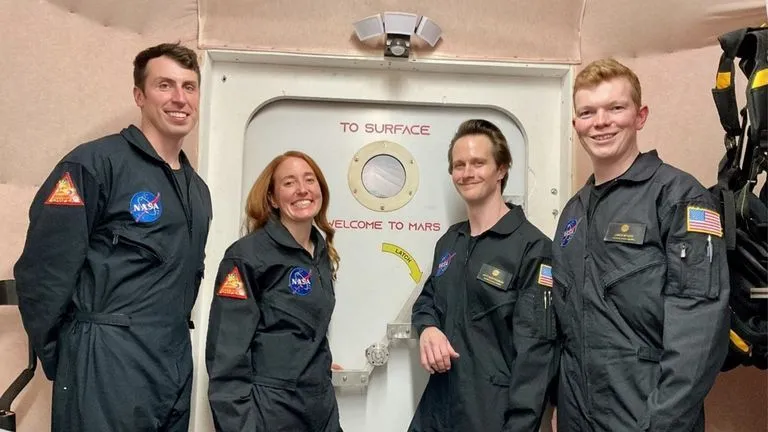
Also read: 4 NASA volunteers complete 378-day Mars simulation, emerge after year in isolation
Searching for signs of alien life
Scientists hope to use the model to distinguish between atmospheric chemicals produced by geological processes and those that could indicate biological activity.
On Earth, organisms continuously replenish gases such as oxygen and methane, which can react with and destroy each other. Detecting comparable chemical imbalances on another planet could provide evidence of life.
Researchers can now simulate how a rocky planet’s atmosphere might develop without biological activity and compare the results with telescope observations.
Senior author Rory Barnes described the research as “an exciting step toward understanding where life can exist in the universe”.
The model could also support the development of NASA’s proposed Habitable Worlds Observatory, which aims to study Earth-like planets orbiting Sun-like stars.
However, the researchers acknowledged several limitations, including simplified representations of clouds and atmospheric chemistry. Their simulation demonstrates one of many possible evolutionary pathways rather than proving that Earth would have remained habitable without life.
Further refinements will be needed before the model can reliably distinguish biological activity from geological processes on distant planets.
(Edited by Aamaan Alam Khan)