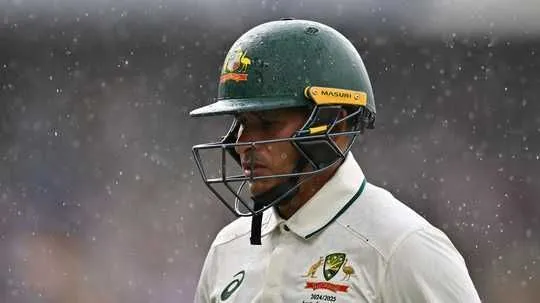
Usman Khawaja says he was told three of South Africa’s players were, like the Australians, ball-tampering during the March 2018 Test series between the teams. Kagiso Rabada was the leading wicket-taker in the rubber with 23 strikes at 19.26. Did he feel Khawaja’s claim tainted his achievement?
“My take on it is we’re not concerned about what they have to deal with,” Rabada told a press conference in Johannesburg on Friday. “It’s not our topic to deal with. It’s obviously an Australian topic. I don’t see where we get involved in that.”
In fairness to Rabada, he wasn’t asked the question above. Or whether he thought Khawaja’s allegation was credible. Or whether he had discussed the assertion with his teammates. Instead he was asked whether he had “seen the blowback that’s currently happening in Australia” and “what’s your take on it?”.
Khawaja’s bombshell is included in his autobiography, “Sabr”, which was published on Tuesday. The book has rekindled the embers of controversy over what has come to be called Sandpapergate into a raging blaze.
A CA investigation at the time found that guilt attached only to then captain Steven Smith, David Warner — the vice-captain and the plan’s mastermind — and Cameron Bancroft, who was caught on camera rubbing sandpaper on the ball to increase the chances of obtaining reverse swing. Smith and Warner were banned from playing for a year and Bancroft for nine months.
Khawaja’s central accusation is that the entire Australia team knew of the plot. He told Nine media on Saturday: “It was all of us. Not the batters, not the bowlers, not the staff. All of us."
Pat Cummins, who played in the series, called a press conference in Sydney on Tuesday. “When [Khawaja] says we all knew, if by that he means we knew sandpaper was going out on the field, he’s 100% wrong,” Cummins said. He rubbished Khawaja’s claim as “complete and utter nonsense”.
Even so, calls for a new investigation into the saga are growing louder. That Australia have lost four of their last seven Tests — including two in South Africa last month — only adds to the pressure they are under.
“I haven’t read his book, nor am I interested in his claims or remarks,” one said. “I hope he has evidence for what he has said.”
The different attitudes to ball-tampering in South Africa and Australia make an intriguing subplot to the drama. “Australians play hard but fair,” an Aussie said over dinner in Cape Town this week. “That’s why this came as such a shock.” Contrast that with not a public peep of protest being uttered in South Africa when Proteas players have been caught doing the same thing.
Faf du Plessis was done for ball-tampering during a Test against Pakistan in October 2013, Vernon Philander in Galle in July 2014, and Du Plessis again in Australia in November 2016. Sandpaper wasn’t among their weapons of choice. Du Plessis used the zip on his trouser pocket in 2013, and, three years later, saliva from his mouth — which contained a sugary sweet — to try to make the ball swing. Philander used his fingernails to scratch the ball. Both methods are open and shut cases of ball-tampering.
Yet South Africans don’t seem to care. That includes CSA, who unlike CA left it to the ICC to punish their errant players. Cricbuzz asked a former senior crew member with SuperSport, South Africa’s host broadcaster — whose cameras caught Bancroft in the act — why repeat offenders South Africa have never been exposed in their own country. “Because they don’t do it at home,” came the glib and wholly unconvincing reply.
Rabada and his teammates will hope no such controversy comes their way in the Test series against Bangladesh that starts at the Wanderers on Sunday. South Africa are riding the rest of a wave that has put them on top of the world rankings and in a solid position to defend the WTC title they won at Lord’s in June last year. In the course of helping to beat Australia 2-1 last month, Rabada reached 350 wickets in the fewest deliveries in Test history.
England will play three Tests in the country in December and January, rounding out a bumper summer in the format for a team who didn’t play a home Test for 20 months before October this year.
Rabada said he saw playing for South Africa as “a blessing; it’s a gift. It’s something not a lot of people get to do. Each and every day I have the opportunity to represent my teammates and myself is me continuing to live my dream.” He hoped the Bangladesh series would continue to “show how healthy cricket is”.
“It feels really good to be the No. 1 team in the world. After going through all the ups and downs it pays off to keep at it, to keep playing for the badge and not give up. It’s not always plain sailing.”
It wasn’t initially against Australia, who won the first Test at Kingsmead. South Africa found a way to win at St George’s Park despite most of the first two days being lost to rain. Then they triumphed by an innings at Newlands to seal the most enthralling series in this country in living memory.