A new book on the 50 best Test cricketers of all time wades into the debate armed with stats and stories
Tim Wigmore
Published: Nov 5, 2026, 2:32 AM (7 hrs ago)
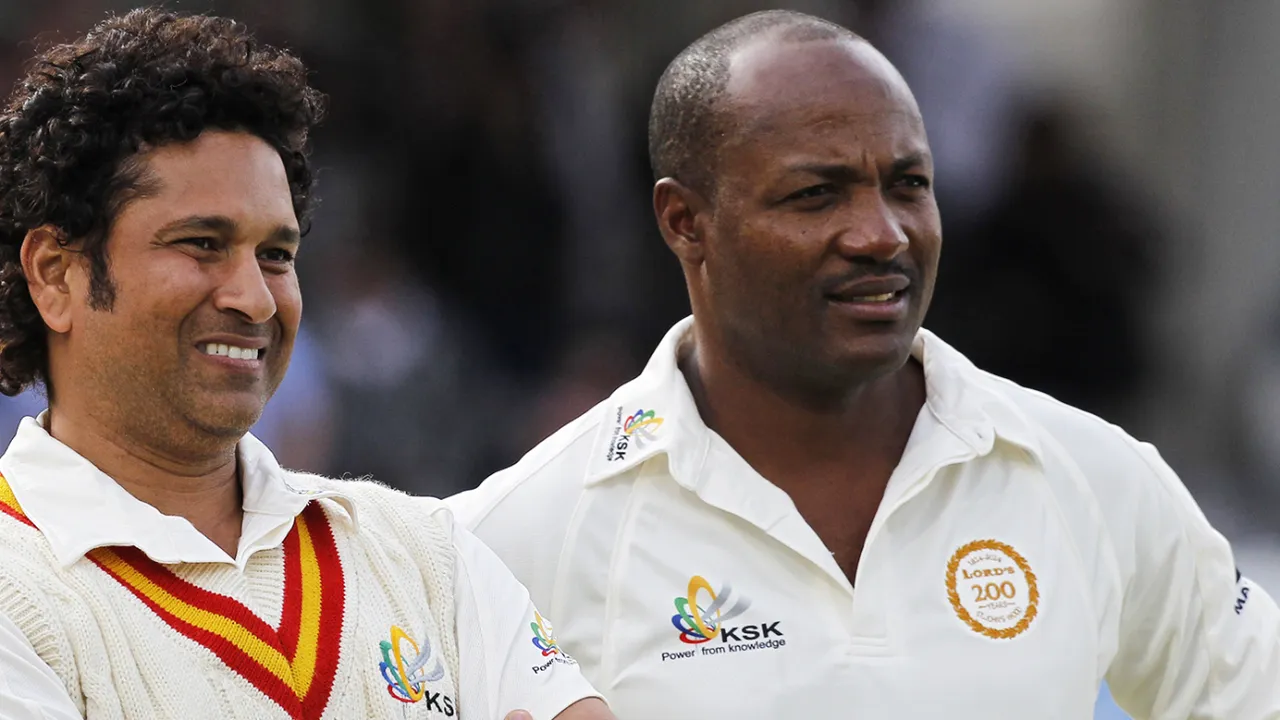
In British pubs, the eternal question of the 1990s was: Blur or Oasis. The debate in cricket grounds was: Brian Lara or Sachin Tendulkar?
Even now, the debate over who was the better Test batsman remains visceral. Tendulkar, the prodigy of the Mumbai maidans turned relentless run-scorer, and only man to reach 200 Test caps; and Lara, the dashing prince of Trinidad.
Lara, the tenth of 11 children, was more individualistic; he honed his game with an ample dollop of street sport alongside his formal coaching. Tendulkar's education was more didactic. His coach, Ramakant Achrekar, preached an orthodox technique.
On the large boundaries in the maidans, "one had to run quite a bit between the wickets to score runs, which can become tiring," Tendulkar told me. 'When you are tired, the first thing that happens is that you lose concentration. Hence playing in those maidans in my school days was a good way to train and develop the habit of concentrating and maintaining focus for long hours."
Related
Head-to-head stats for Lara, Tendulkar, Murali Warne (2013)
The man whom cricket loved back (2013)
Fly Lara fly (2016)
The greatest internationals of the century No. 2: Sachin Tendulkar
These contrasting upbringings manifested themselves on the pitch: Lara was more effervescent, Tendulkar more methodical. Tendulkar prepared for each delivery by tapping his bat down on the pitch in conventional style; Lara's characteristic high backlift combined audacity with a scintilla of vulnerability. "In terms of pure aesthetics and a joy that you wanted to watch at the crease," said former England captain Michael Atherton, "I don't think there has been a more attractive player than Brian Lara."
The best indication of Lara's qualities, perhaps, is not that he twice set a new record for the top Test score - hitting 375 and 400, a decade apart. Rather, it is that neither innings would rank among his five best.
In the first Test against Australia in 1999, West Indies were bowled out for 51. When Lara arrived in Jamaica for the second match, he had not scored a Test century for 21 months. At the toss he told Australia's captain, Steve Waugh: "This could be the last time I'll be doing this."
Late on day one, Lara walked out to bat with West Indies 5 for 2, which swiftly became 34 for 4. His arrival was greeted by boos; a chipped bone in his right elbow exacerbated Lara's challenge.
Australia possessed one of the greatest bowling attacks of all time: Glenn McGrath and Shane Warne, supported by fast bowler Jason Gillespie and legspinner Stuart MacGill. Yet Lara batted throughout the second day unbeaten. His regal 213 turned West Indies' despair into a resounding victory. To Tony Cozier, the voice of Caribbean cricket, Lara's innings was the most important in the team's history. To Lara, "The pressure that I was under, the state of mind that I was in and what that innings brought out of me showed me how strong I was as an individual."
This innings was the prelude to an even more spectacular encore in the next Test, in Barbados. In the fourth innings, West Indies were set 308 to win. Lara walked out at 78 for 3.
There is a unique romance to the fourth-innings run chase. The fourth innings is the lone time in a Test when batsmen know exactly what they need to do to win the game. Here, batsmen battle against not just the hardest conditions, with most pitches wearing, but also the weight of history.
Yet Tendulkar's most extraordinary quality was not technical or physical. Instead, it was his sheer longevity. A few players are prodigies; even fewer excel in their dotage. Tendulkar did both
Before day five, Lara was undefeated on 2. Unable to sleep, he summoned an old friend to his room. Together they watched footage of his 277 against Australia in Sydney in 1993, and the double-hundred in Jamaica a fortnight earlier. Lara "worked out a plan of 'how are we gonna score these runs? Who am I gonna attack and defend against?'"
In front of his mirror, he planned his innings: he would defend against the quick bowlers in the first hour, then "go on the attack" against spin. Lara duly hit MacGill for three fours in his first over, then pulled Warne for a huge six onto the roof.
Lara's problem was familiar: a lack of support. No other batsman made more than 38, from Jimmy Adams. From 238 for 5, West Indies collapsed to 248 for 8, still needing 60 more. "I did not lose the belief," Lara told me; he sought to hit boundaries early in overs, particularly against spin, then leave No. 10, Curtly Ambrose, no more than two deliveries each over to face.
When Ambrose was dismissed, Courtney Walsh - a notoriously inept tailender - walked out with six runs to win. Walsh would have to face four deliveries. Before each one, Lara went down the pitch to advise him.
With the scores level, and the delirious Kensington Oval crowd chanting his name, Lara faced Gillespie. He lashed the ball through extra cover, then ran with his arms aloft as the crowd rushed onto the turf. In a crowded field, this 153 not out - perhaps the greatest fourth innings of all - stands as Lara's finest innings.
Lara's treatment of Warne and MacGill in Barbados illustrated his contempt for spin bowling. In Sri Lanka in 2001, in Muthiah Muralidaran's lair, Lara hit 688 runs in three Tests, culminating in scores of 221 and 130 in Colombo, which amounted to 53.83 per cent of his team's runs, an all-time Test record for a series. West Indies still lost, 3-0.
This embodied the weight that Lara bore later in his career. His brilliance was more likely to delay defeat than avoid it; 14 of his centuries came in losses, an unwanted record.
He mirrored the fate of Tendulkar early in his career, thriving in a floundering side. In his first 44 away Tests, from 1989 to 2000, Tendulkar scored 13 centuries and averaged 53.57. India won just one of these games.
Two months before Lara's 153 not out, Tendulkar faced an almost identical situation. Against Pakistan in Chennai, Tendulkar walked out at 6 for 2 in the fourth innings, with India in pursuit of 271. Defying crippling heat, intense back pain, and Pakistan's superb, varied attack, Tendulkar showed off his repertoire of drives against conventional and reverse swing alike. He swept proficiently against spin, hitting Saqlain Mushtaq for four fours in an over.
Tendulkar hit a stunning 136; his team-mates mustered 86 between them. Tendulkar was out 17 runs shy of victory, before India collapsed; Lara's 153 not out, made two months later, was 17 runs more. Had Tendulkar matched Lara's figure, and both innings come in victory, they might be regarded as equals. "Seventeen runs: the difference between 153 and 136, that narrow gap where greatness lurks," wrote Siddhartha Vaidyanathan in an essay for the Cricket Monthly.
Even if no Tendulkar innings quite matched Lara's 153 not out, he still recorded a dazzling array of centuries in victories. In Chennai in 1998 against Australia, with India trailing by 71 on first innings, his imperious 155 not out turned the match around.
"Tubs, we're stuffed," Warne told his captain Mark Taylor after Tendulkar had creamed three fours in the legspinner's opening over. Tendulkar had prepared for the challenge of facing Warne by scuffing up the area outside his leg stump in the nets; he by turns hit Warne out of the rough through the on side, or played the ball late through the off side. In that 1998 series he scored 446 runs at an average of 111.5 and a strike rate of 80: controlled violence often marked his Test batting in the 1990s.
Back in Chennai in 2008, Tendulkar scored the match-winning fourth innings century that fate denied him in 1999. Arriving with India 141 for 2 in pursuit of 387, Tendulkar's smooth, consummately controlled 103 not out turned the second highest successful chase in India's history into a genteel cruise. Tendulkar's paddle sweep off Graeme Swann was cathartic: one shot simultaneously bringing up his century, victory and a moment of national release in the wake of terrorist atrocities in his home city, Mumbai.
The best indication of Lara's qualities, perhaps, is not that he twice set a new record for the top Test score a decade apart. Rather, it is that neither innings would rank among his five best
From his Test debut, aged 16, Tendulkar only knew a life of unrelenting scrutiny. He could scarcely venture outside during the day - unless it was to a cricket pitch. "I enjoyed the fact that people had some expectations of me," he told me. "I have never seen it as a burden."
Lara was not batting for a billion, like Tendulkar. Instead, he was batting for West Indies' self-respect. Only two Test batsmen - Don Bradman and George Headley - have ever scored a higher proportion of their side's runs.
Tendulkar's greatness was underpinned by subtle tweaks: tinkering with his guard or his approach to adjust to the needs of the day. After a lean series in Australia in 2003-04, he vowed not to play the cover drive in the final Test, in Sydney. He was as good as his word. He hit 241 not out; 188 came on the leg side.
Tendulkar averaged one run more than Lara. Yet, excluding Bangladesh and Zimbabwe, Tendulkar averaged 51.01, Lara 52.53; Lara might also have relished facing his own bowlers after Curtly Ambrose and Courtney Walsh retired. Had Tendulkar ended his career after the 2011 World Cup, rather than played on for two more years, he would have ended with an average of 56.94 - 53.97 excluding Bangladesh and Zimbabwe.
Famously, Tendulkar remained ensconced at number four. But Lara thrived at number three, averaging 60.46 in 45 Tests there. This contrast elevates his claims significantly. Since 1945, number threes average 2.5 runs fewer than number fours.
Both excelled against Australia, the gold standard throughout their careers. Lara averaged 51 against Australia, with nine centuries; Tendulkar averaged 55, with 11 hundreds. Showing off his prowess against pace, and trademark upper cut, Tendulkar averaged 53.2 down under. Lara was comparatively vulnerable on bouncier Australian tracks, averaging 41.97. Warne considered Tendulkar slightly superior; McGrath preferred Lara.
While Tendulkar was a superior player of pace, Lara has a strong claim to being the best player of spin bowling of all time. Overall he averaged 82.52 against spin in Tests, scoring at a strike rate of 65; he averaged 71.57 against Warne, and 124 versus Muralidaran. "A lot of people try to read off the pitch - I think that's a bit too late," Lara explained to me. "I'm trying to understand what's coming out of the bowler's hand."
For all their magisterial batting, both men found the game easier to play than captain. Tendulkar won just four out of his 25 Tests as captain. Lara fared slightly better, winning 10 out of 47 Tests as skipper and averaging 57.83. Yet questions about Lara's suitability to lead always lingered. When he reclaimed the record for top Test score, his 400 not out was criticised for reducing West Indies' chances to win.
As a pure batsman, Tendulkar's record is more without blemish. Unlike Lara, he averaged more away than at home. He averaged at least 40 in all ten countries that he played in; Lara fell below this figure in India, albeit from just three Tests, and New Zealand.
Tendulkar's strongest claim over Lara, perhaps, is sheer volume. His tally of 200 Tests, 69 more than Lara's, remains a record. So does his overall tally of 15,921 runs, and total of 51 centuries, 17 more than Lara. "There are times when Brian gets bored," his former team-mate Jimmy Adams said in the book The Art of Batting. "Sachin never gets bored. Ever."
The sheer completeness of Tendulkar's game was recognised by Don Bradman. In 1996, Bradman observed Tendulkar batting and summoned his wife. He told her, '"I never saw myself play. But I feel this fellow is playing much the same as I used to." It was just his compactness, his stroke production, his technique. It all seemed to gel.
Yet Tendulkar's most extraordinary quality was not technical or physical. Instead, it was his sheer longevity. A few players are prodigies; even fewer excel in their dotage. Tendulkar did both.
In 1990, shortly after his 17th birthday, Tendulkar scored a match-saving century at Old Trafford. By the age of 19, Tendulkar had also hit a century in South Africa and two in Australia. In 2010, the year in which he turned 37, Tendulkar scored more runs than anyone else in Test cricket; he hit seven centuries and averaged 78.1. For all bar a couple of his 24 years in the last throes of his career, India's team was significantly strengthened by Tendulkar's presence.
If the waves of Tendulkar's career were more consistent, Lara's output was even more outlandish. Analysis of batsmen's Test averages conducted by Himanish Ganjoo, comparing how peers fared against the same opponents, finds that Lara averaged 18.3 higher than the overall average for all Test batsmen during his era; Tendulkar averaged 15.9 more.
Lara's performance relative to contemporaries against the same opponents, and against other players in the matches that he played, stands out more than Tendulkar's. Such an output was married to heady heights: Lara can claim to have enjoyed two series greater than any by Tendulkar, as well as playing the single best innings between the two of them. Opponents knew that the threat of Lara's explosiveness always remained: he scored three Test centuries in under 90 balls.
For overall contribution to his team, and sheer insatiable run-scoring, Tendulkar's career is almost impossible to best. Yet the wonder of Lara is that he edges Tendulkar not just based on romance and his peak performances but his overall record too.
This is a lightly edited extract from The Pantheon: Test Cricket's Best 50 Players of All Time by Tim Wigmore, Quercus Publishing, 2026
Tim Wigmore is a sportswriter for the Daily Telegraph and the co-author of Crickonomics: The Anatomy of Modern Cricket