Towhid Hridoy knows what it is like to be on the receiving end of criticism. He has experienced it quite a bit in the last 12 months, and his response has largely remained the same: let the bat do the talking.
In 2025, the Bangladesh batter found himself at the centre of a controversy during a Dhaka Premier League fixture against Abahani at the Sher-e-Bangla National Cricket Stadium in Mirpur. A heated exchange with on-field umpires Tanvir Ahmed and Sharfuddoula Ibne Shahid Saikat turned him into the subject of widespread criticism, with the incident becoming a major talking point in Bangladesh cricket.
Later, in a separate incident, Hridoy was handed a four-match ban for showing dissent at an umpire's decision during the game, after remaining at the crease for some time following his dismissal. He was reported by on-field umpires Moniruzzaman Tinku and Ali Arman Rajon, third umpire Muhammad Kamruzzaman, and fourth official ATM Ikram. The ban was imposed after Hridoy failed to attend the hearing in the umpires' dressing room.
The four-match ban also came against the backdrop of considerable public outrage over his behaviour towards Saikat, an ICC Elite Panel umpire. The incident had become one of the most discussed subjects in the country's cricketing circles at the time.
Hridoy eventually made a strong comeback and, in a subsequent interaction with this website, made it clear that he had little interest in engaging with his critics. “I don't have anything to say [regarding the entire umpiring fiasco] and to tell you the truth all I can do is answer my critics through my bat."
More than a year later, Hridoy found himself in a familiar position, although the circumstances were considerably different. This time, the scrutiny was over his suitability for Test cricket, following two dismissals in the opening Test against West Indies in Dhaka that attracted criticism over his shot selection.
Hridoy had made 43 in the first innings before he suffered cramps and was taken to the dressing room. In the second innings, however, his dismissal, after attempting to take on the bowling without adequately assessing the situation, invited further criticism. His approach became a point of debate, with many questioning whether his natural attacking instincts were suited to the demands of the longer format.
There was little support for the batter from the public or sections of the media, despite his impressive showing for Bangladesh 'A' in South Africa, where he scored 350 runs to stake a claim for a place in the Test side. The team management, however, continued to back him despite the criticism.
Following the opening Test, captain Najmul Hossain was asked whether he felt Hridoy was suited to the longer format. He was unequivocal in his backing of the middle-order batter. “As far as Hridoy's outs or shot selections are concerned it's different for each player. But I don't want to judge any batsman in these four innings and none of us should. We all know how capable he is and how good a batsman he is, especially in white ball cricket, even when he plays first class, he still scores long runs,” said Najmul.
“So he has only batted in four innings in international cricket. I have full faith that he will make a very good comeback and score big runs. So I am not worrying too much about it because he has already proven how good a player he is in international cricket.
“Of course there was a discussion. There was already a discussion and he himself realized what he could have done better. It could be execution, it could be a different mindset, it could be anything. There was already a discussion and all I can say is that a very smart boy learns very quickly. So from that point on, I believe that next time a similar situation arises, the execution might be a little better or the planning might be better,” Najmul said.
If there were still any lingering doubts over how the advice was received, Hridoy answered them in the most emphatic fashion in Sylhet, scoring a stunning 242* to guide Bangladesh to a lead that seemed improbable when they were 184 for 7.
The first signs of a shift in approach were evident on the second day, when he remained unbeaten on 29 off 80 deliveries. It was an innings that required restraint and a conscious effort to resist the temptation to play his natural attacking shots. What followed on the third day, however, was a remarkable display of both patience and authority.
With the West Indies sensing an opportunity to wrap up the innings after exposing the lower order, Hridoy and Taijul Islam had other ideas. The pair mounted a remarkable rearguard effort, adding 117 runs for the eighth wicket to transform the complexion of the contest. Taijul played a disciplined supporting role before departing for 22, leaving Hridoy to continue the assault.
Having reached exactly 100 by Lunch, Hridoy shifted gears after the interval. He unleashed an array of strokes all around the ground, combining clean hitting with an increasingly assured presence at the crease. His innings included 22 fours and 11 sixes, as Bangladesh went on to secure a slender 30-run first-innings lead, a position that had appeared unlikely when the hosts were losing wickets in the morning session.
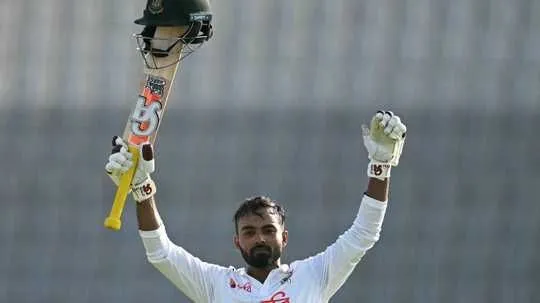
After reaching his maiden double hundred, Hridoy celebrated by pointing his bat towards the fans and the dressing room. It was a moment that appeared to carry considerable relief, having answered questions over his credentials in the longest format with a performance of extraordinary substance.