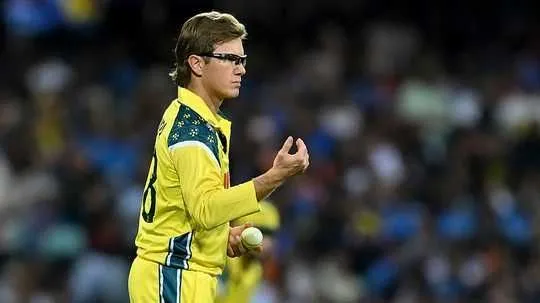
It’s been almost three years since Australia lifted their sixth Men’s ODI World Cup title, their fifth in seven attempts since 1999. The batting line-up has since changed, with David Warner, Steven Smith and Glenn Maxwell retired, but the first-choice bowling unit remains largely intact.
Much has rightly been made of the famed quartet of Pat Cummins, Mitchell Starc, Josh Hazlewood and Nathan Lyon in Tests. Australia have had a similarly efficient look to their bowling in white-ball formats, albeit with a personnel change in the spin department. Adam Zampa has shaped their fortunes for over a decade, but his declining returns and poor record in South Africa are worrying signs for the defending champions ahead of next year’s World Cup.
Australia have lost six of their 10 bilateral ODI series post the 2023 World Cup, and were beaten by India in the semifinals of the Champions Trophy 2025. Overall, they have won 17 and lost 16 games in the timeframe (1 NR), their win-loss ratio of 1.062 ranking sixth among the 12 full-member teams. Sideline the 3-0 clean sweeps against the lower-ranked West Indies and Zimbabwe and that number dips further down to 0.688. Zampa has featured in 31 of these 34 matches, the most for anyone. That’s more than what Hazlewood (14), Starc (11) and Cummins (3) have collectively played in the ongoing cycle.
His returns, though, have been underwhelming. In the recent ODI series defeat in South Africa, the hosts’ spinners took 12 wickets at 27.91 (economy: 5.05), compared to Australia’s 4 at 66.75 (economy: 7.02). Zampa took 4/161 from 22 overs (economy: 7.32), partly redeeming himself with 2/34 in the final ODI as the visitors avoided a clean sweep. However, his numbers in the current World Cup cycle have been far inferior to his overall career stats.
To understand Zampa’s value to Australia’s white-ball setup, it is worth revisiting Australia’s 2023 campaign and what had preceded it. The wrist-spinner went into the World Cup with an underwhelming 11 wickets at 36.09 (ER: 6.72) from his last two bilateral series, against South Africa and India. That included a spell of 0/113 at Centurion - then the joint-most expensive in ODI cricket - largely down to Heinrich Klaasen’s blistering 174.
He was outclassed by KL Rahul and Virat Kohli in Australia’s World Cup opener, returning 0/53 in eight overs on a day the Indian spinners had collectively returned 6/104 in 30 overs. Another disappointing outing followed in a crushing defeat to South Africa. Then things turned around.
Sri Lanka’s openers gave Australia a runaround for the first 21 overs in their next outing, before Cummins removed them both. Zampa then took over, his 4/47 leading the way as Sri Lanka collapsed from 125/0 to 209 all out. He bagged four-fers in the next two outings, and followed that with two more three-fers, becoming the only bowler to take at least three wickets in five consecutive World Cup innings. In the final against India, Zampa’s 10 overs yielded just one boundary (Cummins’ 10 had none), as Australia applied a stunning squeeze to limit the hosts to a sub-par total.
Zampa ended the tournament with 23 wickets, second only to Mohammed Shami’s 24 and level with Muttiah Muralitharan’s 2007 tally as the most by a spinner in a World Cup edition. Two years earlier, he had taken 13 wickets at an economy of 5.81 in Australia’s victorious T20 World Cup campaign in the UAE. The pattern holds across ODIs and T20Is: Zampa’s form directly shapes Australia’s results, with all 13 of his four-plus-wicket hauls in ODIs ending in wins.
Looking at the table above, the economy has barely moved and the strike rate has been a key determinant. Among Australia’s spinners with at least 20 ODI wickets, Zampa’s 31.9 is the best, well ahead of Shane Warne’s 36.4 (291 wickets). He bowls about 7.2 overs per ODI in the middle phase (overs 11-40). In wins, his strike rate in the phase is 29. In defeats, it nearly doubles to 56.5.
The matchups tell the same story. In the middle phase at the 2023 World Cup, his victims included Babar Azam, Mohammad Rizwan, Daryl Mitchell, Tom Latham, Ben Stokes and Jos Buttler, all at key moments while defending totals. The pattern has held true against select middle-order mainstays, as reflected below.
It is noteworthy that Australia have had the best bowling average (26.15) and strike-rate (32.3) in the first 10 overs for any full-member team in the ongoing World Cup cycle. However, they rank 11th on both fronts when it comes to the middle phase: average of 43.33 and a strike-rate of 48.3, which is in tune with Zampa’s struggles.
Of the 20 countries to have hosted ODI cricket since the start of 2023, South Africa has had the second-worst economy rate for spin (5.9) - after 6.15 in England - though the strike-rates in both countries have been on the higher side. Finger-spinners have had a way superior economy (5.44) in the country, compared to 6.66 for wrist-spin.
Zampa has historically had a poor record in South Africa, which will serve as the primary host for next year’s World Cup, with 21 wickets at 39.57, a strike-rate of 37.9 and economy rate of 6.25. In no other country has he conceded runs at a higher rate, and the average ranks worst among the eight countries where he has played at least five matches.
A key differentiator for wrist-spin in South Africa has been the speeds. Since 2016 (Zampa’s debut year), the standard 81-90 km/h band hasn’t been as effective for wrist-spinners in South Africa as it has been elsewhere. The gap widens for the 85-90 km/h range. Wrist-spinners (right-armers or left-armers) have averaged 62.73 and struck at 63.1 operating in this band in the country since 2016, compared to 36.26 and 40.7 in ODIs overall (where data available).
The overall average and strike-rate for deliveries above 90km/h in ODIs in the timeframe read 27.9 and 33.2 respectively, and it improves to 26.17 and 32.3 in South Africa. Imran Tahir was a prime example of a wrist-spinner reaping rewards while bowling it flat and quick in the country, while the success for the prominent visiting ones - Yuzvendra Chahal, Kuldeep Yadav and Adil Rashid - was based on slowing it further down.