Smartwatches are great for keeping important information within reach, but interacting with their tiny touchscreens can be a pain. And when your hands are occupied, tapping a button might not even be possible. Researchers at Northwestern University have developed an alternative that could let you control a smartwatch with simple hand and finger gestures, without ever touching its screen.
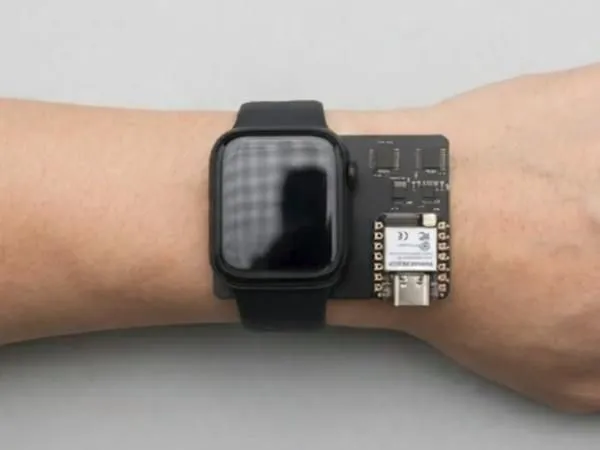
Their experimental system, called EITWatch, uses electrical impedance tomography (EIT) to detect subtle changes in the muscles and tendons beneath the skin. Unlike previous systems that require specialized wristbands, EITWatch packs its sensing electrodes into an area small enough to fit on the back of a conventional smartwatch.
The technology works by passing tiny alternating electrical currents through the wrist and measuring how they travel through the underlying tissues. As fingers move and muscles contract, the electrical impedance of those tissues changes. By analyzing these variations, the system can determine which gesture the wearer is making.
The researchers built a prototype around a custom circuit board featuring eight gold-plated electrodes arranged in a 31-millimeter-diameter ring. These electrodes sit against the skin beneath a standard 40-millimeter watch case. The current prototype's electronics extend beyond the watch housing, but the sensing area itself fits entirely within the watch's footprint.
A Seeed Studio XIAO ESP32-S3 microcontroller manages the measurements, collecting readings at a rate of 48 frames per second. The system uses a technique called multi-depth scanning, which varies the distance between electrodes to send electrical currents along different paths through the wrist. This allows it to capture information from tissues at different depths, improving gesture recognition compared with traditional scanning methods.
To evaluate EITWatch, the researchers recruited 12 participants and tested two sets of gestures. The first consisted of six larger hand poses, including pointing, making a fist, and giving a thumbs-up. The second included five smaller movements, such as pinching, sliding the thumb across the index finger, and rotating the wrist, along with a relaxed state.
The results were promising. During testing within a single wearing session, the system achieved 91.4% accuracy for larger gestures and 90.1% for smaller ones when classifying individual measurement windows. Accuracy improved slightly when predictions were combined across complete gestures.
Performance dropped when participants removed the device and put it back on 48 hours later, reaching 73.2% and 70.4%, respectively. Recognition was less reliable still when tested on people whose data had not been used for training.
EITWatch isn't ready to replace your smartwatch's touchscreen just yet. The electronics still need to be miniaturized, and recognition must become more reliable across different users and wearing conditions. Even so, the research demonstrates that the back of a smartwatch could do much more than monitor your heart rate. One day, a quick pinch or flick of the fingers might be all it takes to control the device on your wrist.