Chhatru. Population = 120. Height = 11,000ft.” announced a rather small board mounted on two iron poles. The information was written in black against a background of white mountains and blue sky. It captured the essence of the place quite succintly. The only relevant bit of information missing was that it was in the Chenab valley with the fast-flowing river right next to it.
It was a little after five in the morning and we had left the comfort of the warm room in Manali, Himachal Pradesh, at an ungodly 3am to get there and the shadows were still long. JK Tyre had invited us to watch the sixth edition of the JK Tyre Rally of Himalayas up close as the two- and four-wheelers zipped past at full tilt so close that one worried that the stones being thrown up by the tyres would hit the camera.
Our viewpoint was along the the road, wherever it existed, from Manali to Kaza in the Spiti Valley in Himachal Pradesh. The participants had stayed overnight in Manali and assembled at Koksar, about two-thirds of the way to where we waited, to be flagged off for the first stage of the four-day rally that would take them to Kaza and back and then on to Padum in Zanskar, which is where the rally would end.
The first stage was a special stage, which meant that it would run on a closed off public road and the participants would have to cover a designated distance in the shortest possible time. So, there was enough incentive to test the limits of how fast they could go.
The road from Manali to Koksar was excellent and, for the first time for us, we went through the 9km-long Atal Tunnel that goes under the Rohtang Pass and the vista on the two sides were totally different. If we had to watch the rally in progress, we had to park ourselves on the route before the flagoff because it would be closed off to traffic thereafter. Hence the early departure. The participants were assembling at Koksar when we went through.
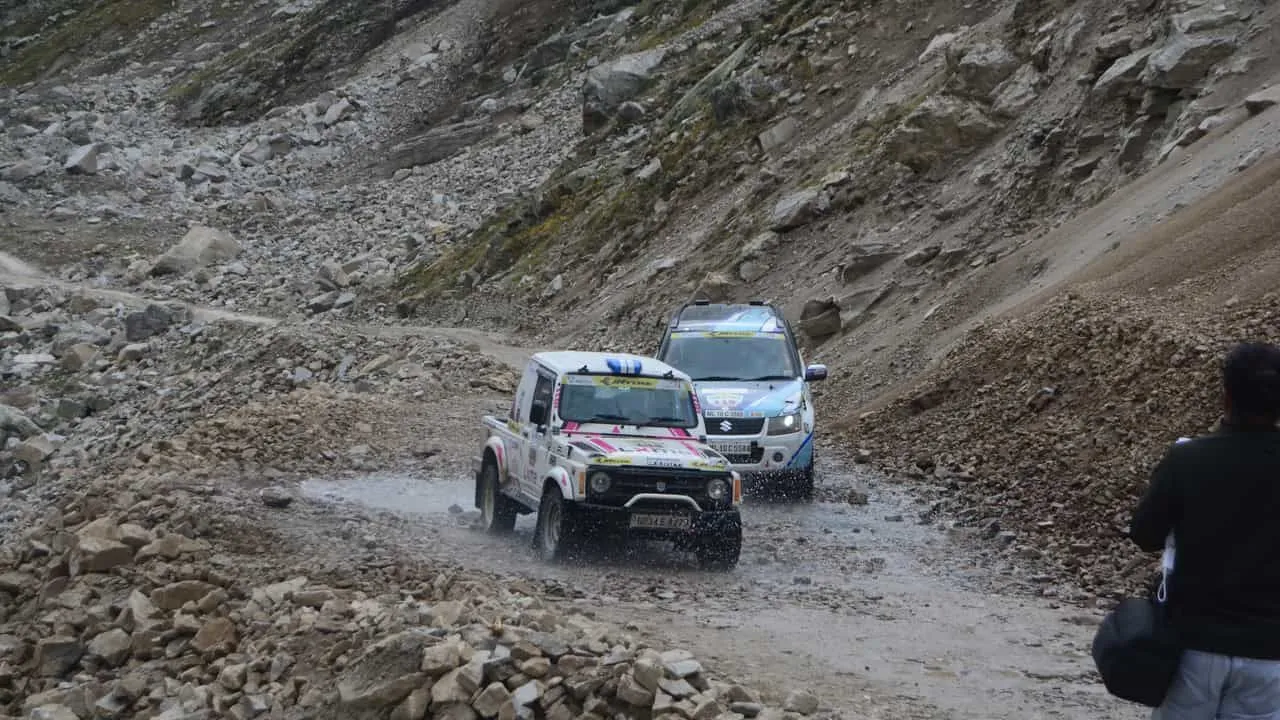
While there were bits of good tarmac, most of the road was essentially an unpaved stretch that had been smoothed out to whatever extent possible by vehicles that travel this stretch. The Border Roads Organisation (BRO) it seems barely manages to keep this road open although it is working on building a better alternative. This is National Highway 505 and the trunk route from Manali to the Spiti Valley that loops all the way back to Sarahan and Shimla. Appropriately, as we found out trying to reach Chhatru (it took more than an hour to cover less than 20km), this had been designated a ‘gravel stage’ as opposed to the later ‘tarmac stage’ to Padum.
This was a straight-ish part of the Chenab valley and one could see a long way into the distance. We had been in Chhatru for a few minutes, soaking in the stark and rugged beauty of the place, when we spotted a cloud of dust far away. Then we saw the speck creating it and soon the Toyota Hilux in colourful livery came into sight. The cable-stayed Chenab bridge at Chhatru that had been bypassed by a Bailey bridge created two turns on the route that forced the participants to slow down a bit and gave us a good viewpoint. The 29 four-wheelers competing in the rally ranged from mean Toyota Hiluxes to a diminutive Honda Brio to a whole bunch of Maruti Gypsies and Jimnys, a Subaru Forester ST, and various kinds of Mahindras in between. With long travel suspension, skid plates, roll cages, and so on, the rally-prepped vehicles looked their part alright.
And then there were the bikes. Most of them were ready for the dirt and so were the participants. And while the four-wheelers had a driver and a navigator, the bike participants rode solo. And were they riding the wheels off the motorcycles! The route was so rough that most of them stood on the footpegs most of the time. This sort of terrain is probably more suited to two-wheelers than four, although it might be a shade riskier to go on two wheels. But, oh boy, were they flying! The kind of speed they were able to hold after two bends and a metal surface bridge in between was seriously impressive. We had our eyes glued on the road and the competitors till the last of them had passed Chhatru.
A bunch of temporary dhabas come up in this middle-of-nowhere place once the road opens after winter. And they make mean parathas. It was mid-morning and once the excitement of the rally had abated we dug into them accompanied by hot, sweet, milky tea that is almost like comfort food in these parts.
The previous evening, 50 four-wheelers in the Xtreme (stage) and Adventure (TSD) categories, and 80 motorcycles in the Moto (stage) section in Manali were present for the briefing and formal flagoff. Not only was the rally plan delineated, but the queries of the participants and those who planned to go to watch answered. As evident from the name, this was the sixth edition of the Rally of Himalayas and JK Tyre was the title sponsor. The ceremonial flagoff was held with much fanfare and the drivers and riders settled to tune up their vehicles for the gruelling race the next day.
On day two of the actual rally the two- and four-wheelers were to return the same way they had gone the previous day. So the whole map had to be read in reverse, a particularly tricky exercise for the bikers who had traversed the same road in the other direction the previous day. There was rain the previous night and the race organisers cut short the stage and delayed the start because of treacherous and invisible black ice on certain parts of the road that had to be given time to melt away as the sun climbed higher.
After another early start, we were back at the point of the flying finish where the timing machinery had been set up. This was a little before our viewpoint of the previous day and on a stretch covered with big rocks. As luck would have it, high up the steep slope a bunch of earthmovers deployed by the BRO were pushing huge boulders off the mountainside to make way for a new road and these were dropping with earthshaking thuds a couple of hundred feet from the flying finish point. It also started to rain a bit. So, one wasn’t sure whether to watch out for the boulders (any one of them could have crushed someone in their path), the rain or the rallyists. Any amount of calling out to the earthmovers failed to elicit a response and it was only after the organisers got in touch with the BRO that the boulders stopped falling. Whew!
The competitiors came tearing down the road soon afterwards, passing between the two electronic timers. Same as the previous day, first came the four-wheelers, followed by the two-wheelers. The rough and tumble of the Manali-Kaza road had taken their toll on the participants. The field had been whittled down from the 29 four-wheelers that had started the Xtreme rally the previous day to nearly half with DNFs (did not finish) even for experienced hands like a former Raid de Himalaya winner. The bikes fared better, with a higher percentage of participants still in the running.
Competitors faced demanding Himalayan conditions as they navigated steep inclines, fast stretches, unpredictable weather and high-altitude terrain that placed additional pressure on both machines and riders. From technical stages to challenging route navigation, this year’s rally reinforced its reputation as a true rally raid, testing competitors on both speed and consistency as they navigated demanding Himalayan passages including Kunzum La, which is known for its extreme conditions.
From the opening day, Rajiv Yadav established a strong presence in the field, taking the lead on Day One. He built momentum through the early stages while keeping a close watch on strong local competition, particularly Aaryak Rana, who remained among the closely tracked competitors during the initial phase.
There were two more stages, tarmac ones, till the Rally of Himalayas finished at Padum in Zanskar two days later. Following the reverse stage, the rally’s momentum shifted towards Daksh Gill, who delivered strong performances and secured the next two stages, beginning with the reverse Losar to Gramphu stage. From there, the competition advanced towards Shinku La, with the route climbing to elevations of more than 16,500ft.
The rally then moved into the Zanskar Valley, where competitors faced a high-speed run across the high-altitude, desert-like landscape. Here, Gill reached speeds of up to 200kmph, underlining the combination of speed, control and precision required to compete at the highest level in Himalayan rally raids. The Zanskar stage proved decisive for the standings and reinforced the importance of combining outright pace with control in extreme terrain.
The Moto (two-wheeler) category was won by local boy Dhritimaan Singh.
The rally concluded in Padum, the headquarters of Zanskar district.
PRIZE WINNERS
Moto (2-Wheel)
Winner: Dhritimaan Singh