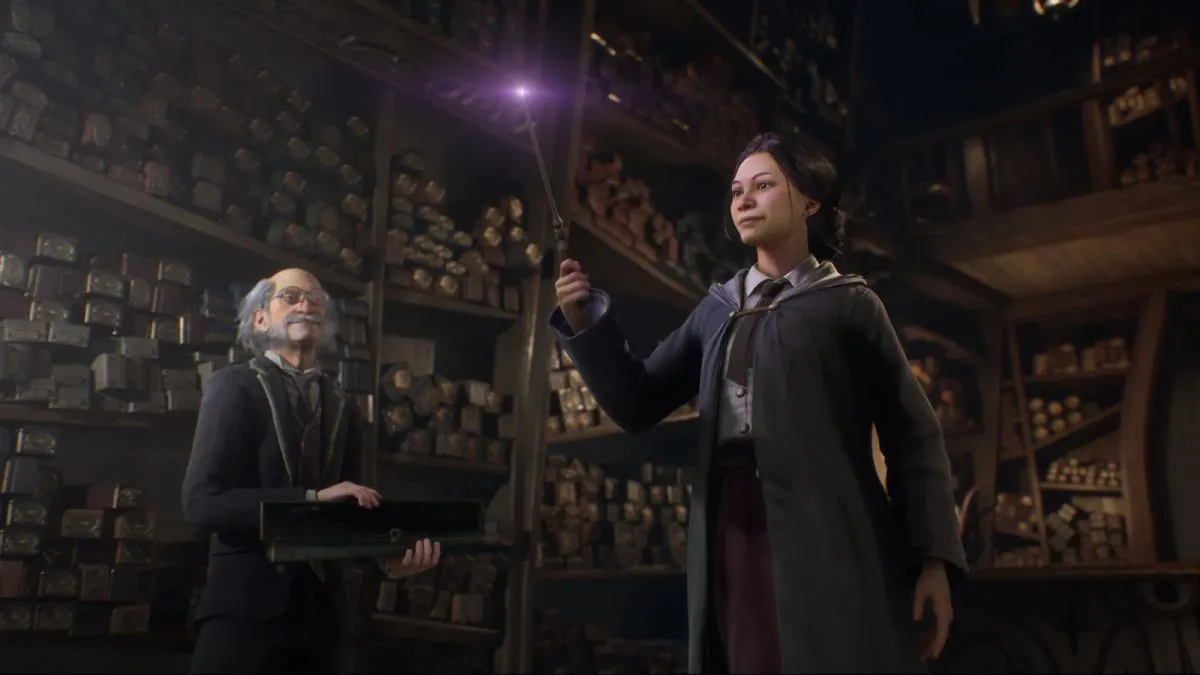
Nvidia's DLSS 5 upgrade landed on the PC version of Hogwarts Legacy on Nov. 5, bringing AI-driven Neural Rendering to the open-world wizarding title and making it the first of three games slated to receive the technology this month.
The update, announced by Nvidia and integrated with the help of developer Avalanche Software, targets owners of GeForce RTX 50-series desktop and laptop GPUs, RTX Spark systems and the GeForce NOW Ultimate streaming tier. After installing the patch, players can switch the feature on through a new Neural Rendering entry in the game's graphics settings menu.
Unlike conventional upscaling, which sharpens or enlarges an existing frame, DLSS 5 uses machine learning to change how light behaves across surfaces. Nvidia says the result is more convincing illumination, deeper shadows and finer detail in everything from weathered stonework and rooftops to foliage and reflections.
Avalanche Software tuned the effect through DLSS 5's controls so that environments and characters are treated differently, and the studio said it deliberately left character faces untouched in order to preserve its original art direction. Jose Villeta, director of software engineering at Avalanche Software, said the team worked closely with Nvidia "to ensure the best visual results while maintaining our artistic intent," adding that the controls let developers "iterate and tune environments, tone and skin structural parameters in a manner that keeps the game true to the original vision."
The release also carries Nvidia's newer Neural Rendering model, which the company says runs at twice the performance of its earlier version. Nvidia has previously put the model's footprint at roughly 118 million parameters, a 24% reduction, with 4K VRAM consumption down 20%.
On compatible hardware, DLSS 5 can be stacked with other Nvidia features, including Super Resolution, Ray Reconstruction, Reflex and Multi Frame Generation. Nvidia's own demonstrations show very high frame rates on flagship GPUs, though actual results will vary with the graphics card and in-game settings.
TitleDLSS 5 arrivalNotesHogwarts LegacyNov. 5First game with Neural Rendering; faces left untouchedWar ThunderMid-NovemberEagle's Shadow update; focus on shadows, lighting, reflectionsWhere Winds MeetNov. 23Third title in the November rollout
Note: Dates and details as announced by Nvidia.
The rollout coincides with a new GeForce Game Ready driver, version 621.14, which Nvidia has optimized for the Hogwarts Legacy patch, for next week's War Thunder integration and for the launch of World of Warcraft Forever. The Blizzard title does not use DLSS, but it supports Reflex latency reduction and runs on RTX Spark systems, and it ships with markedly higher system requirements than the base game, including 128 GB of SSD storage and 16 GB of RAM at the recommended tier.
For Nvidia, the push matters beyond a single title. Neural Rendering is the company's bid to keep PC graphics upgrades tied to its newest RTX hardware, and each supported game gives RTX 50-series buyers a visible reason to upgrade. For Avalanche Software, the patch offers a way to draw players back to a game released years earlier without rebuilding its assets. Gamers, meanwhile, face a familiar trade-off: the visual gains are gated behind current-generation GPUs or a GeForce NOW Ultimate subscription, leaving older cards out of the picture.