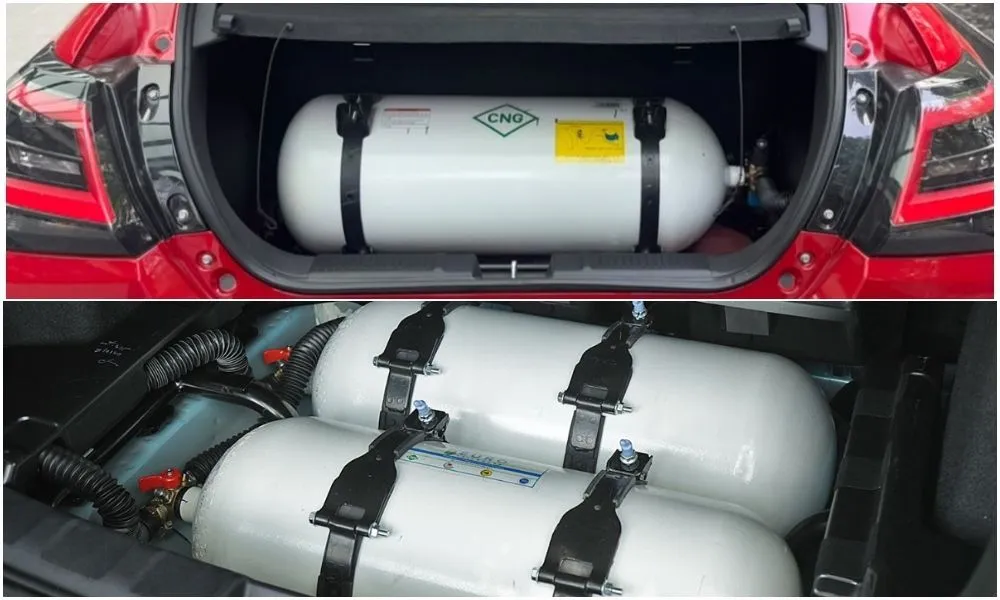
Earlier, manufacturers used to bolt a single, bulky steel cylinder right across the floor of a CNG car’s boot. That left just enough room for a couple of soft backpacks stuffed down the sides, so carrying hard suitcases or doing an airport run was practically out of the question back then.
Things changed with modern packaging solutions. Pioneered by Tata Motors and adopted by Hyundai under its Hy-CNG Duo badge, twin-cylinder technology split the gas reserve into two compact tanks. Maruti Suzuki took a different approach, though, keeping the single-cylinder design but relocating it to the underbody in newer models like the Victoris to preserve luggage room.
We have taken a closer look at how Tata and Hyundai manage to make the most of this technology in their recent cars, and at the same time, how Maruti Suzuki has managed to expand boot space instead by optimising the single-tank layout.
The Traditional Single-Cylinder Problem
A conventional factory CNG setup uses a single cylindrical steel tank with a water-equivalent capacity of 55 to 60 litres. Because the tank must hold compressed natural gas at an intense pressure of 200 bar, it needs thick walls, rounded hemispherical ends, and a substantial diameter, typically between 300 mm and 350 mm.
When automotive engineers had to fit this bulky metal barrel into a sub-four-metre hatchback or sedan, they had only one place to put it: straight across the luggage floor behind the rear passenger seat.
This created four practical headaches:
Severe Loss of Volume: A typical compact hatchback boot of 260 to 300 litres was reduced to less than 100 litres.
Awkward Loading Height: Because the cylinder sat directly on the floor, lifting heavy objects over the cylinder was physically straining.
Trapped Spare Wheel: The spare tyre remained bolted inside the wheel well beneath the heavy gas cylinder.
High Centre of Gravity: A filled 60-litre steel tank weighs between 45 and 55 kg. Placing that dead weight high up on the boot floor further compromised the rear suspension travel.
Tata Motors: The Pioneers Of The Twin-Cylinder Layout
Tata Motors first introduced its patented dual-cylinder iCNG technology on the Altroz back in 2023, and quickly rolled it out to the Tiago, Punch and Nexon. Instead of installing a single 60-litre cylinder, Tata engineers replaced it with two smaller, interconnected cylinders, each holding roughly 30 litres of water-equivalent capacity.
Because the diameter of each individual tank is a lot smaller, both cylinders sit comfortably side-by-side inside the recessed floor well where the spare tyre used to live.
A heavy-duty steel cradle surrounds the cylinders, covered by a flat, reinforced composite board. When you open the tailgate of a Tata iCNG car, there is no exposed gas cylinder. You see a conventional, completely flat luggage boot.
But Where Did The Spare Tyre Go?
Across its twin-cylinder range, including the Tiago, Altroz, Punch and Nexon, Tata relocated the spare wheel to an underbody cradle beneath the rear chassis, similar to how full-size SUVs store their spares. Lowering the tyre requires turning a winch bolt located inside the luggage sill using the standard jack handle, which ensures full spare-wheel utility despite the dual cylinders occupying the spare wheel well.
Hyundai: The Hy-CNG Duo Tech
Hyundai branded its own twin-cylinder engineering package as Hy-CNG Duo. First seen on the Exter micro-SUV and the Grand i10 Nios hatchback, Hy-CNG Duo uses two smaller cylinders placed beneath the floorboard. However, Hyundai reworked the fuel-line plumbing and valve integration to sit even more compactly against the chassis subframe.
In the Grand i10 Nios Hy-CNG Duo, this setup keeps 260 litres of usable boot space, making it the most spacious CNG hatchback boot on sale in India. In the Exter, usable luggage capacity is 225 litres for its CNG versions. To house the dual cylinders without redesigning the rear subframe or chassis rails, Hyundai kept out the physical spare wheel entirely across both models, supplying a 12V tyre inflator and puncture repair kit instead.
Maruti Suzuki: Optimised Single Cylinders
As India's largest CNG manufacturer, Maruti Suzuki thought and addressed the same issue a bit differently. In high-volume compact models like the Dzire and Fronx, Maruti Suzuki bolts the single 55-litre cylinder directly across the boot floor over the spare wheel well. While this layout keeps showroom prices competitive and efficiency high, it creates an irregular loading surface and makes accessing the spare tyre difficult.
To address luggage volume in larger segments without adopting twin tanks, the brand then introduced a single underbody-mounted 55-litre cylinder on the Victoris. By mounting the tank under the rear floorpan, the Victoris keeps a completely flat 320-litre luggage bay above the deck, relying on a standard tyre mobility kit in place of an underbody spare.
A Comparison Between Single-Cylinder & Twin-Cylinder Models
Here’s how the leading CNG vehicles in India compare:
Safety, Inspection And Servicing: Are Twin Cylinders As Safe?
When buyers see two cylinders instead of one, their first question might be about safety. Does having twice as many valves and pipes increase the risk of gas leaks?
The answer is no. Twin-cylinder systems must meet the same rigid safety standards set by the Automotive Industry Standards (AIS) and the Petroleum and Explosives Safety Organisation (PESO) in India. In fact, modern twin-tank setups have several advanced safety elements:
Single Integrated Fill Valve: Even though there are two cylinders, they are connected through high-pressure stainless steel equalisation pipes. You still refuel through a single standard NGV1 nozzle located beside your petrol filler cap.
Dual Solenoid Cut-Offs: Each cylinder has an independent electronic shut-off valve. If a pressure drop or pipe rupture is detected anywhere in the system, both solenoids cut the gas supply instantly at the tank neck.
Thermal Pressure Relief Devices (PRD): When a vehicle fire occurs, special fusible plugs release the gas safely into the atmosphere in a controlled manner, so that there’s no pressure build-up inside the tanks.
Micro-Switch Ignition Isolation: All modern factory-fitted CNG cars also have a micro-switch on the fuel lid. If the fuel flap is open during refuelling, the car's starter motor is physically disengaged. It prevents the car from being driven off by accident.
The only minor difference comes at the three-year mark. Under Indian motor vehicle regulations, every CNG cylinder must undergo mandatory hydro-testing every three years to certify its structural strength. With a twin-cylinder vehicle, you will have to pay for two cylinders to be tested rather than one, which will add roughly Rs. 1,500 to Rs. 2,000 to your third-year maintenance bill.
Which CNG Boot Setup Should You Choose?
If you are buying a car purely for short daily city commutes, office runs and local errands, a traditional single-cylinder car like the Maruti Suzuki Dzire or Fronx is a financially logical choice. The initial purchase price is slightly lower, fuel efficiency remains high at over 28 to 31 km/kg, and you still have the usual rear parcel shelf and remaining boot corners for soft duffel bags and daily shopping.
However, if your car is the primary family vehicle, such as you use it for weekend highway road trips, carrying prams, or picking up relatives from the airport, then a twin-cylinder setup from Tata or Hyundai is undoubtedly the smarter buy.
The Hyundai Grand i10 Nios offers the highest boot volume in the CNG hatchback space with 260 litres of room. The Tata Punch and Hyundai Exter give you practical luggage bays combined with the needed high ground clearance to cross broken roads. And if you refuse to compromise on either highway overtaking pace or family luggage capacity, get the Tata Nexon, which offers a 321-litre boot and a powerful, turbocharged engine.