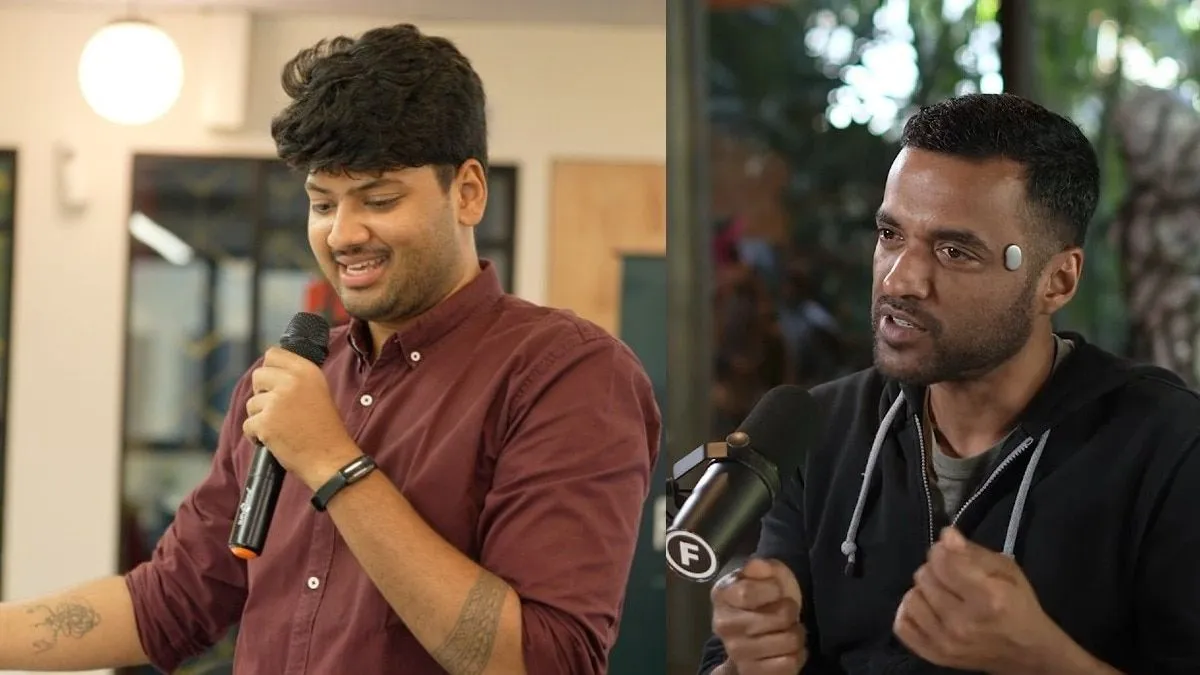
A Bengaluru-based tech enthusiast has attempted to recreate the voice-detection technology used in Deepinder Goyal's Temple wearable using his laptop. His experiment caught the attention of the Zomato founder, who praised his work and offered him a chance to test the device.
Krishna Veera Vanamali shared details of his experiment in a LinkedIn post. He wanted to test Goyal's claim that Temple can detect a person's voice through physical vibrations generated by the skin and skull, without using a microphone. Vanamali used his laptop's built-in accelerometer, a sensor that detects movement and vibrations, for the experiment. His initial attempts to capture his voice by speaking, shouting and humming near the laptop did not work. The sensor could not pick up the frequencies required to recognise normal speech.
He then slowed down a sentence by 40 times and played it through the laptop's speakers with the microphone input switched off. After recording the vibrations using the accelerometer, he sped up the recording by 40 times and fed it into a speech-to-text model. The model correctly recognised every word.
Explaining the result, Vanamali said his laptop's accelerometer could detect usable signals only below around 200Hz, while normal speech frequencies generally fall between 300Hz and 3,400Hz. Slowing down the audio brought the vibrations within the sensor's detection range. Responding to his post, Goyal explained that Temple uses two accelerometers with high-frequency sampling to capture the wearer's voice.
"Nicely done. Temple uses two accelerometers at high frequency sampling to capture your voice," Goyal wrote.
He added that Temple increases its sampling frequency to up to 16kHz when the user double-taps the device. Keeping it at that level all the time would consume too much battery, he explained. Goyal also offered Vanamali an opportunity to test Temple for a day. The Bengaluru-based tech enthusiast accepted the offer.
What is Deepinder Goyal's Temple?
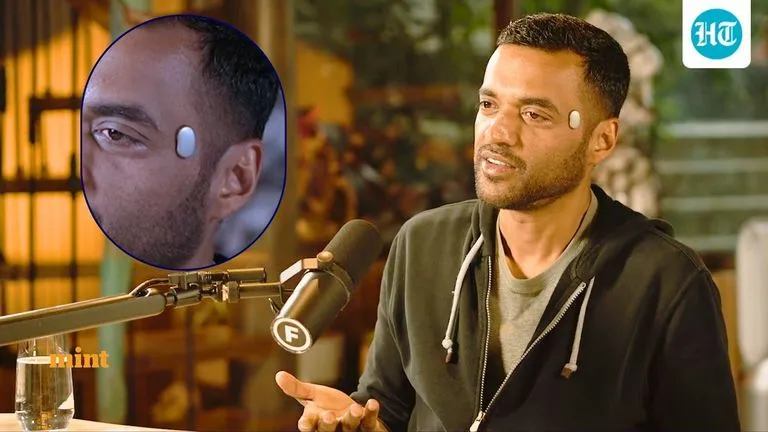
Temple is a wearable AI companion developed by Goyal. The device sits against the side of the head and uses motion sensors to detect vibrations produced when the wearer speaks. It does not have a microphone, camera or screen and is activated with a double tap.
Goyal has also positioned Temple as a health wearable capable of tracking metrics such as heart rate, HRV, sleep and VO2 max. Temple 01, which will include AI and health features, is set to start shipping in early 2027. It recently went on pre-order and is priced at Rs 85,000 in India.
- Ends