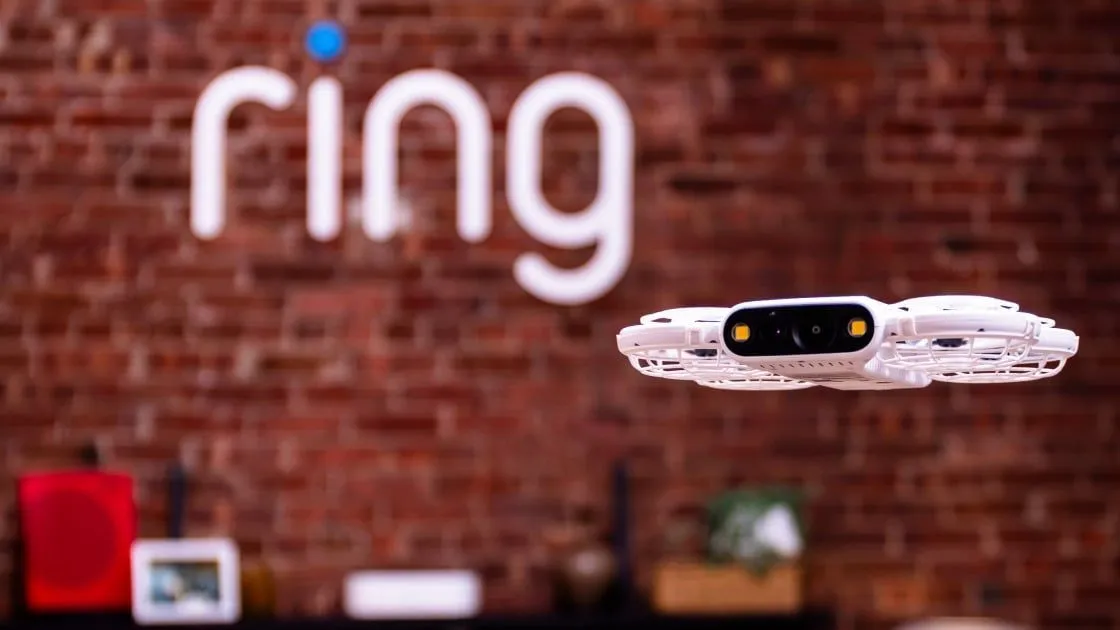
Ring has been teasing a home security drone for more than five years. Now it's finally here. The $249.99 Ring Drone Cam flies scheduled patrols around your home, checks out anything suspicious, and heads back to its dock to recharge. I watched it buzz around a demo space at a preview event in New York on Monday, alongside the Rover Cam, Ring's all-business reboot of the Amazon Astro robot. Here's what I thought of both.
Ring Drone Cam: A Security Guard's Flashlight, With Propellers
The Ring Drone Cam is a small, blocky quadcopter with a built-in 2K camera that flies around your home on a set schedule or as you direct it, turning its robotic eye in every direction to make sure nothing's amiss before returning to its base station. Because it's a drone, it can cover much more area than a conventional security camera and can be directed to investigate disturbances. It features a bright LED that lets it patrol dark spaces and can potentially scare away burglars by resembling a security guard's flashlight.
The Ring Drone Cam is a small (and loud) robot for patrolling your home (Credit: René Ramos/CNET Group)
Don't expect to take the Drone Cam around with you to shoot videos. Unlike most camera drones, it's only for home security and doesn't support direct user piloting. It uses visual AI to navigate spaces and identify what it's looking at, and it integrates with the Alexa Home Map feature announced last month to let you know where it is. You can use the map view to send the drone to patrol a specific location in your home, but that's the most hands-on control you get.
You probably shouldn't count on using the drone to spy on anyone, either. It was loud during the demo, whining like a hive of angry bees. This is partly by design, with the noise helping to let anyone nearby know when it's active. More realistically, though, it's just what this drone sounds like, and it isn't particularly quiet.
The Ring Drone Cam in its charging station, where it will spend most of its time because of its short battery life (Credit: René Ramos/CNET Group)
The Drone Cam is tiny compared with most camera drones we've reviewed. I don't have specific measurements, but it seems closest to the DJI Neo ($199), a 4.75-ounce selfie drone that's half the weight and a fraction of the size of the DJI Flip ($439). The small size means it can't fly for very long; Ring says the Drone Cam has a flight time of up to eight minutes, and each minute of flight requires eight minutes of charging. It's best for periodic sweeps and investigating areas as needed, not constantly hovering around.
The $249.99 Ring Drone Cam is scheduled to start shipping on Jan. 27.
The Ring Drone Cam (Credit: René Ramos/CNET Group)
Ring Rover Cam: Amazon Astro Is Back, and This Time It's a Cop
The Drone Cam isn’t Ring's only new robot. The company has also turned the Amazon Astro into the Ring Rover Cam, stripping out its smart display features and pet-like personality. What's left is an emotionless security machine.
The Ring Rover Cam (Credit: René Ramos/CNET Group)
Physically, the Rover Cam is nearly identical to the Astro, with a 10-inch touch-screen "face" and a periscope camera that extends up to four feet. That camera now records in 4K, up from the Astro's 1080p.
The Ring Rover Cam in its charging station (Credit: René Ramos/CNET Group)
One visual difference from the Astro is a cone-like hump on the Rover Cam's back, topped with an LED ring. It's not just decoration: The ring projects a circle of light onto the ceiling, so you can find the little robot even when furniture hides it from view. The light glows blue during routine patrols, but it can flash red and sound a siren when an alert is triggered.
The Rover Cam projects a ring of light on the ceiling, letting you know where it is (Credit: Will Greenwald)
It will probably be obscured by shelves and cubicle walls much of the time because the Rover Cam isn't intended for home security. Ring designed it for small offices and warehouses up to 5,000 square feet, where it'll spend most of its time weaving between shelves and cubicle walls. It runs for up to 30 minutes per charge and takes about 30 minutes to recharge.
The idea is to provide security-guard-like surveillance coverage in a small, relatively inexpensive robotic package. The Rover Cam goes on sale next month for $999.99, well below the Astro's $1,600 launch price.