After nearly half a century in space, NASA's Voyager 1 spacecraft is approaching a distance so vast that even light needs a full day to cross it.
The interstellar spacecraft will become the first human-made object to reach one light-day from Earth on Wednesday, Nov. 18, at about 5:16 a.m. EST. To celebrate, the agency is inviting people to participate in a worldwide event called "Shine Bright for Voyager's Light-Day."
Nearly 50 years to cross one light-day
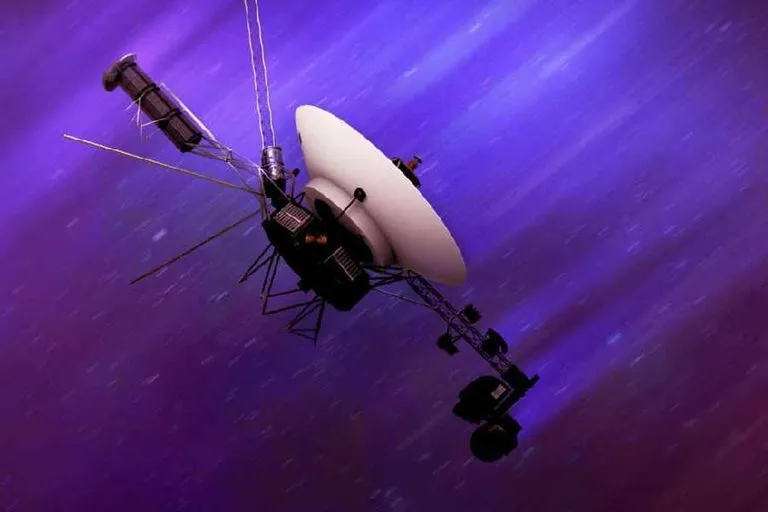
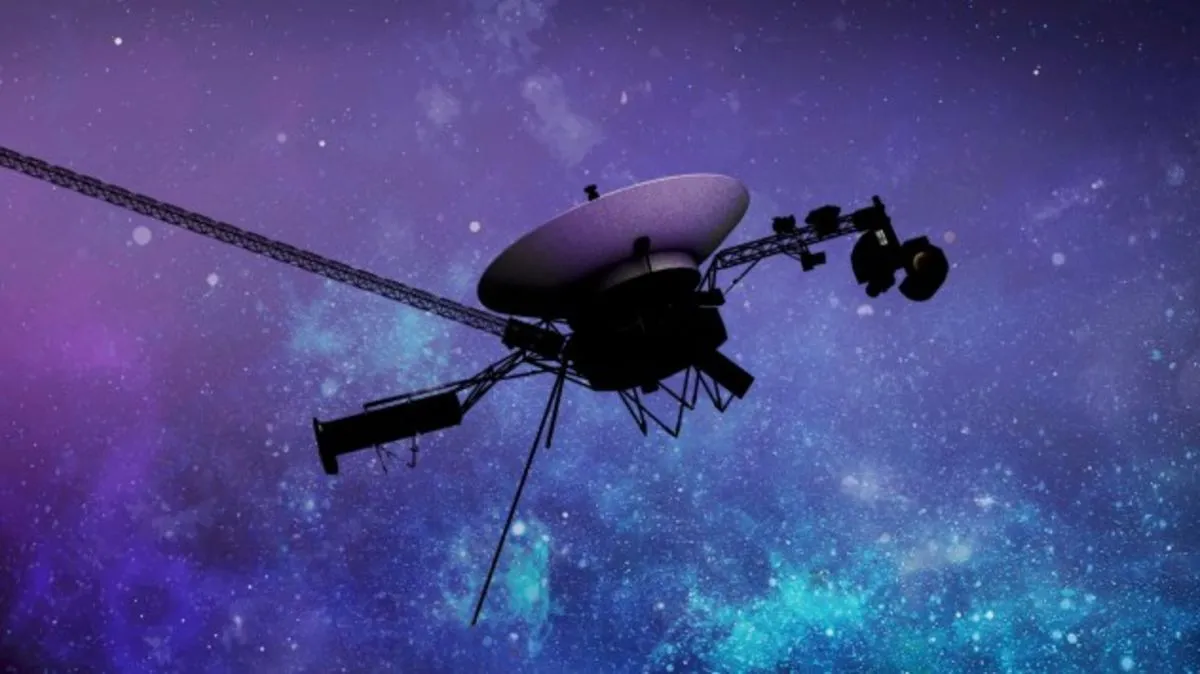
Voyager 1 launched on Sept. 5, 1977, and had a primary goal of flying past Jupiter and Saturn. Since then, it has been outward bound at 38,000 mph, recently surpassing 16 billion miles away from our planet, or more than 173 times the distance between the Earth and the sun.
Voyager 1 entered interstellar space on Aug. 25, 2012, becoming the first human-made object to leave the bubble of the sun's magnetic field and solar wind known as the heliopause. It will achieve another distance milestone later this month.
A light-day measures distance: how far light travels in 24 hours. "Nothing in the universe travels faster than light," NASA explained.
That enormous distance presents a challenge for scientists communicating with the far-flung probe. Radio signals travel at light speed, so once Voyager reaches the milestone, a message will need approximately 24 hours to make the trip each way. Even with an immediate response, a question-and-answer exchange would take about two days.
Travel time is only part of the challenge. Voyager 1's radio signals reach Earth so faintly that NASA's Deep Space Network uses giant antennas to receive them, sometimes combining several antennas' receiving power to collect the spacecraft's transmissions.
How to join NASA's light-day celebration
Participating in the celebration will require considerably less equipment than a deep-space communications station.
After sunset Tuesday, Nov. 17, NASA's "Shine Bright for Voyager's Light-Day" event invites participants to create a symbolic wave of golden light around the world.
People can open NASA's automated flasher on a smartphone or tablet and point the screen skyward. The tool flashes V-G-R, Voyager's call sign, in Morse code.
Skywatchers can also use a flashlight to manually send the signal: V is three short flashes followed by one long flash; G is two long flashes and one short; R is short-long-short. NASA recommends pausing between letters and repeating the sequence for about a minute.
The activity celebrates the journey symbolically, rather than establishing a communications link with Voyager. Participants can photograph or record their signals and share them on social media, tagging @NASA. "Your light can be tiny, but the moment is huge," NASA said.
The milestone comes as engineers work to extend the aging spacecraft's operating life.
Voyager 1's plutonium power source produces less electricity over time, forcing engineers to switch off instruments to conserve energy, such as its cameras. NASA says those efforts could keep at least one science instrument operating into the 2030s.
Even after its instruments fall silent, Voyager will keep traveling, carrying a Golden Record filled with sounds and images of Earth. The gold-plated disk serves as a time capsule of life and culture on our planet, intended for any extraterrestrial civilization that might someday find it.